5 Best Battery Load Tester In 2026
As an Amazon Associate we earn from qualifying purchases.
Checking a battery is one of the simplest ways to avoid being stranded with a car that will not start. A battery load tester is a tool that shows how well a battery holds up under stress. This guide helps beginners who want to understand the best battery load tester options before buying one for a car, truck, boat, RV or lawn equipment.
The five products in this round-up have some things in common. All of them are designed to test 12V lead-acid batteries, and most also check the starting and charging system. The comparison below rests on the listed features and typical use of each product, not on personal testing.


1. ANCEL BA101 Car Battery Tester: best for quick digital readings
The ANCEL BA101 is a digital tester that reads state of health, state of charge, voltage, current and cold cranking amps (CCA). It suits drivers who want a clear set of numbers without learning a complicated dial. It is aimed at car, truck, boat, RV and similar owners.
Where it fits best
This tester fits routine checks at home or in the driveway. It can also help spot a weak battery before a winter morning or a long trip. Because it reads several values at once, it gives a broader picture than a simple voltmeter.
Key features in plain words
State of health tells you roughly how much life the battery has left. State of charge tells you how full it is right now. Cold cranking amps describe how much power a battery can deliver in cold weather to start an engine.
The tester asks you to enter the battery type, rating and temperature from the label. This step matters because the readings depend on those inputs. The screen is black and white with a backlight, which helps in bright sun or dim garages.
Everyday use
Daily use is mostly about clamping the leads, entering the battery details and reading the screen. The product description says it runs on power from the vehicle battery, so there are no internal batteries to recharge. Multi-language support may also help users who prefer a language other than English.
Performance and ease of use
The listed features point to good clarity of results and a simple one-handed process. Accuracy depends on entering the correct label data and clamping firmly. Beginners should expect to read the on-screen prompts carefully the first time.
Value for money
At the listed price, it sits in the lower-middle part of this group. It offers more reading types than many basic testers. Buyers who want numbers rather than a simple pass or fail may find that a good match.
Pros
- Shows several readings, including state of health and state of charge
- Built-in protection against reverse polarity and short circuits
- Works with many 12V battery types, including AGM and EFB
- Easy-to-read screen with adjustable contrast and backlight
Cons
- Requires entering battery details, which beginners may find fiddly at first
- Not suitable for lithium batteries or 6V, 8V or 24V systems
- Does not apply a heavy analog-style load, so it works differently from a dial tester
- Motorcycles below 30Ah are not supported
2. Schumacher Electric Battery Load Tester: best for a classic analog option
The Schumacher BT-100 is an analog tester with a needle meter and a rocker switch. It covers 6V and 12V batteries and is designed to run three tests from one device. It suits people who prefer a traditional look and a simple layout.
Where it fits best
This tester fits garages where several vehicle types are serviced, such as cars, motorcycles, ATVs, lawn tractors and boats. The listed range covers batteries up to 1,000 CA, with a 100-amp load test for 12V units.
Key features in plain words
An analog meter uses a moving needle instead of digits. Many people find a needle easy to read at a glance, especially when they want to see how far a reading moves. The rocker switch sits on top, so the tester can be operated while holding the unit.
The product description says it can test the battery, the charging system and the starter motor draw. Color-coded clamps help beginners connect the leads in the right order. The package includes the tester and a user manual.
Everyday use
Daily use is mostly about connecting the clamps, pressing the switch and reading the needle. Because there is no screen setup, the process is quick once the leads are attached. Users should still read the manual before the first test.
Performance and ease of use
The listed design aims for clear results in a short time. An analog meter does not show exact digits, so readings are best used as a general guide. The layout is simple, which suits beginners who want fewer menus.
Value for money
At the listed price, it sits in the middle of this group. It offers several test types from one unit, which can reduce the need for extra tools. The brand has a long history in automotive power products, as its product description notes.
Pros
- Runs battery, charging and starter draw tests from one device
- Covers both 6V and 12V batteries
- Simple analog layout with a top-mounted rocker switch
- Color-coded clamps make connections easier to get right
Cons
- An analog needle gives less exact information than a digital readout
- Results depend on reading the needle position with care
- Does not show state of health or state of charge as digital numbers
- Needs a clear read of the manual before the first use
3. TOPDC 500A Carbon Pile Battery Load Tester: best for heavy-duty testing
The TOPDC 500A is a carbon pile load tester with a variable load up to 500 amps. It is built for 6V and 12V lead-acid batteries and is also listed for testing starters and alternators. It suits people who work on larger vehicles or want a sturdier tool.
Where it fits best
This tester fits cars, trucks, vans, RVs, farm vehicles and boats with larger batteries. The listed capacity covers batteries up to 1,000 CCA and 160Ah. Its heavy load control makes it a better match for demanding tests than lighter units.
Key features in plain words
A carbon pile is a stack of carbon discs that can be squeezed to change the load on the battery. This lets the tester apply a controlled, strong load. Large color-coded meters show voltage and amperage, along with a temperature-compensated pass or fail chart.
The clamps are copper-plated and described as biting through corrosion on terminals. A built-in timer beeps after a 15-second test, reminding the user to wait about one minute before the next run. The product recommends three tests every five minutes.
Everyday use
Daily use involves setting the load with the dial, running the test and waiting for the timer. The cool-down rule means testing takes a little patience. Users who test often will want to plan their runs around the recommended pace.
Performance and ease of use
The listed design aims for professional-grade results with a clear assessment. The dual-dial layout is designed to make the reading quick. Beginners may need a short learning period to understand the load settings and the pass or fail chart.
Value for money
At the listed price, it is the most expensive in this group. Buyers pay for the higher load range, the timer and the wider battery coverage. For occasional car owners, a lighter tester may give enough information at a lower cost.
Pros
- Variable load up to 500 amps for heavy-duty testing
- Large color-coded meters and a pass or fail chart
- Built-in timer helps prevent overheating during tests
- Also checks alternator and regulator performance
Cons
- Highest price Highest price in this group, which may be more than occasional users need.
- Testing requires waiting between runs, so a full check takes more time
- The heavier build and larger load range suit experienced users more than total beginners
4. QWORK 12V 100A Battery Load Tester: best for a budget-friendly steel case
The QWORK 12V 100A is a compact load tester that covers 6V and 12V batteries. It includes an alternator testing function and a shock-resistant steel case. It suits people who want a basic, portable tool without spending a lot.
Where it fits best
This tester fits cars, trucks, RVs and golf carts, as well as ATVs. The listed maximum CCA is 1,000, which covers many common batteries. It is a practical choice for a home garage or a vehicle kit.
Key features in plain words
The steel case is meant to handle rough handling in a toolbox or trunk. Copper-plated clamps help make a solid connection to the battery terminals. The alternator test lets the user check if the charging system is putting out power.
The compact size and included handle make storage and carrying simple. The product description does not list detailed meter features, so buyers should check the display style before purchase.
Everyday use
Daily use is mostly about clamping the leads, running the test and reading the result. The steel case helps the tool survive a busy workshop or a crowded tool bag. Storage is straightforward because of the compact body.
Performance and ease of use
The listed features point to a simple process with a focus on core battery and alternator checks. Results depend on clamping the leads firmly and reading the scale correctly. Beginners should follow the product instructions closely the first few times.
Value for money
At the listed price, it is the lowest-priced tester in this round-up. It covers the main jobs of battery and alternator testing in one unit. Buyers who want fewer extras may find it a sensible starting point.
Pros
- Lowest price in this group
- Shock-resistant steel case for rough use
- Includes alternator testing alongside battery testing
- Compact and easy to carry or store
Cons
- Warranty details are not specified in the product information
- Fewer listed features than digital or heavy-duty models
- Product description gives limited detail on the meter design
- Likely best suited to basic checks rather than detailed diagnostics
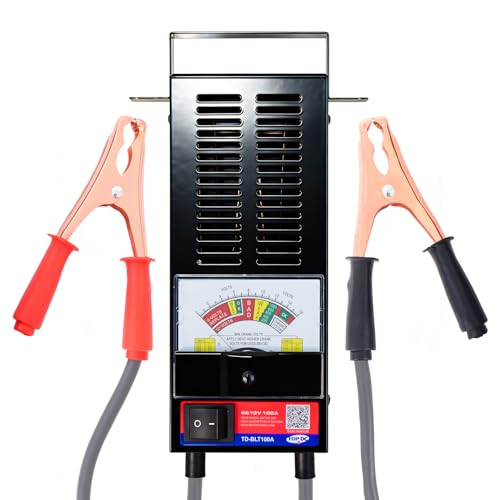
5. TOPDC 100A Battery Load Tester: best for light everyday checks
The TOPDC 100A is an analog tester that works with 6V and 12V batteries. It checks batteries, starting and charging systems in one compact device. It suits people who want a simple, portable tool for routine checks.
Where it fits best
This tester fits cars, motorcycles, RVs, boats and ATVs. The listed CCA range runs from 100 to 1,000. Its 100-amp load capability is a good match for light to moderate testing needs.
Key features in plain words
The analog dial shows results with a needle, which many users find easy to follow. Heavy-duty alligator clips and red and black color coding help with clear connections. Ventilation holes are included to help the unit stay cool during use.
Rubber grips and a shock-resistant meter add comfort and protection. The compact build makes it simple to carry to the vehicle or store in a drawer. The product description lists 50 amps for 6V tests and 100 amps for 12V tests.
Everyday use
Daily use means attaching the clips, running the test and reading the needle. The compact size keeps the tool handy for quick checks. Users should still watch the meter closely during each test.
Performance and ease of use
The listed design aims for clear reading and easy handling. An analog meter gives a general picture rather than exact figures. The simple layout suits beginners who pref er a straightforward tool with fewer settings.
Value for money
At the listed price, it is the second-lowest in this group. It offers testing for batteries, starting and charging systems in one unit. For light everyday use, it may cover the main needs without extra cost.
Pros
- Affordable price for a multi-function analog tester
- Covers 6V and 12V batteries and charging system checks
- Compact, portable and easy to store
- Color-coded clips and rubber grips support safer handling
Cons
- Analog meter gives less exact data than digital models
- Lower 100-amp load limit than the heavy-duty option
- Results depend on reading the needle carefully
- Limited detail on warranty or long-term durability in the product information
Comparison insights: how these load testers differ
The five products fall into three broad groups. Two are digital or near-digital in their readouts, two use classic analog needles, and one is a heavy-duty carbon pile design. Each group suits a different kind of user.
Performance differs mostly by load range. The TOPDC 500A offers the highest listed load, while the ANCEL BA101 focuses on data-rich readings instead of a heavy load. The Schumacher and the two smaller TOPDC and QWORK units sit in the middle for everyday needs.
Ease of use depends on how much a beginner wants to set up. The ANCEL BA101 asks for battery details, while the analog units need only clamps and a switch or dial. Value for money follows the listed price, with the QWORK lowest and the TOPDC 500A highest.
Buying guide: key factors explained in plain words
Start with the battery type and voltage. Most of these testers work with 12V lead-acid batteries, but some also cover 6V. Lithium batteries are not supported by several of these models.
Next, consider the load range. A load test applies a strong current to the battery to see if it holds voltage. Higher load ranges suit larger batteries and heavier vehicles.
Then think about the readout. Digital screens show exact numbers, while analog needles show a position on a scale. Beginners who want clear numbers may prefer digital, and those who like a simple dial may prefer analog.
Finally, check build and extras. Steel cases, copper-plated clamps, protection features and alternator tests can add value. Compare these against the price and how often the tool will be used.
Who should buy these products
Drivers who want clear digital numbers for a car or truck may find the ANCEL BA101 a good match. It suits people who like to see state of health and state of charge on screen. It also works well for boats and RVs with 12V batteries.
Owners of several vehicles, such as motorcycles, lawn tractors and boats, may prefer the Schumacher BT-100. Its three-test layout and 6V and 12V coverage can serve a mixed garage. It suits people who like a traditional needle meter.
Mechanics and heavy-vehicle owners who need a strong load may look at the TOPDC 500A. Its variable load and timer suit demanding tests on larger batteries. It is a better fit for regular users than for a single occasional check.
Budget-conscious buyers who want a steel-cased tool with alternator testing may consider the QWORK 12V 100A. It suits basic checks for cars, golf carts and ATVs. Those who want light, multi-function checks at a modest price may also consider the TOPDC 100A.
Final verdict
No single tester is the right choice for everyone. The best option depends on the battery size, the vehicle type and how often the tool will be used. Beginners should match the features to their real needs rather than the largest specification.
For clear digital readings, the ANCEL BA101 stands out in this group. For heavy-duty work, the TOPDC 500A offers the highest load range. For a low-cost basic tool, the QWORK 12V 100A is the most affordable option.
Frequently Asked Questions
What is a battery load tester?
A battery load tester
A battery load tester applies a controlled load to a battery and watches how the voltage behaves. This shows if the battery can still deliver power when it is needed most. It is a simple way to spot a weak battery before it leaves a vehicle stranded.
Do I need a load tester if I have a voltmeter?
A voltmeter shows the resting voltage of a battery. A load tester goes further by applying a load and showing how the battery responds. For a fuller picture of starting power, a load tester is usually the better choice.
Can these testers be used on lithium batteries?
Most of the testers in this round-up are designed for 12V lead-acid batteries. The ANCEL BA101 specifically states that it is not for lithium batteries. Buyers should check the product information before testing any other battery type.
How often should a battery be tested?
Many owners test a battery at least once a year, and more often before cold weather or a long trip. A test is also useful if the engine cranks slowly. The right schedule depends on the vehicle and how it is used.
Is a digital or analog tester better for beginners?
A digital tester gives exact numbers, which can help beginners understand what the readings mean. An analog tester uses a needle that is simple to follow once the scale is understood. Either type can work well if the user reads the manual and follows the steps carefully.

Peterson is an automotive enthusiast and auto parts reviewer with a passion for vehicle maintenance, upgrades, and performance. He enjoys researching and testing car parts, tools, and accessories to help drivers make informed buying decisions. Through AutoPartsTalk.com, Peterson shares honest reviews, practical maintenance tips, and expert guides to keep vehicles running safely and efficiently.