5 Best Multimeter For Automotive Use In 2026
As an Amazon Associate we earn from qualifying purchases.
Car owners who want to check a battery, track down a wiring fault or test a sensor often reach for a multimeter. This guide helps beginners with no prior knowledge understand which types of meter suit automotive work. The best multimeter for automotive use is the one that matches the jobs you plan to do, not simply the one with the longest feature list.
The five products covered here share a common purpose: they measure electrical values such as voltage, current and resistance. Most are digital, auto-ranging and sold for both car and household electrical tasks. The comparison below rests on the listed features and typical use, not on personal testing. Before you buy, it helps to think about how often you will use the meter and how much detail you need from its readings.



1. AstroAI Digital Multimeter: best for everyday car checks
The AstroAI Digital Multimeter is a general-purpose meter for measuring voltage, current, resistance and more. It suits drivers and beginners who want one handy tool for basic automotive and household jobs. Its list of functions is broad for the price, so it can cover many small tasks without a second tool.
What it measures
This meter covers AC and DC voltage, AC and DC current, resistance, continuity, capacitance, frequency, duty cycle and temperature. Continuity means checking if a wire or fuse completes a path for electricity. Duty cycle describes how long a signal stays switched on compared with off. Knowing these terms helps you match the right setting to the job in front of you.
Key features in plain words
Auto-ranging means the meter picks the right measuring scale for you. You turn the dial to the general function, such as voltage, and the meter selects the range. The backlit screen helps when working under the bonnet or in a dim garage. A data hold button freezes the reading so you can read it after pulling the probes away.
Real-life use
In practice, most car owners use a meter like this to check battery voltage or confirm that a fuse is intact. A healthy 12-volt car battery typically reads a little above 12 volts when the engine is off, so a noticeably lower reading can point to a problem worth investigating.
The kickstand lets the meter stand upright on a bench, which leaves both hands free. The included ceramic fuses protect the meter from overload when used correctly.
Performance and ease of use
The meter is simple to set up: turn the dial to the function you need and plug in the leads. Because it is a general tool, it does not offer the depth of higher-end professional meters. Still, for routine checks it covers the essentials. Beginners will find that a little practice with the dial and probes goes a long way.
Value for money
At its listed price, this meter offers many functions for a modest outlay. It is a sensible first purchase for a beginner who wants to learn basic electrical testing. Its strong seller standing suggests many buyers find it useful for everyday tasks, though a sales ranking alone does not confirm how well it will suit your own work.
Pros
- Wide range of measurement functions for the price
- Auto-ranging keeps setup simple for beginners
- Backlit display and kickstand aid working in tight or dim spaces
- Includes ceramic fuses for overload protection
Cons
- Less advanced than professional-grade meters
- Does not offer the non-contact or recording features found on some rivals
- Users must remove the cap before using the test leads, which is easy to forget
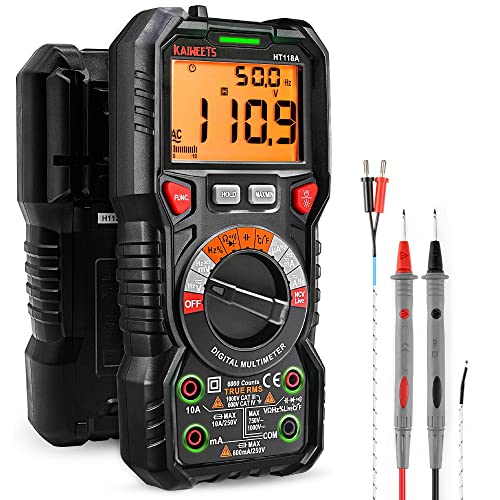
2. KAIWEETS Digital Multimeter Automotive TRMS: best for wide voltage range
The KAIWEETS meter is a True RMS automotive multimeter with a wide voltage and current range. It suits users who want more measuring headroom and extra features such as non-contact voltage testing. It is a good step up for someone planning regular electrical work, such as checking battery systems, sensors and wiring on a vehicle.
Measuring range
The listed ranges go up to 1000 V DC, 750 V AC, 10 A and 60 megaohms of resistance. True RMS means the meter reads accurately on distorted or non-standard waveforms, not only simple sine waves. That matters when you test signals from electronic controls, where the waveform is often not a clean sine curve. The meter also tests temperature, capacitance, frequency, duty cycle, diodes and continuity, so one tool can cover many common checks.
Extra features
Non-contact voltage testing lets the meter sense live wires without touching them, with a sound and light alarm. A flashlight on the back helps you see inside a dim engine bay or behind a panel. Min, Max and Average readings record how a signal changes over time, which is useful when you are looking for an intermittent fault. A stable kickstand, a pen slot and a low battery prompt add everyday convenience.
Safety ratings
The meter lists IEC ratings of CAT III 1000 V and CAT IV 600 V, along with CE and RoHS certification. Measurement categories describe the electrical environments a meter is designed to handle safely, so check the category before you measure high-energy circuits. The meter also has double ceramic fuses and a thermistor protection circuit. Fuses and protection circuits help limit damage if you connect the leads to the wrong range or source.
Ease of use
Switching the dial lights the matching jack, which helps prevent plugging leads into the wrong socket. Autoranging means you do not need to know the expected value in advance. The large 2.9-inch backlit display makes digits easy to read in a dark garage or under the hood. Beginners will still want to read the manual once to learn the dial positions and the meaning of each symbol.
Value for money
The meter sits slightly above the AstroAI general model in listed price. For that difference, buyers gain a higher voltage range, non-contact testing and more recording functions. If you only need basic voltage, current and resistance checks on a car, a simpler meter may meet your needs at a lower cost. Its moderate seller standing suggests a loyal but smaller user base.
Pros
- Wide voltage and current ranges with True RMS accuracy
- Non-contact voltage testing with sound and light alarm
- Flashlight, pen slot and silicone case add practical extras
- Stated support of 36 months after sale and lifetime technical support
Cons
- Non-contact testing can give false alerts near shielded wires
- More functions can mean a slightly longer learning curve
- Its seller standing is moderate, so there are fewer user reviews to compare
3. AstroAI Digital Clamp Meter Multimeter 2000: best for measuring current without disconnecting wires
This is a clamp meter, which means its jaws open around a wire to measure current without breaking the circuit. It suits users who need to check current flow on cables, alternator leads or starter wiring. It is a different tool from a standard meter and works best alongside one.
How the clamp works
To measure AC current, clamp the jaws around one wire, not the whole power cord. The conductor must sit in the centre of the clamp head. The jaws measure current only, so clamping a live wire to read voltage is not correct.
Other functions
The meter also measures AC and DC voltage, resistance, capacitance and continuity. It includes a live wire test with a non-contact sensor. Data hold, max and min readings, a flashlight and a continuity buzzer add useful support.
Limits to know
The meter cannot measure DC current.
This is an important limit for battery and charging circuit work, where DC current is common. Buyers should check this before purchase.
Ease of use and value
The clamp design makes current checks quicker than breaking a circuit to insert a meter.
The meter comes with two AAA batteries and sits at the lowest listed price in this group. Its strong seller standing reflects steady interest from buyers.
Pros
- Measures AC current without cutting into wires
- Lowest listed price in this round-up
- Non-contact live wire test with clear audible and visual alerts
- Includes batteries and a flashlight
Cons
- Cannot measure DC current, a real gap for some automotive jobs
- Clamp jaws are only for current, which requires careful technique
- Works best as a second tool rather than a full replacement
4.
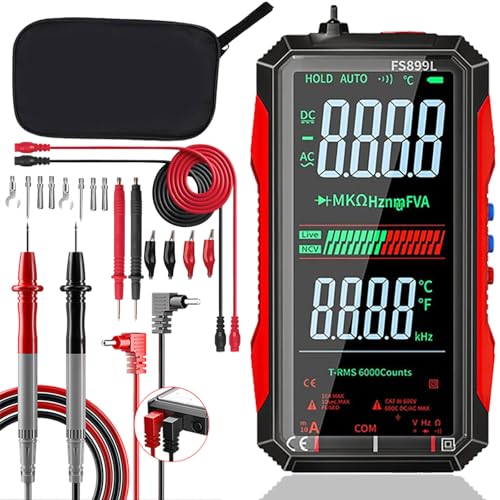
Upgraded FS899L Digital Multimeter: best for rechargeable, colour-screen use
The FS899L is a True RMS meter with a large colour screen and a rechargeable battery. It suits users who work for long periods and want a modern display. It includes a large accessory kit, which adds value for beginners.
Screen and battery
The 4.8-inch backlit screen is large and easy to read in low light. The meter charges over USB-C, and the list the list of features covers rechargeable use and a built-in torch, so no disposable cells are needed for regular work.
The product data gives a charging time of 2 hours and up to 8 hours of use, which suits long jobs in a workshop.
Measuring range
The meter covers AC and DC voltage, current, resistance, capacitance, frequency and temperature. It also offers continuity testing and non-contact live wire detection.
The listed accuracy figures are given as percentages for each range.
Safety and build
The meter carries CAT III 1000 V and CAT IV 600 V ratings, with CE and RoHS certification. Double fuses and overload safeguards help protect against burns and shocks when used correctly. A data hold function freezes readings for awkward positions.
Ease of use
Auto-ranging removes the need to pick a range by hand. The colour screen makes it easy to see several readings at a glance. The kit includes alligator clips, test probes and adapters, so the meter is ready to use straight away.
Value for money
The listed price sits in the middle of this group. For that price, buyers receive a rechargeable battery, a large screen and a full accessory set. Its moderate seller standing suggests fewer independent reviews are available.
Pros
- Rechargeable over USB-C, reducing the need for spare batteries
- Large backlit colour screen with data hold
- Includes a 20-piece accessory set
- Dual safety ratings for high-energy circuits
Cons
- Requires a USB-C charger and charging time before use
- Accuracy figures are given per range, which can be harder for beginners to compare
- Fewer independent user reviews than the most established brands
5.
FNIRSI 2C53T 3-in-1 50MHz 2CH Oscilloscope Multimeter: best for advanced diagnostics
The FNIRSI 2C53T combines a two-channel oscilloscope, a signal generator and a multimeter in one handheld unit. It suits hobbyists and technicians who want to see how a signal changes over time, such as sensor or ignition waveforms.
It is the most advanced and most expensive tool in this round-up.
Many users start with a basic meter and move up when a simple reading no longer answers their question. This unit is designed for that next step. It rewards patience and a clear goal, such as checking why a sensor signal drops out under load.
What an oscilloscope does
An oscilloscope draws a picture of a voltage signal over time. This helps users spot faults that a single reading can miss, such as a noisy sensor line or a signal that is correct on average but briefly spikes. The 2C53T lists 50 MHz bandwidth and 250 MSa/s sampling, along with automatic measurement that reports values such as frequency and peak voltage for you.
A single number from a multimeter tells you the average or effective value of a signal. A waveform shows its shape, which is often where the problem appears. For example, a square edge that rounds off or a ripple riding on a DC line can point to a failing component.
Multimeter and generator
The built-in multimeter covers AC and DC voltage, current, resistance, capacitance and continuity, with a 19999-count display. Higher counts give finer resolution, so small changes in a reading are easier to see. The signal generator outputs up to 13 waveforms, with frequencies reaching 50 kHz, which is useful for testing a circuit or an input with a known signal.
Users can also save waveform images and export them to a computer. This makes it easier to compare a healthy signal with a faulty one or to keep a record of a repair. Saved captures are also handy when asking another person for help with a fault.
Learning curve
An oscilloscope takes more time to learn than a basic meter. Beginners may need to study how to set up time base and voltage scales, and how to set a trigger so the waveform holds still on the screen. Incorrect settings can make a healthy signal look faulty, so it helps to check the scale before trusting a result.
The manual and practice on simple circuits help build confidence over time. A good first exercise is to connect the probe to a known signal, such as a battery voltage or a wall adapter output, and adjust the settings until the display makes sense.
Value for money
At the highest listed price in this group, the 2C53T offers several tools in one unit. For someone who needs an oscilloscope, this can cost less than buying separate instruments. For a beginner who only checks batteries and fuses, it may be more than needed, and a simpler meter from this group will cover those tasks well.
Pros
- Three tools in one: oscilloscope, multimeter and signal generator
- Automatic measurement and waveform saving for analysis
- Built-in high-voltage protection module
- Rechargeable battery with listed standby time of up to 6 hours
Cons
- Highest price and steepest learning curve in this group
- Small screen and a 1 Kpts record depth limit detail on long signals
- Overkill for simple battery and fuse checks
Comparison insights: performance, ease of use and value for money
In practice, the five meters split into three groups. The AstroAI general meter and the KAIWEETS and FS899L models cover standard automotive and household tests. The AstroAI clamp meter focuses on current, and the FNIRSI unit targets signal analysis.
For performance, the KAIWEETS and FS899L offer the widest listed ranges and True RMS accuracy. True RMS matters when a circuit carries distorted AC waveforms, because it reports the true heating value of the signal. The FNIRSI unit offers the most functions, though its strength lies in waveform work rather than simple readings. The clamp meter performs one job well but cannot read DC current.
Ease of use favours the AstroAI general meter, which keeps controls simple and setup quick. The KAIWEETS meter adds lights and alarms that help avoid mistakes. The FNIRSI unit asks the most of its user, since reading a waveform takes practice.
Value for money depends on needs. The clamp meter has the lowest listed price, while the FNIRSI unit has the highest. The FS899L offers a rechargeable battery and a full accessory kit at a middle price, which many buyers may find appealing.
Buying guide: key factors explained in plain words
Start by listing the jobs you plan to do. Checking a battery needs only DC voltage, while diagnosing a charging system may need both DC and AC readings. Matching the tool to your tasks prevents overspending. A short list of your typical jobs also shows you which features you can safely skip.
Measurement functions
Look for DC and AC voltage at minimum, since most car checks rely on them. A resting battery usually reads about 12.6 volts when fully charged, and a running engine’s charging system should read higher than that. Current and resistance are useful for fuses and wiring.
Continuity checks confirm that a wire or fuse is intact, and many meters signal this with a beep.
Auto-ranging and True RMS
Auto-ranging picks the right scale for you, which suits beginners. Without it, you must turn a dial to the correct range before each reading.
True RMS means the meter reads accurately on irregular waveforms, such as those from variable-speed motors or electronic dimmers. Both features make readings more reliable and simpler to take.
Safety ratings
Measurement categories such as CAT III and CAT IV describe the environments a meter is designed for.
CAT III covers distribution and fixed installations, while CAT IV covers the origin of a building’s supply, such as the service entrance. Choose a meter rated for the circuits you plan to test. Fuses and insulated leads add further protection, and a damaged lead should be replaced before use.
Display, battery and portability
A backlit screen helps in dim engine bays and under dashboards. Rechargeable batteries save money on replacement cells, while disposable batteries work anywhere, even when you cannot charge. A kickstand and a compact body make bench use easier, and a rubber holster protects the meter if it is dropped.
Clamp meters and extra tools
A clamp meter reads current without breaking the circuit, which saves time when a wire is hard to disconnect. It is useful, but it does not replace a standard meter, because most clamp meters have fewer functions for continuity and resistance.
Oscilloscopes suit more advanced work, such as viewing signal waveforms over time, and they need time to learn before they become useful.
Who should buy these products: matching buyers to a product
Beginners who want one simple tool for routine checks may find the AstroAI Digital Multimeter a sensible start.
It covers the basics at a modest price, and it suits everyday tasks like testing batteries, outlets and simple fuses.
Drivers who want wider measuring headroom and non-contact testing may prefer the KAIWEETS meter.
Its extra features suit regular household and car electrical work, especially when you want to check for live wires before touching them.
Users who work long hours and want a large colour screen and rechargeable power may consider the FS899L.
The complete accessory kit suits those who want to start straight away, without buying leads or cases separately.
People who need to measure current on live cables without cutting wires may find the AstroAI clamp meter useful. It works best as a companion to a standard meter, not as a full replacement for one.
Hobbyists and technicians who want to see signal waveforms may find the FNIRSI unit worth its higher price. It suits those willing to learn the tool over time, since reading waveforms takes practice.
Final verdict on the best multimeter for automotive use
No single meter suits every car owner.
The AstroAI Digital Multimeter offers the simplest route for beginners, while the FS899L suits long, careful sessions. The FNIRSI unit serves those who need waveform analysis.
For most people, a standard meter with auto-ranging and DC voltage capability covers the core tasks. Adding a clamp meter later can expand what you can check. The right choice is the tool that fits the jobs you actually plan to do, such as checking a battery, testing fuses or tracing a wiring fault.
Frequently Asked Questions
What is the best multimeter for automotive use for a beginner?
A basic auto-ranging digital meter with DC voltage is usually the simplest start. The AstroAI Digital Multimeter is one option in this round-up. Look for clear display markings and sturdy test leads that are easy to grip.
Can a multimeter test a car battery?
Yes, a multimeter can measure battery voltage on the DC setting. A reading near the top of its range suggests a healthy charge, though a full check needs the manufacturer’s guidance. Always set the meter to DC voltage before connecting the leads, and connect the red lead to the positive terminal and the black lead to the negative terminal.
What does True RMS mean?
True RMS means the meter gives accurate readings on irregular or distorted signals, not only smooth waves. This matters for some electronic circuits found in modern vehicles, such as those driven by pulse-width modulation. Basic meters may read these signals less precisely.
Is a clamp meter enough on its own?
A clamp meter is useful for current, but it cannot replace a standard meter. It cannot measure DC current in the AstroAI model, so a second tool is often needed. Many users keep both, using the clamp for current checks and the standard meter for voltage and resistance.
Do I need an oscilloscope for car repairs?
Most simple checks do not need one. An oscilloscope helps when you need to see how a signal changes over time, such as sensor waveforms. Beginners can start with a standard meter and add more tools later, once they know which problems they face most often.

Peterson is an automotive enthusiast and auto parts reviewer with a passion for vehicle maintenance, upgrades, and performance. He enjoys researching and testing car parts, tools, and accessories to help drivers make informed buying decisions. Through AutoPartsTalk.com, Peterson shares honest reviews, practical maintenance tips, and expert guides to keep vehicles running safely and efficiently.