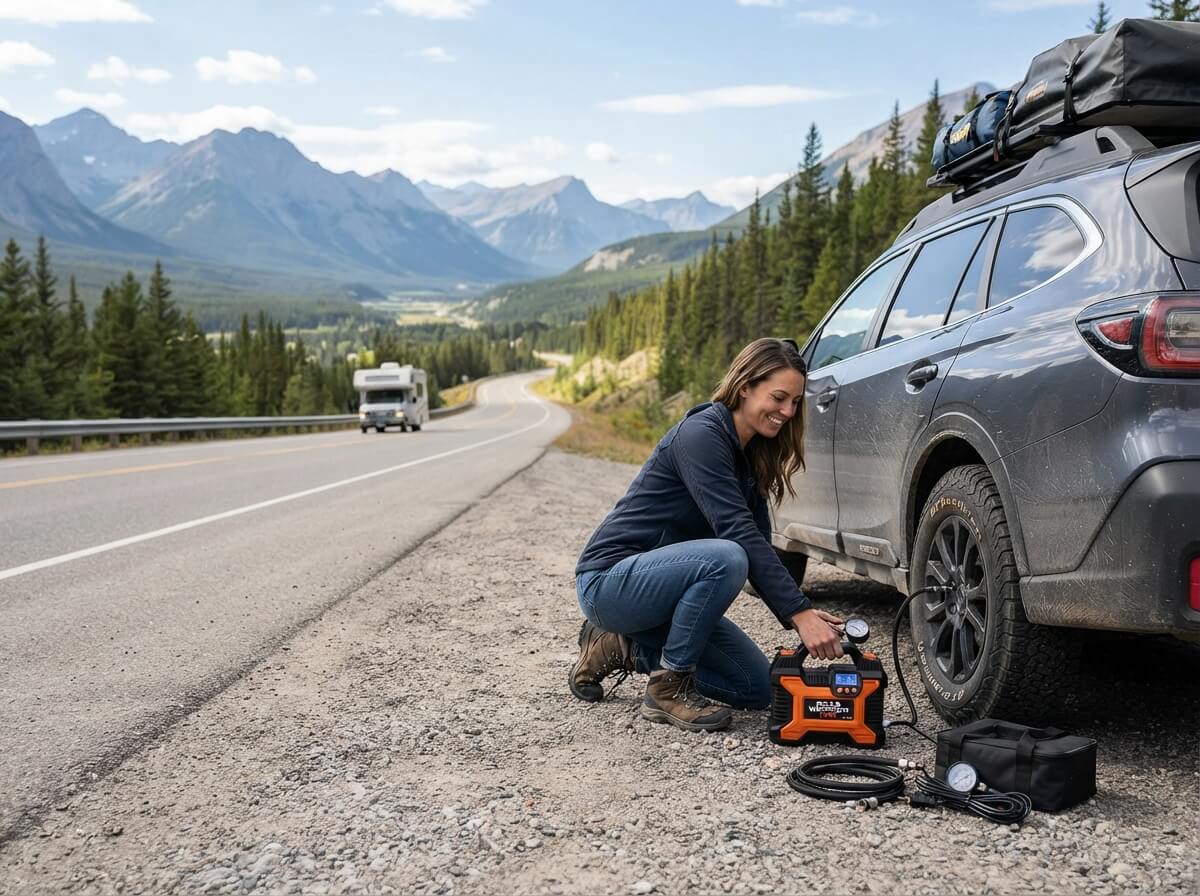
5 Best Tire Inflator for Road Trips In 2026
Introduction
A flat or low tire has a way of showing up at the worst time. It might happen on a quiet highway with no gas station in sight, or right before you load up the car for a long drive with the family. This is exactly why a good tire inflator belongs in your trunk, right next to your jumper cables and first aid kit.
A portable tire inflator is a small air compressor that plugs into your car or runs on a battery, and it lets you pump up your tires wherever you are. No need to hunt for a gas station with a working air pump, and no need to pay a few dollars just to check your tire pressure. You just plug it in, set your target PSI, and let the machine do the work while you grab a coffee or stretch your legs.
Road trips put extra strain on your tires. Long hours on the highway, changing temperatures, heavy luggage, and rough backroads can all cause your tire pressure to drop faster than usual. A tire that looks fine in your driveway can lose several PSI after a few hundred miles, and low pressure means worse fuel economy, faster tire wear, and a higher risk of a blowout. Carrying your own inflator means you can check and fix this in minutes, right on the shoulder of the road.
In this roundup, we look at five popular portable tire inflators that are built with travel in mind: the AstroAI L7, the OlarHike Tire Inflator, the Lamicall Car Tire Inflator, a 160PSI dual power model with 20V battery and 12V DC support, and the ETENWOLF S1. Each one promises fast inflation, auto shut-off, and a digital pressure gauge, but they differ in power source, speed, size, and overall design. We will walk through what each one does well, where it falls short, who it fits best, and how it stacks up against the others.
By the end of this guide, you should have a clear picture of which inflator suits your driving habits, your budget, and the kind of trips you take most often. Let’s get into it.
How We Look at These Tire Inflators
Before jumping into the reviews, it helps to know what actually matters when you’re comparing tire inflators. Here are the main points we focus on for every product:
- Inflation speed – how fast it fills a standard car tire from empty or low pressure to the target PSI
- Power source – corded 12V DC, rechargeable battery, or both
- Accuracy – how close the digital gauge reading is to a trusted pressure gauge
- Auto shut-off – whether the unit stops on its own at your set pressure, so you don’t overfill
- Build and portability – size, weight, and how easy it is to store in a trunk or glove box
- Noise level – some units are loud enough to wake up sleeping passengers
- Extra features – LED lights, preset modes, extra nozzles, and carrying cases
- Value for money – what you get for the price compared to similar tools on the market
With that out of the way, let’s look at each product one by one.
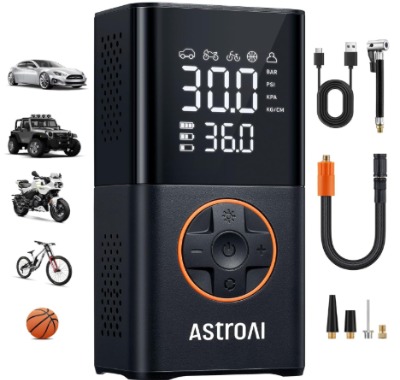
1. AstroAI L7 Tire Inflator Portable Air Compressor
Product Description
The AstroAI L7 is a cordless tire inflator built for people who want a grab-and-go tool without dragging a cable around. It reaches up to 150 PSI, which is more than enough for cars, bikes, motorcycles, and even sports balls. It runs on a built-in rechargeable battery, so there is no need to keep your car running or search for a 12V outlet.
Key Features Explained Simply
- Cordless design: You charge it ahead of time, and then use it anywhere, even away from your car.
- 150 PSI max pressure: This is plenty for passenger car tires, bike tires, and small equipment.
- Digital display: Shows your current tire pressure so you’re not guessing.
- Auto shut-off: Once your tire hits the pressure you set, the pump stops on its own.
- LED light: Handy for late-night stops or checking tires in a dim garage.
Best Use Cases
This inflator fits people who bike often, own a car and a motorcycle, or just want something light to toss in a backpack. It’s also a solid pick for topping off sports balls before a weekend game, since the cordless setup means you don’t need to be near an outlet at all.
Real-Life Usage Insight
For everyday tasks like topping off a slightly low tire or filling a bike tire before a ride, the AstroAI L7 handles the job at a steady pace. Filling a tire from completely flat takes longer than filling one that’s just a bit low, which is normal for cordless units since battery-powered motors usually run a bit slower than corded ones. It works best as a maintenance tool rather than an emergency flat-tire fix, though it can still get you moving again in a pinch.
Pros
- Truly cordless, so you’re not tied to your car
- Simple button layout that’s easy to figure out without a manual
- Bright LED light adds real value at night
- Compact enough to fit in a glove box or door pocket
- Works on more than just car tires
Cons
- Battery life means you need to charge it before longer trips
- Slower than corded units when filling a tire from empty
- Small battery capacity limits how many tires you can fill in one charge
Performance Discussion
The motor on the AstroAI L7 is tuned for convenience over raw speed. It’s not the fastest option in this list, but it makes up for that with the freedom of not needing a power outlet. If you mostly deal with small top-ups rather than fully flat tires, the speed difference won’t bother you much.
Ease of Use
This is one of the simpler units to operate. You turn it on, set your target PSI using the display buttons, attach the nozzle to your valve stem, and press start. The screen shows live pressure, and the pump stops by itself once it hits the number you picked.
Value for Money
Given the cordless convenience, this sits at a fair price point. You’re paying a bit more for freedom from cables, and for most casual users, that trade feels worth it.
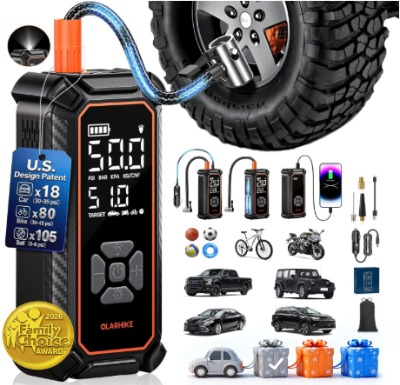
2. OlarHike Tire Inflator Portable Air Compressor
Product Description
The OlarHike stands out because of its dual power setup. It comes with three swappable 2000mAh batteries along with a 12V DC car adapter, so you get flexibility whether you’re near your car or not. This makes it a strong pick for anyone who wants a backup power option built right into the box.
Key Features Explained Simply
- Dual power sources: Use the batteries when you’re away from the car, or plug into the 12V socket when you’re near it.
- Three swappable batteries: If one runs low, you can pop in another instead of stopping to recharge.
- Digital pressure gauge: Lets you track PSI in real time as it fills.
- Auto shut-off: Stops automatically at your chosen pressure setting.
- LED light: Useful for roadside stops after dark.
Best Use Cases
This inflator is a great match for families who take long road trips and want backup power just in case one battery runs out mid-trip. It’s also handy for people who tow trailers, campers, or use their car for outdoor gear, since you can inflate more than one item without needing to recharge between each one.
Real-Life Usage Insight
Having three batteries changes how you plan for a trip. Instead of worrying about charge levels the night before, you can pack all three and rotate them as needed. This is especially useful on multi-day trips where a wall outlet isn’t always around. When the batteries do run low, the 12V DC cord is there as a backup, so you’re never fully stuck.
Pros
- Backup batteries reduce the stress of running out of charge
- Dual power setup adds flexibility for different situations
- Solid inflation speed for a battery-powered unit
- Good option for trailers, RVs, and multi-vehicle households
- Bright display that’s easy to read in daylight
Cons
- Carrying three separate batteries adds a bit of bulk
- Slightly more setup time compared to single-battery models
- Charging all three batteries fully takes a while before a trip
Performance Discussion
Thanks to the swappable batteries, the OlarHike keeps working even after one battery drains. This makes it more reliable over a full day of use compared to single-battery cordless models. The 12V cord option also gives it near-unlimited runtime when you’re near the car, closing the gap with corded inflators.
Ease of Use
Setup is simple: screw the nozzle onto the valve stem, pick your power source, set the target PSI, and start the pump. Swapping batteries is quick and doesn’t require any tools.
Value for Money
Given that you’re getting three batteries plus a DC cord in one package, this is a strong deal for the price. It offers more flexibility than most single-battery options without a big jump in cost.
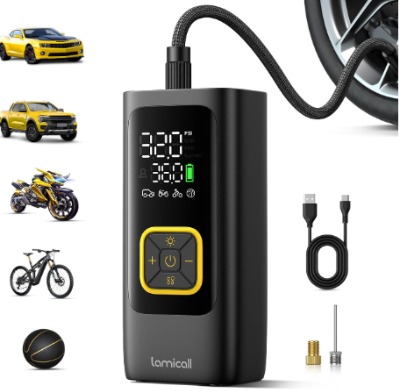
3. Lamicall Car Tire Inflator Portable Air Compressor
Product Description
The Lamicall inflator markets itself as 4x faster than standard inflators, reaching up to 150 PSI. It’s rechargeable, so you’re not stuck plugging into your car every time, and it includes an auto-stop feature along with a clear pressure display.
Key Features Explained Simply
- Faster motor: Built to fill tires quicker than basic entry-level models.
- 150 PSI max: Covers car tires, bike tires, and sports balls.
- Rechargeable battery: Charge once and use it away from your vehicle.
- Auto stop: Cuts off the pump once your target pressure is reached.
- Pressure gauge display: Digital screen for reading current PSI.
Best Use Cases
This is a good pick for drivers who want speed without giving up the cordless setup. It works well for quick top-ups before a trip or for handling a slow leak on the go. It’s also compact enough to keep in a backpack for cyclists who ride longer distances and want a reliable pump on hand.
Real-Life Usage Insight
The extra motor speed makes a noticeable difference when filling a tire that’s dropped a fair amount of pressure. Instead of standing around for several minutes, you’re done in a shorter window, which matters when you’re on a tight schedule or stopped somewhere you’d rather not linger, like the side of a busy road.
Pros
- Noticeably faster than basic cordless inflators
- Compact and lightweight for easy storage
- Auto stop prevents overinflation
- Simple, beginner-friendly controls
- Doubles as a pump for balls, rafts, and bike tires
Cons
- Battery capacity limits continuous use on very low tires
- Can get warm during extended sessions
- Fan noise is a bit more noticeable at full speed
Performance Discussion
Speed is the main selling point here, and it holds up in real use. Filling a passenger tire from a moderately low pressure to full happens fairly quickly, which is a nice change if you’ve used slower pumps before. Just keep an eye on the unit if you’re filling several tires back to back, since it can warm up.
Ease of Use
The button layout is straightforward, and the screen makes it easy to set your target pressure before you even start pumping. There’s very little learning curve here, which makes it a solid choice for someone who wants function without extra steps.
Value for Money
For the speed boost you get, the price feels reasonable. It’s a good middle-ground option between a basic slow pump and a more expensive heavy-duty compressor.
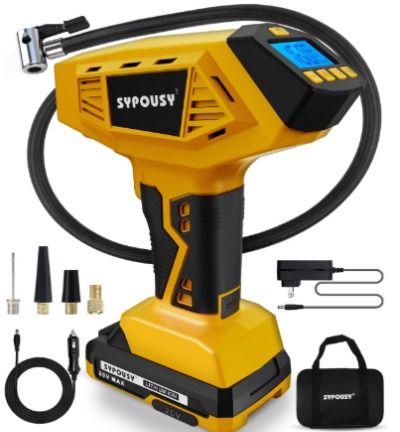
4. Tire Inflator Portable Air Compressor – 160PSI, 20V Battery & 12V DC (Dual Power)
Product Description
This model pushes the ceiling a bit higher, hitting 160 PSI, and it runs on both a 20V battery and a 12V DC car adapter. The dual power setup means you get the flexibility of a cordless tool along with the near-unlimited runtime of a corded one.
Key Features Explained Simply
- 160 PSI max pressure: Higher ceiling than most competitors, useful for larger tires.
- 20V battery power: Gives strong, steady performance away from the car.
- 12V DC option: Plug into your car for extended use without worrying about battery life.
- 4x faster motor: Built to cut down inflation time compared to older basic pumps.
- Auto shut-off: Stops the pump automatically at your target PSI.
- Digital pressure gauge: Displays real-time readings as you fill.
Best Use Cases
This is a strong fit for truck owners, SUV drivers, or anyone dealing with tires that need a bit more air pressure than a standard sedan. It also suits people who want one tool that works both cordless and corded, since it removes the need to pick just one power style.
Real-Life Usage Insight
The higher 20V battery gives this unit more muscle compared to smaller 2000mAh-style batteries. It handles fuller tires and larger tire volumes with less strain, which matters if you’re dealing with truck tires or off-road tires that hold more air. Switching over to the 12V DC cord when the battery runs low keeps you from being stuck mid-task.
Pros
- Higher max PSI covers a wider range of tire types
- Strong battery output compared to smaller battery-powered units
- Dual power setup gives backup runtime
- Fast fill times thanks to the upgraded motor
- Solid pick for trucks, SUVs, and bigger tires
Cons
- Bulkier than some of the smaller cordless models here
- Higher price point compared to basic single-power inflators
- Battery adds weight to the overall unit
Performance Discussion
This is one of the stronger performers in the group when it comes to raw power. The 20V battery gives it enough punch to handle bigger tires without slowing down much, and the 12V backup means you’re never fully out of options. If your vehicle has tires with higher recommended PSI, like a truck or SUV, this model handles that range more comfortably than the smaller 150 PSI units.
Ease of Use
Despite the added power, the controls stay simple. You still just set your target PSI, attach the nozzle, and press start. The dual power switch is clearly labeled, so switching between battery and DC power doesn’t require guesswork.
Value for Money
Given the higher PSI ceiling and dual power setup, this sits at a higher price point, but it earns that price through added capability. For truck and SUV owners, it’s likely worth the extra cost.
5. ETENWOLF S1 Tire Inflator Portable Air Compressor
Product Description
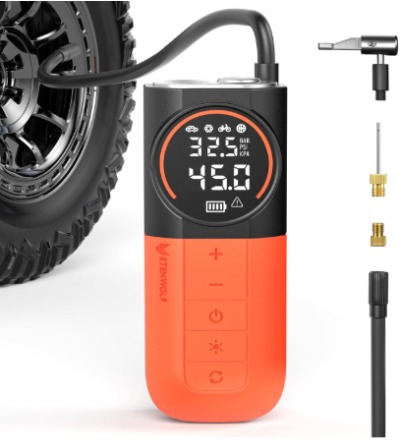
The ETENWOLF S1 is a cordless inflator that reaches up to 160 PSI, matching the higher-end models in this list while keeping a compact, travel-friendly shape. It comes in a bright orange finish that makes it easy to spot in a dark trunk or glove box, along with the usual auto shut-off and digital gauge features.
Key Features Explained Simply
- 160 PSI max pressure: Covers most car, motorcycle, and bike tire needs.
- Cordless operation: No cable needed, just charge and go.
- Fast inflation: Motor built to cut down wait time compared to basic pumps.
- LED light: Useful for roadside checks after dark.
- Auto shut-off: Stops once your target pressure is hit, so you avoid overfilling.
- Digital pressure gauge: Clear readout for tracking PSI as you go.
Best Use Cases
This one suits drivers who want a higher pressure ceiling in a cordless package, which is handy for motorcycles and smaller trucks that need more air than a standard sedan tire. The bright color and compact size also make it a good glove box companion for regular road trips.
Real-Life Usage Insight
The 160 PSI ceiling gives this unit a bit more range than the standard 150 PSI cordless models, which is helpful if you switch between a car and a motorcycle, since bikes often need different pressure settings. The bright orange shell isn’t just for looks either, it genuinely helps when you’re digging through a dark trunk trying to find your gear.
Pros
- Higher PSI ceiling than many similarly priced cordless units
- Easy to spot thanks to the bright color
- Compact and lightweight for travel
- Simple controls with a clear digital display
- Good option for mixed car and motorcycle use
Cons
- Battery life is on the shorter side under heavy use
- Not the fastest option when filling a fully flat tire
- Limited accessories included compared to some competitors
Performance Discussion
The ETENWOLF S1 performs well for routine top-ups and small pressure adjustments. It’s not the quickest at handling a fully flat tire, but for the kind of maintenance most drivers actually do, checking pressure before a long drive and adding a bit of air, it gets the job done without much fuss.
Ease of Use
Like most models in this list, it keeps things simple. Set your PSI target, attach the nozzle, and start the pump. The display is easy to read, and the auto shut-off means you don’t have to babysit it while it works.
Value for Money
Given the 160 PSI range and cordless convenience, this sits at a fair mid-range price. It’s a solid pick if you want more pressure range without stepping up to a bulkier dual-power model.
Comparison Insights
Now that we’ve gone through each one, let’s line them up side by side so the differences stand out more clearly.
| Model | Max PSI | Power Source | Portability | Best For |
|---|---|---|---|---|
| AstroAI L7 | 150 PSI | Cordless battery | Very compact | Bikes, casual use, sports balls |
| OlarHike | 150 PSI | 3 batteries + 12V DC | Compact, slightly bulkier | Long trips, backup power needs |
| Lamicall | 150 PSI | Rechargeable battery | Very compact | Quick top-ups, speed-focused users |
| 160PSI 20V Dual Power | 160 PSI | 20V battery + 12V DC | Bulkier | Trucks, SUVs, higher pressure tires |
| ETENWOLF S1 | 160 PSI | Cordless battery | Compact | Mixed car and motorcycle use |
A few patterns show up once you compare these side by side. The models capped at 150 PSI are generally lighter and more compact, which makes sense since they don’t need as strong a motor. The two models rated at 160 PSI, the dual power option and the ETENWOLF S1, are built for situations where you need a bit more pressure range, like motorcycles or trucks.
Power source is another big divider. If you hate the idea of ever running out of charge mid-trip, the dual power models (OlarHike and the 20V dual power unit) give you a safety net that the fully cordless options don’t. On the other hand, if you want the lightest, most grab-and-go option, the AstroAI L7 and Lamicall lean that direction.
Speed also varies. The Lamicall and the 20V dual power model both lean on faster motors as a selling point, so if waiting around annoys you, those two are worth a closer look.
Buying Guide: What to Look For in a Tire Inflator
Shopping for a tire inflator is not just about picking the first one that shows up in search results. Here’s what actually matters when you’re comparing options.
1. Power Source
Cordless models are convenient but rely on battery charge, so they work best for people who remember to charge gear before a trip. Corded 12V DC models never run out of power as long as your car is running, but they tie you to your vehicle. Dual power models give you both, which is the safest bet if you don’t want to think too hard about it.
2. Max PSI Rating
Most cars need somewhere between 30 and 35 PSI, so a 150 PSI max is more than enough for daily driving. Motorcycles, trucks, and some SUVs may need higher pressure, so if you own one of those, lean toward a 160 PSI or higher rated model.
3. Inflation Speed
If you’re often dealing with tires that are significantly low, a faster motor saves real time. For light top-ups, speed matters less since the job only takes a minute or two anyway.
4. Accuracy of the Gauge
A digital gauge is only useful if it’s accurate. It helps to double check a new inflator against a trusted separate gauge the first time you use it, just to confirm the readings line up.
5. Auto Shut-Off
This feature protects your tires from overinflation, which can affect handling and even cause damage over time. Every model in this roundup includes it, and it’s genuinely worth having rather than skipping.
6. Size and Weight
If trunk space is tight, smaller cordless models are easier to tuck away. Larger dual power units take up more room but often make up for it with stronger performance.
7. Noise Level
Some inflators run quite loud, which matters if you’re using it late at night near a campsite or a sleeping car full of passengers. It’s worth checking reviews for noise complaints before buying if this matters to you.
8. Included Accessories
Extra nozzles for balls, bike valves, and inflatables add versatility. A carrying case also helps keep things organized in your trunk.
Who Should Buy These Products
Not everyone needs the same type of inflator, so here’s a quick breakdown based on different needs.
- Daily commuters who just want peace of mind will do fine with a compact cordless option like the AstroAI L7 or Lamicall.
- Road trip families who want backup power for long stretches without gas stations should lean toward the OlarHike with its swappable batteries.
- Truck and SUV owners dealing with higher tire pressure requirements will get more out of the 160PSI dual power model.
- Motorcycle riders and mixed vehicle owners will appreciate the higher PSI range on the ETENWOLF S1.
- Cyclists and outdoor hobbyists who inflate more than just car tires will benefit from any of the cordless models with multiple nozzle attachments.
Common Mistakes to Avoid
A tire inflator is simple to use, but a few common mistakes can lead to frustration or even tire damage.
- Not checking your car’s recommended PSI first. This number is usually printed on a sticker inside the driver’s door, not on the tire itself. The number on the tire sidewall is the maximum rating, not the recommended one.
- Forgetting to charge the battery before a trip. Cordless models are only helpful if they actually have power when you need them.
- Overinflating tires. Even with auto shut-off, it’s smart to double-check the reading against your car’s recommended PSI rather than just guessing a round number.
- Ignoring valve stem condition. A worn or damaged valve stem can cause air to leak out as fast as it goes in, making it seem like the inflator isn’t working.
- Skipping regular checks. Waiting until a tire looks visibly flat means you’re reacting instead of preventing the issue. A quick monthly check catches slow leaks early.
- Using the wrong nozzle attachment. Most inflators come with multiple nozzle types, and using the wrong one can lead to air leaking out during inflation instead of going into the tire.
Final Verdict
All five of these tire inflators do the core job well: they fill tires, they shut off automatically, and they give you a digital readout so you’re not guessing. The right pick really comes down to how you plan to use it.
If you want the lightest, simplest option for casual use, the AstroAI L7 is an easy recommendation. If backup power matters most because you take long trips or use your car for outdoor gear, the OlarHike with its three batteries stands out. If speed is your main concern and you don’t want to wait around, the Lamicall earns its spot. For truck owners or anyone needing higher pressure with strong, reliable output, the 160PSI 20V dual power model is the stronger match. And if you split time between a car and a motorcycle, the ETENWOLF S1 covers that range nicely with its 160 PSI ceiling.
There’s no single “best for everyone” answer here, since the right inflator depends on your vehicle, your battery habits, and how often you’re dealing with more than just a light top-up. What matters most is that you have one in your car at all. A slow leak caught early with any of these tools beats a surprise flat tire on the side of the highway every single time.
Keep your inflator charged, check your tire pressure before every long drive, and you’ll spend a lot less time worrying about your tires and a lot more time enjoying the actual trip.