5 Best Tire Repair Kit For Cars In 2026
As an Amazon Associate we earn from qualifying purchases.
Getting a flat tire is one of the most common roadside problems. A good tire repair kit for cars can turn a stressful wait for help into a quick fix you do yourself. This guide helps beginners who have never repaired a tire and want to know what to keep in the trunk.
The five kits in this round-up share a common purpose: they seal small punctures in tubeless tires without removing the tire from the rim. They differ in how they seal the hole, how many parts they include and how much they cost. The comparison rests on the listed features and typical use, not on personal testing.
Before you buy, it helps to know the two main sealing methods. Plug kits push a rubber strip into the hole from the outside, while patch-and-plug kits add an inner seal as well. Plug kits are usually quicker and need less equipment, but they call for more hands-on skill.



1. AUTOWN Flat Tire Repair Kit 68pcs: best for a large, all-in-one set
What this kit is and who it suits
This is a plug-style repair kit with a large number of parts. It is aimed at people who want one set that covers cars, trucks, motorcycles and even lawn equipment. It suits drivers who like to keep a complete kit ready rather than a minimal one.
The kit uses a T-handle tool and a spiral probe. The probe cleans out the hole, and the T-handle pushes a rubber plug into the puncture. The included storage case keeps everything together, so the pieces are less likely to get lost in the trunk.
Key features in simple terms
The listing describes the kit as made of high-quality steel tools and rubber repair plugs. It states that the plugs are meant to resist aging and keep a long shelf life. The manufacturer says the kit fits many vehicle types, which is useful if you share tools across several machines.
Check the listing for the exact contents before you buy. Parts counts and included items can change between sellers and versions, so confirm that the set matches what you need.
What daily use usually feels like
Most buyers of plug kits find the process is hands-on and takes some practice. You need to find the hole, ream it, and push the plug in with steady force. A kit with many pieces gives you spare plugs and tools, so a failed attempt does not end the repair.
It is a good idea to read the instructions once at home, not for the first time beside a busy road. Practicing on a tire that is off the car makes the real job much less stressful.
Performance and ease of use
Plug kits generally work well on small punctures from nails and screws. Performance depends on the hole size and how carefully you follow the steps. The T-handle and probe are the main tools for doing the work, and the listing presents them as easy to use.
Plug repairs are usually considered temporary or semi-permanent, so have the tire inspected by a professional as soon as you can. This is a safety step, not a sign that the kit failed.
Value for money
At the listed price, this is one of the higher-priced options in this round-up. You get a large parts count, which many buyers see as good value if they will use spares or repair several vehicles. If you only need a basic kit for one car, a smaller set may be enough.
Pros
- Large parts count with spare plugs and tools
- Covers cars, trucks, motorcycles and more
- Includes a compact storage case
- Steel tools are listed as durable
Cons
- Costs more than basic kits
- Many parts can feel like too much for a single car
- Plug repairs still need practice and steady hands
- Not suited to large sidewall damage
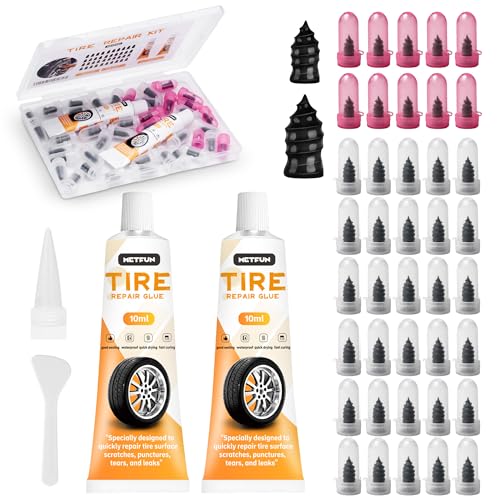
2. MetFun 40 PCS Quick Fix Screw-in Tire Plug Kit: best for a fast, no-tools roadside fix
What this kit is and who it suits
This kit uses screw-in rubber plugs instead of a T-handle insertion system. It is designed for quick fixes on tubeless tires, and it suits drivers who want a simple process they can follow at the roadside. It is a good fit for people who want to avoid carrying a larger set of tools.
Many drivers keep a kit like this in the trunk for emergencies. It works best for someone who wants a compact, easy-to-store option rather than a full shop-style setup.
How the screw-in method works
You remove the object that caused the puncture, clean the area, apply the included sealant, and then screw the rubber plug into the hole. The listing says no tire removal is needed. Because the method is different from plug-and-push kits, the steps feel more like a simple sequence than a tool-based technique.
Each step matters. Skipping the cleaning or rushing the sealant can leave the repair weaker, so it helps to work slowly and follow the order exactly.
Features that matter at the roadside
The kit includes two plug sizes, which the listing says suit small and larger nail punctures. It also includes two tubes of sealant glue, so you do not need to buy extra materials. The rubber is described as resistant to aging and high temperatures, and the storage keeps the parts organized.
Having both plug sizes in one case means you can match the plug to the hole rather than forcing a single size to fit every puncture. Organized storage also makes it easier to find the right part quickly when you are short on time.
Real-life use and ease of use
Screw-in kits tend to be quick to learn, which makes them appealing for beginners. Because the process uses fewer tools, there are fewer steps to remember when you are stressed on the side of the road. Even so, you still need to find the hole and apply the sealant carefully.
If you practice the steps once at home before you need them, the process will feel far less intimidating on the road.
Value for money
At the listed price, this is one of the lowest-cost options here. The parts count is high, so you have plenty of plugs for more than one repair. For drivers who want a budget-friendly kit that covers many vehicle types, the value is strong.
A high parts count also means you can keep spares in the vehicle, so you are not left without material after a single repair.
Pros
- Low listed price with a high parts count
- Includes sealant, so no extra materials are needed
- Two plug sizes for different puncture sizes
- Simple process that does not require removing the tire
Cons
- Screw-in plugs may not suit every puncture location
- Requires careful cleaning and sealant application
- Not a substitute for a professional repair on large damage
- Fewer tools than a full T-handle set
3. ETENWOLF Flat Tire Repair Kit: best for a compact, budget-friendly plug kit
What this kit is and who it suits
This is a plug-style kit with a compact bag and a moderate number of parts. It suits drivers who want a basic plug kit that fits easily in a car door pocket or small storage space. It is a practical choice for one vehicle, especially for someone who wants a simple roadside option without a large set of tools.
Tools and plug sizes
The kit includes stainless steel T-handle tools with rubber-coated grips. The listing says the grips reduce hand fatigue, which helps when pushing a plug takes effort. Two plug sizes, 0.14 inch and 0.18 inch, let you match the plug to the hole. Matching matters, because a plug that is too small may not seal and one that is too large can be hard to insert.
What is included
The contents include both T-handle tools, a lubricant, a utility knife, two sets of plugs, an empty spray bottle and a storage bag. Having a knife and lubricant in the box means you can start the repair without buying extra items.
The spray bottle can hold water or soapy solution, which you can use to check for bubbles that show where air is escaping. Keeping everything in one bag also makes it easier to find items when you are on the roadside.
Performance and ease of use
Plug kits with two sizes give you more flexibility than single-size sets. The rubber-coated handles are described as comfortable, which many users value during a repair. Like any plug kit, success depends on technique and hole size. A clean, well-lubricated plug and a firm, straight push usually give the best result.
Value for money
The listed price sits in the middle of this round-up. You get a complete set of tools and two plug sizes in a compact bag. For drivers who want a balance of cost and completeness, the kit offers sound value. It is most useful for those who need only the basics and do not expect to repair many punctures.
Pros
- Compact bag that fits easily in a vehicle
- Two plug sizes for different punctures
- Rubber-coated handles described as comfortable
- Includes lubricant, knife and spray bottle
Cons
- Fewer total parts than the largest kit here
- Plug repairs still require some practice
- Designed for tubeless tires only
- Not suitable for repairing sidewall damage
4. AUTOWN Flat Tire Repair Kit: best for a mid-size professional plug set
What this kit is and who it suits
This is a plug kit from the same brand as the largest set in this round-up, with a smaller parts count. It suits drivers who want the same style of tools in a more modest package. It fits people who expect to repair a few vehicles over time, or who want a sturdier set than a basic budget kit.
Materials and build
The listing describes the tools as made of high-quality steel. It also claims the repair plugs have good adhesion, flexibility and shock absorption, and that they resist aging. These are claims from the listing, so treat them as the manufacturer’s description rather than verified results. Checking the product page for current material details is a sensible step before you buy.
Real-life use
Because the kit has fewer parts, you carry fewer spares. This suits a single-car owner who wants the core tools without extra pieces. The T-handle and spiral probe work the same way as in the larger AUTOWN set. If you later need more plugs, you can buy refills separately rather than carrying a full set at all times.
Performance and ease of use
The listing says the kit includes everything needed for repair, with the T-handle and spiral probe making insertion easier. The spiral probe helps clear debris and open the puncture channel before the plug goes in. The portable case takes up little room. As with any plug kit, a clean hole and steady pressure make the biggest difference.
Value for money
At the listed price, this kit sits between the budget and premium options. You get professional-style tools and a case in a smaller package. For a single vehicle, the value depends on if you need the extra parts in the larger set. If you only expect an occasional puncture, a smaller kit like this may be enough.
Pros
- Same tool style as the larger AUTOWN kit
- Compact case that is easy to carry
- Covers many tubeless tire types
- Mid-range price for a plug kit
Cons
- Fewer spare plugs than the 68-piece set
- Plug repairs still take practice
- Not suited to large or sidewall damage
- Limited to tubeless tires
5. CKAuto 36 pcs Universal Tire Repair Kit: best for a value pack with extra accessories
What this kit is and who it suits
This is a plug kit that bundles many extras beyond the plugs and tools. It suits drivers who want a kit that also covers valve parts and inflation-related items. It is a good match for people who like a complete set in one bag.
If you only want a basic kit for a rare flat, this bundle may feel larger than you need. It works best for someone who wants to keep spare valve parts on hand, such as a car owner who likes to be ready for more than one type of roadside issue.
What is included
The listing shows two T-handle tools, two replacement tools, twenty 4-inch repair plugs, valve stem caps, a valve stem tool, lubricant, a hex key, valve cores, a knife and a bag. The extra valve parts are a noticeable difference from the other kits here. Each item is listed clearly, so you can check the set before you buy.
Before you buy, compare the contents list with what you already keep in your trunk. Some items, such as the knife and hex key, may overlap with tools you own, while the valve parts may be the main reason to choose this set.
Materials and durability
The listing describes the T-handle tools as made of rust-resistant zinc alloy. It says the repair strips use natural rubber and come in an airtight bag, which helps them last. These are listing claims, and actual durability will depend on storage and use.
Keeping the kit in a dry, cool place, away from direct sun and heat, is a simple way to protect rubber parts. Check the plugs and lubricant from time to time so you know they are still usable when you need them.
Performance and ease of use
The kit is described as usable without removing the tire from the rim. The listing says detailed instructions help beginners work through the repair. Because the plugs are longer than the 0.14 and 0.18 inch plugs of the ETENWOLF kit, the listing suggests a different use range. Check the hole size before you start.
Plug repairs are a skill that improves with practice. It helps to read the instructions once before a real emergency, and to lay out the tools in the order you will use them so you are not searching for parts on the roadside.
Value for money
At the listed price, this kit is among the higher-priced options. The extra accessories add value if you want valve parts in the same box. If you only need plugs and tools, the extras may not matter much to you.
A useful way to judge value is to count the items you would actually use. If you would buy valve cores and caps separately anyway, the bundle may save you a trip to the shop. If you would never touch those parts, a smaller kit with fewer extras may suit you better.
Pros
- Large bundle with valve parts and accessories
- Airtight packaging for the repair strips
- Rust-resistant tool material as described
- Instructions aimed at beginners
Cons
- Costs more than several kits in this round-up
- Many accessories may go unused for basic repairs
- Plug repairs still need practice
- Only for tubeless tires, not tube tires
Comparison insights: how the kits differ
The five kits split into two main styles. Three use T-handle insertion with rubber plugs, while the MetFun kit uses screw-in plugs and sealant. Each style has trade-offs in speed, learning curve and tools needed.
On performance, the choice depends on the size and location of the puncture. Plug kits with two sizes, such as the ETENWOLF kit, give more options for matching the hole. Screw-in plugs suit quick, small punctures but may be less flexible for unusual spots. None of the listings claim one style is superior in every case.
For ease of use, the MetFun screw-in kit is described as the simplest to follow, since it needs fewer tools. The plug kits take more practice. Beginners who want a clear step sequence may find the CKAuto instructions helpful, based on the listing.
On value, the MetFun kit has the lowest listed price and a high parts count. The ETENWOLF kit offers a middle price with a compact bag. The two AUTOWN kits and the CKAuto kit cost more, with the larger AUTOWN set and the CKAuto bundle offering the most parts or accessories.
Buying guide: key factors explained in plain words
Before you buy, check the type of tire your vehicle uses. Most kits in this round-up are made for tubeless tires, which hold air without a separate inner tube. Tubed tires need a different repair method, so a tubeless kit may not be the right tool for them. Look at the sidewall of your tire or your vehicle manual to confirm the type.
Next, think about the repair method. Plug kits push a rubber strip into the hole with a T-handle tool. Screw-in kits use a rubber screw coated with sealant. Plug kits give you more control over how the repair sits in the tread, while screw-in kits are often quicker to learn and faster to finish when you are stuck on the roadside.
Parts count matters too. A larger kit gives you spare plugs and tools, which helps if a first attempt fails or a second puncture appears soon after. A smaller kit is easier to store and may cost less, which suits a single vehicle that rarely sees rough roads or nails.
Storage and portability are worth a look. A compact bag fits under a seat or in a trunk organizer, while a bulkier case may stay at home. Check that the case keeps the parts from shifting and getting damaged, since loose tools can rattle around and bend a plug or snap a handle over time.
Finally, consider the extras. Some kits include lubricant, a knife, valve parts or a spray bottle for checking leaks. Extras help only if you will use them, so match the contents to your needs. A valve core tool, for example, is useful for some drivers but unnecessary for others who never service valves.
Who should buy these products: matching buyers to a kit
If you want one large set that covers many vehicles, the 68-piece AUTOWN kit is the most complete option here. It suits households with several vehicles or people who like to keep spares on hand for family members and friends who drive.
If you want a fast, simple fix and a low price, the MetFun screw-in kit fits well. It suits beginners who want fewer tools and a clear sequence to follow, especially if they have never repaired a tire before and want to keep the process straightforward.
If you want a compact plug kit with two plug sizes for one car, the ETENWOLF kit is a sensible choice. It balances cost, portability and useful tools, and the two plug sizes give you some flexibility for different hole sizes in the tread.
If you want a middle-sized professional-style set from a known brand, the smaller AUTOWN kit suits a single-vehicle owner. It offers the same tool style without the larger parts count, so you get a dependable set without carrying more than you need.
If you want a bundle with valve parts and accessories, the CKAuto kit suits drivers who want everything in one bag. It is a good match for those who value extras and beginner instructions, and it works well as a first kit kept in the trunk for emergencies.
Final verdict
No single kit is the best choice for every driver. The right pick depends on your budget, how many vehicles you need to cover and if you prefer a plug method or a screw-in method. Each kit in this round-up offers a clear set of trade-offs, so it helps to decide your priorities before you compare listings.
For a low-cost, quick fix, the MetFun screw-in kit is a strong starting point. Its small set of tools keeps the process simple for a first-time user. For a balanced plug kit with two sizes, the ETENWOLF kit makes sense, since having two plug sizes lets you handle a wider range of small punctures.
For a large set or a bundle with extras, the AUTOWN 68-piece and CKAuto kits fit those needs, especially if you want spare parts on hand for family vehicles or a shared garage.
In short, match the kit to the vehicle, the puncture type and your comfort with tools. Keep any kit in the car so you are prepared when a flat happens on the road, not just at home. Remember that large or sidewall damage still calls for professional help, because no roadside kit can safely fix that kind of failure.
Frequently Asked Questions
Can these kits repair any flat tire?
These kits are designed for small punctures in tubeless tires, such as a nail or screw in the tread area. They are not meant for large cuts or damage to the sidewall, where the tire structure itself is compromised. Check your tire type and the location of the damage before you start.
Do I need to remove the tire from the rim?
The listings for these kits describe repairs done without removing the tire from the rim. Always follow the instructions included with your specific kit, because steps and tool use can differ between a screw-in method and a plug method.
Is a screw-in kit easier than a plug kit?
Screw-in kits generally use fewer tools and fewer steps, so many beginners find them simpler. Plug kits offer more control over how the plug is seated, but they take more practice to do well. Your comfort with tools and how much time you want to spend at the roadside will guide the choice.
How long do the repair plugs last?
The listings describe rubber that resists plugs and sealant can age over time, so the listings mention shelf life and aging resistance as features. Check the kit periodically and replace worn parts, especially if the kit has been stored in a hot car for long stretches. A repair is a temporary or semi-permanent fix, so have the tire checked by a professional after any roadside repair.
Should I still call for help after a repair?
A repair can get you to a service center, but it does not always replace professional assessment. If the tire loses air again or the damage is large, call for roadside assistance. Safety comes first, so do not drive on a tire that looks unsafe.

Peterson is an automotive enthusiast and auto parts reviewer with a passion for vehicle maintenance, upgrades, and performance. He enjoys researching and testing car parts, tools, and accessories to help drivers make informed buying decisions. Through AutoPartsTalk.com, Peterson shares honest reviews, practical maintenance tips, and expert guides to keep vehicles running safely and efficiently.