5 Best Emergency Roadside Kit In 2026
Nobody plans to break down. A battery dies on a cold morning. A tire goes flat in the rain. The tow truck is an hour away, and you are standing next to a busy road with your phone at 12 percent. A good emergency roadside kit can turn that bad moment into a small problem you handle yourself.
This guide looks at five popular emergency kits and jump starters. Some are full bags with tools and supplies. Others focus on one job, like starting a dead battery. We cover what each one includes, how it performs in common situations, where it falls short, and who it suits best. We also explain the features that matter most, so you can judge any kit on your own, not just these five.
Our review is based on product specifications, typical buyer feedback, and how each kit is likely to work in everyday roadside situations. We avoid hype. Marketing numbers can look impressive, but the real test is whether the kit helps you get moving again.
How This Roundup Works
Every kit here was judged on the same points. Each review touches on most of these areas, but the weight changes depending on the product.
What is included. A kit is only as good as its contents. We checked whether the kit has a power source, a tire inflator, jumper cables, a first aid kit, lighting, and other basics.
Starting power. For jump starters, we looked at the stated peak amps, the battery capacity, and the engine sizes each one is meant for. We also paid attention to how realistic those numbers are.
Air compression. A tire inflator is handy only if it fills a tire at a reasonable speed and reaches the pressure it claims.
Ease of use. In a roadside emergency, stress is high and light is low. Clear controls, clamps that grip well, and simple instructions matter a lot.
Build and storage. Your kit lives in your trunk through heat, cold, and bumps. Sturdy cases, good cable insulation, and a compact shape make a real difference over time.
Value for money. The cheapest kit is not always the best deal, and the most expensive one is not always worth the price. We asked what you actually get for what you pay.
Quick Look at the Five Kits
Here is a short summary before we get into the details.
| Kit | Main Type | Starting Power | Air Compressor | Best For |
|---|---|---|---|---|
| Everlit Survival Car Emergency Kit | Full roadside kit | Jumper cables only | Digital inflator | Budget all-in-one coverage |
| GOOLOO GP4000 Jump Starter | Jump starter | 4000A peak | Not included | Simple, compact jump starting |
| 5000A Jump Starter with Air Compressor | Jump starter with inflator | 5000A peak | 150 PSI | Gas and light diesel engines |
| WOLFBOX MV24A Jump Starter | Premium jump starter with inflator | 4000A peak | 160 PSI | Tech-friendly power and fast charging |
| Car Emergency Safety Kit Bag | Winter-focused full kit | Jumper cables only | Portable compressor | Cold climates and family cars |
1. Everlit Survival Car Emergency Kit
Product Description
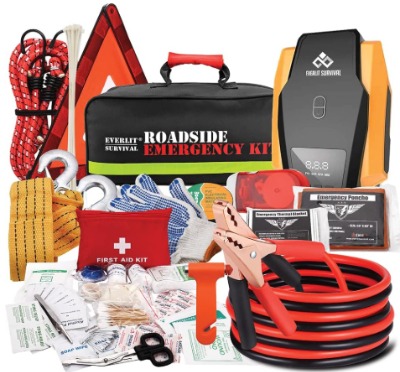
The Everlit Survival Car Emergency Kit is a full roadside bundle. It includes a digital tire inflator, a first aid kit, a set of 12-foot jumper cables, a tow strap, a flashlight, and work gloves. It is designed for drivers who want one package that covers many common problems without buying each item separately.
It is marketed for women, men, and teenagers, which tells you it is meant to be simple enough for any driver in the family to use.
Best Use Cases
This kit fits best as a basic first line of defense. It works well for a daily driver that stays mostly in town, for a first car for a new driver, or as a gift for someone who has never built an emergency kit before. It also suits people who want to cover small problems like a slow leak, a minor cut, or a dark trunk at night.
It is less suited to someone who regularly drives long distances in remote areas, or to anyone with a large engine that needs serious starting power.
Key Features Explained Simply
The jumper cables are the main way this kit helps with a dead battery. They are 12 feet long, which gives you enough reach for most cars parked close together. Jumper cables are useful, but they need a second car with a working battery. If you are alone in an empty parking lot, they do nothing on their own.
The digital tire inflator plugs into your car’s power outlet and fills a tire with air. Digital inflators show the pressure as you fill, so you can stop at the right number. They are slower than a dedicated home compressor, but they are good enough to get you to a shop or gas station.
The tow strap is handy for pulling a car a short distance out of a ditch or mud. It is not meant for towing a car behind another car over long distances, so keep that in mind.
The first aid kit covers small injuries like cuts, scrapes, and burns. It is a basic kit, so you may want to add a few items later if you have specific medical needs.
The flashlight and work gloves are simple but useful. A bright light helps you see under the hood at night, and gloves keep your hands clean and safe when you handle a dirty battery or a sharp tool.
Real-Life Usage Insight
Think about a typical problem. Your car will not start in a store parking lot. You flag down a friendly driver, connect the cables, and wait a few minutes. The engine turns over. This kit gives you the tools for that job, but it depends on help from another driver.
Now think about a slow tire leak. You pull over, plug in the inflator, and fill the tire to the right pressure. It takes some patience, but you avoid a costly call to roadside assistance.
Many people find that a kit like this gives them confidence. Knowing the tools are in the trunk makes you less worried about a breakdown.
Performance Discussion
The jumper cables perform the job they are designed for, as long as the second battery is healthy. The inflator is the weaker part of the performance story. Digital compressors in this price range tend to be slow, and they can heat up if you run them for a long time. Filling a large tire from very low pressure can take a while, so plan to take breaks.
The first aid kit and flashlight are basic but dependable. You should not expect advanced medical supplies or a very powerful light, but both do their jobs.
Ease of Use
This kit is very easy to understand. The inflator has a clear digital display, and the cables have color-coded clamps that help you connect them the right way. Set it up once and it is ready to go.
The main learning curve is the jump-starting process itself. If you have never jump-started a car before, read the instructions in your owner’s manual and practice in a calm setting. Doing it for the first time on a dark, rainy road is much harder.
Value for Money
This is one of the better values in the group. You get many items in one package for a lower price than buying each one separately. The trade-off is that the individual pieces are basic. The cables are not the heaviest gauge, and the inflator is not built for heavy daily use. For occasional emergencies, the value is strong.
Pros
- Covers many common roadside problems in one package
- Digital inflator shows pressure while you fill
- Easy setup and simple controls
- Good option for new drivers and gift giving
- Strong value for the money
Cons
- Jumper cables need a second working car
- Inflator is slow with large tires or very low pressure
- Basic first aid supplies only
- Not enough power for large trucks or diesel engines
2. GOOLOO GP4000 Jump Starter
Product Description
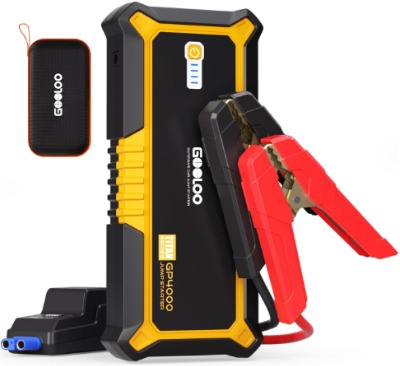
The GOOLOO GP4000 is a compact portable jump starter. Instead of relying on another car, it stores power in a built-in battery and sends that power to your dead battery. It is rated at 4000 amps peak, which is a common number in this category. It runs on a 12-volt system, the standard for most passenger cars.
A jump starter like this is a small box with clamps, a power button, and a few indicator lights. It is meant to be the main answer to a dead battery.
Best Use Cases
This jump starter suits drivers with small to mid-size gas engines, especially those who want to avoid asking a stranger for a jump. It also works well as a second kit for a family car. It is a good pick if you park in places where help may not be close by, like a rural road or a large parking garage.
It is not the best match for a large diesel truck or an engine that needs heavy starting power.
Key Features Explained Simply
The peak amp rating tells you the maximum burst of power the unit can give for a very short time. It is a useful number for comparison, but it is not the same as real-world starting power. Real starts depend on engine size, battery condition, temperature, and how long the cranking takes. Treat the number as a rough guide.
The built-in battery stores the energy. Because it is a lithium-type battery, the unit is light and small compared to a traditional car battery of similar power.
The clamps connect the unit to your dead battery. Good clamps have strong springs and clean contact surfaces. Clamps that feel loose or flimsy are a warning sign.
The USB ports let you charge a phone or small device while you wait. This is a nice extra during a long delay.
Real-Life Usage Insight
Imagine a cold morning when your car clicks but does not turn over. You pull the jump starter from the trunk, clip the red clamp to the positive terminal, clip the black clamp to a solid ground point, and press the start button. Within a short time, the engine turns. You then let the car run for a while so the alternator can recharge the battery.
That process is much simpler than finding a second car and lining up the cables. You also avoid the awkward moment of asking a stranger for help.
Performance Discussion
For a typical gas car, the GP4000 can do the job well when the battery is only drained, not fully dead or damaged. It is most at home with smaller and mid-size engines. Larger engines, especially diesel, may need more than it can comfortably deliver, and you may need to try several times.
Cold weather reduces power from any jump starter and any battery. If you live where winters are hard, expect the unit to work less efficiently on the coldest mornings.
Ease of Use
The unit is simple to operate. Most people can figure it out from the labels and a quick read of the manual. The main point to remember is the correct clamp order: red to positive, black to a clean metal ground away from the battery. Connecting the clamps in the wrong order can cause sparks or damage, so take that step seriously.
Value for Money
This is a solid middle-ground option. It costs more than basic jumper cables, but it removes the need for a second car. For drivers who worry about breakdowns, that convenience is often worth the price. The unit does not include an air compressor, so if you need one, you will need to buy it separately.
Pros
- Compact and easy to store in a trunk or glovebox
- No second car needed for a jump
- Simple controls and clear indicator lights
- USB ports for charging phones during a wait
- Good value for typical gas engines
Cons
- Peak amp rating is marketing-heavy, so real starting power is more modest
- Not ideal for large diesel engines
- Cold weather reduces performance
- No tire inflator included
- The unit needs regular charging to stay ready
3. 5000A Jump Starter with Air Compressor (Red)
Product Description
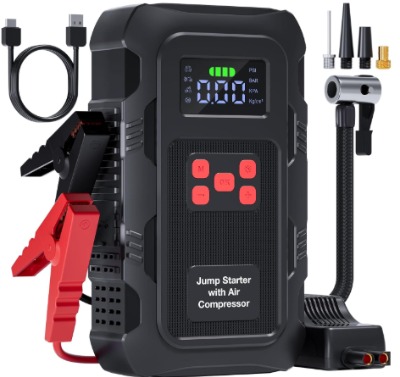
This 5000A jump starter is a combined unit. It starts a dead battery and also works as a portable air compressor. The compressor is rated at up to 150 PSI, which is enough for most passenger car tires and many light truck tires. The product lists support for gas engines up to 10.0 liters and diesel engines up to 8.0 liters, which is a wider range than the basic jump starters in this roundup.
It comes in a bold red color, which makes it easy to spot in a dark trunk.
Best Use Cases
This product fits drivers who want both starting power and air in one device. It suits small SUVs, sedans, and light trucks. It is also a sensible choice for drivers who travel with families, since a flat tire and a dead battery are two of the most common roadside problems.
It is a good fit for someone with a modest diesel engine, but heavy diesel trucks may still need more power than this unit can offer.
Key Features Explained Simply
The 5000A peak rating sounds higher than the GP4000, but the real difference in power depends on the battery capacity and the quality of the internal parts. Peak ratings are short-burst numbers, so compare the rest of the specs too.
The 150 PSI compressor is a useful feature. It gives you a way to fill a flat tire without a separate pump. Most passenger tires need between 30 and 40 PSI, so the compressor has more than enough reach for everyday driving.
The built-in display or indicators show the battery level and the air pressure, depending on the model. These readings help you know when the unit is ready and when the tire has reached the right number.
The clamps and cables are a key part of the design. Thicker, well-insulated cables handle heavy current better and stay flexible in cold weather.
Real-Life Usage Insight
Picture a Sunday trip with your family. A tire goes soft on the highway shoulder. You pull out the unit, connect the air hose to the valve, and set the target pressure. The compressor runs for a while and brings the tire up to the right level. Later, the car will not start at the next stop. The same unit can handle that job too.
This two-in-one setup saves space and reduces the number of items you need to carry.
Performance Discussion
As a jump starter, this unit works well for common gas engines and smaller diesels. It is a step up from the basic models, and it gives you more margin when the battery is weak. As an air compressor, it fills tires at a reasonable speed, although it will still take several minutes to fill a larger tire from very low pressure.
Like all compressors in this class, it can get warm during long use. Give it breaks, and do not leave it running unattended.
Ease of Use
Setup is simple. The compressor usually has a clear screen and a few buttons. The jump-starting controls are easy to find. The main thing to learn is how to switch between the two functions and how to set the target pressure for the tire.
Some users find the hose or valve adapter a bit fiddly at first. A little practice at home helps a lot.
Value for Money
This product offers good value for drivers who would otherwise buy a jump starter and a separate compressor. The price is higher than a basic jump starter, but the combined function makes it a strong choice. If you only need a jump starter, the extra compressor adds cost you may not use.
Pros
- Two tools in one: jump starter and tire inflator
- Strong 150 PSI compressor for everyday tires
- Good range of engine sizes, including some diesel
- Bold color makes it easy to find in the trunk
- Good value when both functions are needed
Cons
- Compressor is slow on very large or very flat tires
- Can get warm during long inflation sessions
- Heavy diesel trucks may still need more power
- Adapter setup takes a little practice
4. WOLFBOX MV24A 4000A Jump Starter with Air Compressor
Product Description
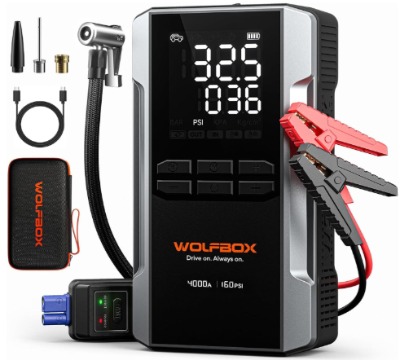
The WOLFBOX MV24A is a premium jump box with a built-in air compressor. It is rated at 4000 amps peak and offers a 160 PSI compressor. The listing mentions support for gas engines up to 10 liters and diesel engines up to 6 liters. It has an 88.8 watt-hour battery, which is a useful number when you compare battery capacity across products. It also includes 65W fast charging for phones, laptops, and other devices, plus an LED light.
It is a more feature-rich unit than the basic jump starters in this roundup.
Best Use Cases
This jump box suits drivers who want strong features in one compact device. It is a good match for daily commuters, road trippers, and drivers who use their car as a work vehicle. The fast charging and LED light make it useful beyond car emergencies, such as camping or power outages.
It is not the best fit for very large diesel trucks, since the diesel rating is lower than some competitors.
Key Features Explained Simply
The 88.8 watt-hour battery tells you how much energy the unit stores. A higher number generally means more jumps and more device charging before a recharge. This number is often more useful than peak amps when you want to judge real capacity.
The 160 PSI compressor is one of the stronger tire inflators in the group. It gives you a good amount of pressure for regular tires, and it helps you fill a tire faster than many budget options.
The 65W fast charging lets you charge a laptop or phone quickly. Many people find this feature useful during long waits, especially when the car cannot charge devices.
The LED light provides enough illumination to work under a hood or along the side of the road. It is handy for checking connections at night.
The jumper cables are included, which gives you a backup if you need a standard jump from another car.
Real-Life Usage Insight
Think about a cold evening when the battery is low after a long day of short trips. You plug the device in to charge overnight. In the morning, you connect the clamps and start the car. Later, you use the fast charging to power your phone while you wait for a tow.
This type of unit fits well into daily life because it does more than rescue a dead battery. It becomes a small power source you can use for many tasks.
Performance Discussion
For gas engines in the typical range, the MV24A gives a strong start. Its battery capacity and build quality are good for a unit in this price range. Diesel performance is more limited, so check your engine size before buying.
The compressor performs well for regular tires. It reaches target pressures without much trouble, though larger tires will take more time. The fast charging works as advertised with compatible devices, and the LED light is bright enough for basic work.
Ease of Use
The unit is easy to use, with clear buttons and indicators. The main controls are intuitive, and the instructions are straightforward. The clamps grip well, which helps when the battery terminals are dirty or corroded.
Like other jump boxes, you should charge it regularly. Keeping it topped up is the best way to ensure it works when you need it.
Value for Money
This is a premium option. It costs more than the basic kits and most single-function jump starters. The value comes from the combination of strong starting power, a strong compressor, fast charging, and a built-in light. If you use these features regularly, the price is justified. If you only want a basic jump, you can find a cheaper option that does the job.
Pros
- Strong 160 PSI compressor for faster tire inflation
- Useful 88.8 watt-hour battery capacity
- 65W fast charging for phones and laptops
- LED light helps at night
- Includes jumper cables as a backup
Cons
- Higher price than basic kits
- Diesel rating is lower than some competitors
- Compressor still takes time on large tires
- Battery needs regular charging to stay ready
5.Car Emergency Safety Kit Bag with Winter Gear
Product Description
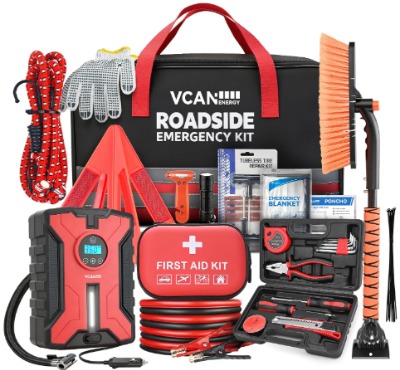
This emergency safety kit comes in a zippered bag. It includes a portable air compressor, jumper cables, a first aid kit, and winter items like a snow brush and an ice scraper. It is marketed for women, men, and teenagers, and it is clearly aimed at drivers who face cold weather and snow.
Unlike the jump starters in this roundup, this kit relies on jumper cables for starting power. It is a broad, practical package with a seasonal focus.
Best Use Cases
This kit is ideal for drivers in cold climates where snow and ice are common. It also suits family cars, since the bag holds several basic items in one place. It works well as a gift for a new driver or a relative who lives in a snowy area.
It is less useful if you live in a warm area and never deal with winter driving. You can still use the basics, but you may not need the winter tools.
Key Features Explained Simply
The zippered bag keeps everything together. This makes it easy to grab in an emergency and easy to store in the trunk. A good bag keeps items from rolling around during driving.
The portable air compressor fills tires. Portable compressors in this class are generally slower than dedicated jump-box inflators, but they do the basic job.
The jumper cables are the main starting tool. Like the Everlit kit, they need a second working car to be useful.
The snow brush and ice scraper are very useful in winter. Clearing snow and ice from windows and mirrors is important for safe driving. A brush and scraper are small items, but they make a real difference on cold mornings.
The first aid kit covers basic needs. Like other basic kits, it is a starting point, not a full medical setup.
Real-Life Usage Insight
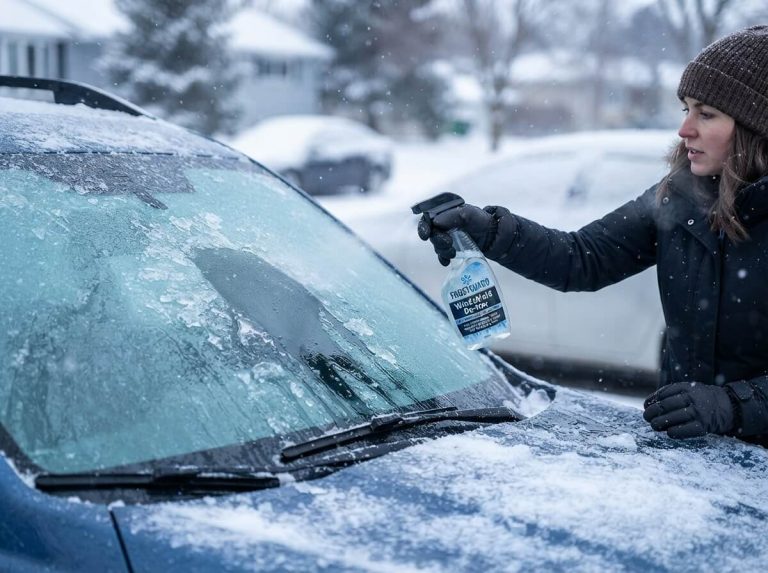
Imagine a snowy morning. Your windshield is covered in ice, and the car will not start. You use the scraper to clear the glass and the brush to clear the snow from the roof and lights. You then find a driver nearby to help with a jump. Once the car is running, you use the compressor to top up a low tire.
That sequence shows how useful a winter-focused kit can be. Many small items help you deal with a cold, slow, stressful situation.
Performance Discussion
The jumper cables work as expected, provided a second battery is available. The compressor is slower than a jump-box inflator, so expect a longer wait for larger tires. The snow brush and ice scraper are simple tools, and they perform their job well when used correctly.
The first aid kit covers basic cuts and scrapes. It is useful for minor injuries but should not be relied on for serious problems.
Ease of Use
The kit is easy to use. The bag is straightforward, and the items inside are common tools. The main learning curve is the jump-starting process, which is the same as in the Everlit kit. Practice in a calm setting helps.
Value for Money
This kit gives good value, especially for winter drivers. You get several useful items for a modest price. The main trade-off is that the starting power depends on another car, and the compressor is not as strong as the premium jump boxes.
Pros
- Includes winter tools like a snow brush and ice scraper
- Zippered bag keeps items organized
- Good value for cold-climate drivers
- Easy to store and grab in an emergency
- Works well as a gift for new or family drivers
Cons
- Jumper cables need a second working car
- Compressor is slower than dedicated jump boxes
- First aid kit is basic
- Less useful in warm, dry climates
Comparison Insights
Looking at all five products together reveals some clear patterns.
Jump starters beat jumper cables for solo drivers. If you often drive alone, or park in quiet areas, a jump starter is much more useful than jumper cables. The GP4000, the 5000A model, and the WOLFBOX MV24A all remove the need for a second car. The Everlit and winter safety bag still rely on a helper car, so they are better as complements than as complete solutions.
Air compressors are a big selling point. The 5000A model and the WOLFBOX MV24A stand out because their compressors are strong enough for everyday tire work. The Everlit kit and the winter bag have compressors too, but they are slower. For a flat tire on a highway shoulder, speed and reliability matter.
Battery capacity tells a better story than peak amps. Many products lead with large peak numbers. The WOLFBOX MV24A lists its battery capacity in watt-hours, which is a clearer measure of how much energy it stores. When comparing units, look at both the battery capacity and the engine size range.
Extra features add real value. Fast charging, USB ports, and LED lights are small details, but they matter during a long wait. The WOLFBOX MV24A offers the most of these extras. The GP4000 includes USB charging, and the 5000A model focuses on the core functions.
Winter gear is a separate need. Only the winter safety bag includes snow tools. If you live in a snowy area, these tools are worth looking for, whichever kit you pick.
Cost follows features. The basic full kits cost the least and cover the most items in one box, but they rely on cables. The jump starters cost more and give you independent starting power. The premium jump box costs the most and offers the widest range of extras.
Buying Guide: What to Look for in an Emergency Roadside Kit
Before buying any emergency kit, think about how and where you drive. Your daily habits should guide your choice more than any product claim.
Jump Starter or Jumper Cables?
Jumper cables are cheap and reliable, but they need a second car. A jump starter works alone, which is a big advantage if you drive in quiet areas or at odd hours. Many drivers keep both: a jump starter as the main tool and cables as a backup.
Check Engine Size and Type
Look at the engine size range listed for the jump starter. Gas and diesel engines have different starting needs. A unit rated for a 6-liter gas engine may struggle with a much larger diesel. If you drive a truck or SUV with a big engine, look for higher ratings.
Read Past the Peak Amp Number
Peak amps are a short-burst figure, and manufacturers use different methods to measure them. Battery capacity, measured in watt-hours or milliamp-hours, gives a more useful picture of how much energy the unit can hold. Compare the capacity alongside the peak rating.
Think About Air Compression
If you often deal with slow leaks or flat tires, a built-in compressor is a strong feature. Look at the maximum PSI and the typical fill time. A higher PSI number is useful for larger tires, but the real measure is how fast the unit gets your tire to the right pressure.
Consider Extra Features
Fast charging, USB ports, LED lights, and displays can make a kit more useful. These features matter most if you spend long periods waiting on the side of the road or need to charge devices during a power loss.
Look at Build Quality
Thick, insulated cables and strong clamps last longer and perform better in cold weather. Check the reviews for comments about cable thickness and clamp grip. Flimsy parts often fail at the worst moment.
Plan for Winter if Needed
If you live where snow and ice are common, look for snow brushes, ice scrapers, and a way to stay warm and visible. Extra items like reflective triangles and a warm blanket can also help.
Keep It Charged and Checked
Jump starters and jump boxes lose charge over time, even when they are not used. Set a reminder to check and recharge the unit regularly. A dead jump starter is just a box in your trunk.
Who Should Buy Which Kit
Daily commuters in town can do well with the Everlit kit. It covers the basics, and the cost is low. Pair it with a simple jump starter later if you find yourself stuck alone.
Drivers who often drive alone should consider the GOOLOO GP4000 or the 5000A jump starter. Either one lets you get moving without a second car. The 5000A model is a better pick if you also want an air compressor.
Families and road trippers will find the 5000A jump starter or the WOLFBOX MV24A useful. Both handle flat tires and dead batteries, and the WOLFBOX adds fast charging for devices during long trips.
Tech-minded drivers and gadget lovers may enjoy the WOLFBOX MV24A. The fast charging, LED light, and battery capacity make it a practical power source beyond the car.
Cold-climate drivers and winter commuters should look hard at the Car Emergency Safety Kit Bag. The snow brush and ice scraper are the kind of simple tools you will use often in snow. Keep a jump starter in the trunk as well for a stronger backup.
New drivers and gift buyers will find the Everlit kit or the winter bag a friendly starting point. Both cover many situations and come with clear basic tools.
Common Mistakes to Avoid
Many roadside problems get worse because of simple mistakes. Here are the most common ones.
Waiting until you need it to check the kit. Open the trunk kit every few months, check the battery charge, test the compressor, and look for damaged cables. Do this before winter and before long trips.
Connecting jumper cables or clamps in the wrong order. Reversing the clamps can cause sparks, damage the electronics, or hurt you. Always follow the labels and the manual. Red goes to positive, black goes to a clean metal ground.
Assuming peak amps tell the whole story. A high number on the box does not guarantee a strong start. Check the engine size range and the battery capacity too.
Ignoring the engine size limit. Using a small jump starter on a large engine can lead to repeated failed attempts and a drained unit. Match the kit to your car.
Forgetting to recharge. A jump starter that sat unused for a long time may have little charge left. Charge it regularly, especially before cold weather.
Running the compressor for too long. Compressors can overheat. Let the unit cool between uses, and avoid leaving it running unattended.
Skipping the manual. Every product works a bit differently. A quick read of the manual before you need the kit saves time and stress.
Buying a kit that does not fit your life. A winter kit in a hot desert or a diesel-only jump starter for a small gas car may not be the best use of money. Match the kit to your driving.
Thinking one kit covers everything. Even a good kit cannot fix every problem. Keep a charged phone, a list of emergency numbers, and a plan for roadside assistance as well.
Final Verdict
There is no single best emergency roadside kit for every driver. The right choice depends on your car, your climate, and how you drive.
The Everlit Survival Car Emergency Kit is the best value for drivers who want a full set of basics in one package. It works well for new drivers and gift giving, although it relies on another car for starting power.
The GOOLOO GP4000 Jump Starter is a solid pick for drivers who want a compact, independent jump starter for typical gas engines. It is simple to use and easy to store.
The 5000A Jump Starter with Air Compressor gives you the most useful combination for everyday trouble. You get starting power and a working tire inflator in one unit, with a range that covers many gas engines and some diesels.
The WOLFBOX MV24A Jump Starter is the premium choice. Its battery capacity, strong compressor, fast charging, and LED light make it useful well beyond roadside emergencies. It costs more, but it does more too.
The Car Emergency Safety Kit Bag is the best fit for cold-climate drivers. The snow brush and ice scraper make a real difference during winter, and the bag keeps everything organized.
If we had to pick one overall, the 5000A Jump Starter with Air Compressor offers the best balance of power, function, and price for most drivers. If you live in a snowy area, the winter safety bag becomes a strong second choice. Whatever you pick, check it regularly, keep it charged, and learn how to use it before you need it.
Frequently Asked Questions
Do I need both a jump starter and jumper cables?
Not always. A jump starter works alone, so cables are a backup. Many drivers keep both because they cost little and add flexibility.
Can a jump starter damage my car’s electronics?
Modern units include safety features like reverse-polarity protection and spark prevention. Still, always connect the clamps in the correct order and follow the manual closely.
How often should I recharge my jump starter?
Check it regularly and recharge it when the battery indicator drops. Many experts suggest topping it up periodically, especially before cold weather or long trips.
Is a portable air compressor as good as a home compressor?
No. Portable compressors are slower and less powerful. They are good for emergency use and topping up tires, but they are not meant for heavy or frequent work.
What else should I add to my roadside kit?
Consider reflective warning triangles, a flashlight with spare batteries, a warm blanket, drinking water, non-perishable snacks, and a phone charger. In winter, add gloves, a small shovel, and kitty litter for traction.

Peterson is an automotive enthusiast and auto parts reviewer with a passion for vehicle maintenance, upgrades, and performance. He enjoys researching and testing car parts, tools, and accessories to help drivers make informed buying decisions. Through AutoPartsTalk.com, Peterson shares honest reviews, practical maintenance tips, and expert guides to keep vehicles running safely and efficiently.