How to Bypass a Fuel Pump Relay?
Introduction
Your car won’t start, and you suspect the fuel pump relay is the culprit. The engine cranks, but the fuel pump never engages. This frustrating situation leaves you stranded and wondering what to do next. The good news? You can bypass a fuel pump relay and get your vehicle running again without heading straight to an expensive mechanic.
A fuel pump relay is a small electrical switch that controls power to your fuel pump. When it fails, your fuel system shuts down completely, and your engine refuses to fire up. Learning how to bypass this component helps you troubleshoot the problem and restore function to your car’s fuel delivery system.
This guide walks you through the entire process step by step. By the end, you’ll understand how fuel pump relays work, why they fail, and exactly how to bypass one safely.
What Is a Fuel Pump Relay?
A fuel pump relay acts as an electrical gateway. It sits between your car’s ignition system and the fuel pump motor. When you turn your key, the relay receives a signal and switches on, sending power directly to the fuel pump. The pump then pressurizes fuel and pushes it through your fuel lines to the engine.
The relay operates like a light switch. Your ignition signal is the hand that flips the switch. The fuel pump is the light bulb that turns on as a result. Without a working relay, that signal never reaches the pump, and your fuel delivery stops dead.
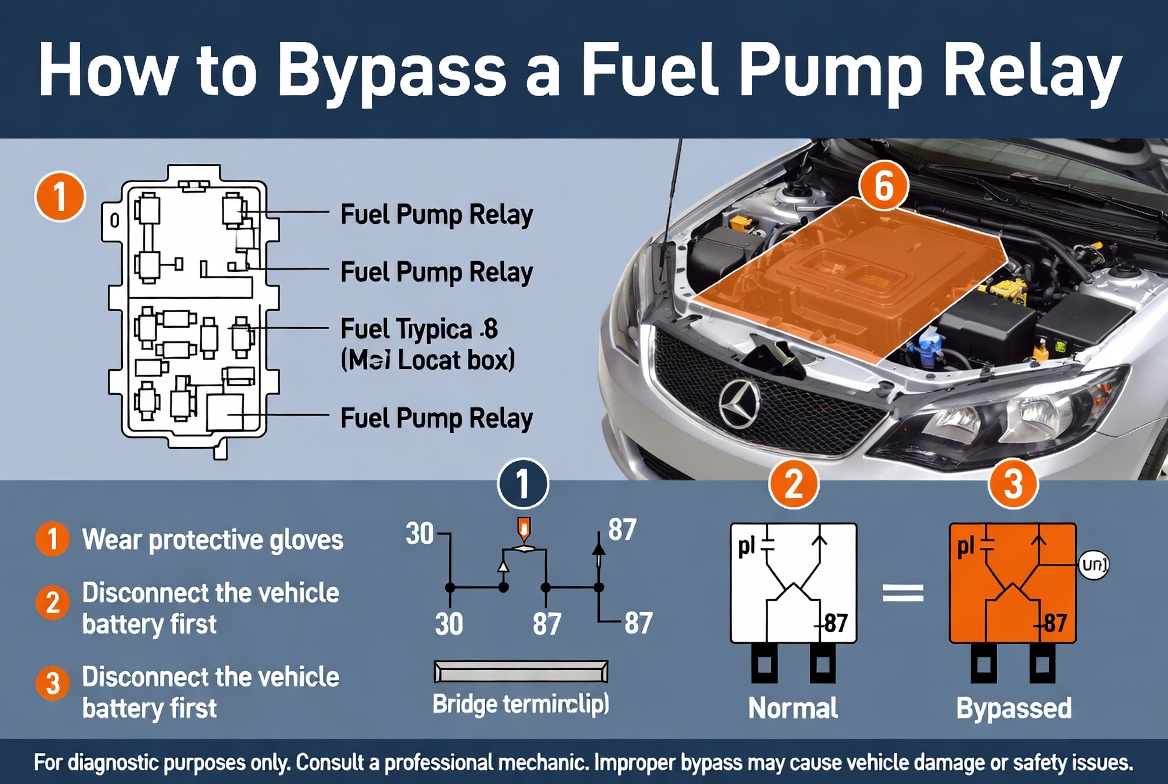
Fuel pump relays typically sit in your vehicle’s fuse box or relay panel. Most cars have a fuse box under the dashboard, in the engine compartment, or in both locations. The relay itself is a small cube-shaped component with four or five metal pins sticking out from the bottom. It plugs into a socket just like a fuse.
Why Fuel Pump Relays Fail
Relays fail for several common reasons. Heat exposure damages the internal circuitry over time. Constant electrical cycling causes the metal contacts inside to wear out and oxidize. Voltage spikes from jump-starting or poor electrical connections can fry the relay instantly.
Vibration also plays a role. Your car bounces and shakes on the road, which puts stress on all electrical components. A relay’s internal contacts are delicate and sensitive to constant motion. Eventually, they wear down or come loose.
Moisture is another killer. Water seeping into the relay housing corrodes the metal contacts and causes them to stick or fail to make proper connection. Roadside salt and debris don’t help matters either.
Age simply catches up with relays too. The older your car gets, the more likely its relays are to fail. Most relays last several years, but nothing lasts forever.
Signs Your Fuel Pump Relay Is Bad
Before you jump into bypassing, confirm that you actually have a bad relay. Several symptoms point directly to relay failure.
Your engine cranks strongly but won’t start. You turn the key, the starter motor spins the engine over, but it never catches and fires. This is the classic sign of a failed fuel pump relay.
You hear the fuel pump prime when you turn the ignition to the “on” position but then nothing happens when you try to start the engine. The relay worked once but failed under full load.
No fuel pump sounds at all. When you turn the key, you don’t hear that familiar electric whirring noise from the fuel tank. The pump never gets power.
The engine stalls while driving, and you can’t restart it. This often happens when the relay burns out from heat stress during heavy use.
Your check engine light comes on, and diagnostics reveal fuel pump or fuel delivery fault codes.
Tools You Need to Bypass a Fuel Pump Relay
Gathering the right tools makes this job much easier and safer. Here’s what you need to collect before you start:
A basic multimeter helps you test electrical connections and confirm relay failure. You can find a simple one at any auto parts store for under thirty dollars.
A relay socket connector or wiring harness allows you to connect your bypass directly to the relay socket. You can make one from spare electrical connectors or buy a pre-made unit.
Wire strippers let you expose the copper inside electrical wires so you can make solid connections.
A crimper or terminal connectors let you attach wires securely to relay pins.
A twelve-volt power source or relay provides the switching power needed for your bypass circuit.
A proper relay or automotive relay switch gives you a functioning replacement component.
A test light or small LED tells you if power is present at various points in your circuit.
An automotive wiring diagram for your specific car model shows you exactly where each relay pin connects.
Understanding Your Car’s Wiring Diagram
Your vehicle’s wiring diagram is your roadmap for this entire project. It shows how power flows through the fuel pump circuit and which wires do what. Every car is different, so relying on generic advice can lead you astray.
You can find wiring diagrams in your owner’s manual, online repair databases, or by searching your car’s year, make, and model with the phrase “fuel pump relay wiring diagram.” Many sites offer free diagrams for download.
Study the diagram until you understand which wire brings power in, which wire goes out to the pump, which pin grounds the circuit, and which pin receives the ignition signal. These four connections are absolutely critical.
The relay socket has labeled pins. Your diagram identifies what each pin does. Don’t skip this step. Connecting wires to the wrong pins can damage your fuel pump, drain your battery, or cause an electrical fire.
Step-by-Step Guide to Bypassing Your Fuel Pump Relay
Step 1: Disconnect Your Battery
Safety comes first. Remove the negative cable from your car battery. This stops all power flow in your vehicle and prevents electrical shocks or short circuits while you work. Wait five minutes to ensure all residual power drains from the system.
Step 2: Locate Your Fuel Pump Relay
Pop open your fuse box. Most cars have the fuse box labeled, and the inside lid usually shows a diagram of which relay is which. Look for the fuel pump relay diagram. It may be labeled “fuel pump,” “EFI,” “engine control,” or something similar.
The relay itself is a small cube with pins underneath. Remove it gently by gripping it and pulling straight up. Don’t force it, or you might break the plastic socket.
Step 3: Test the Relay
Use your multimeter to test if the relay is actually bad. Set the multimeter to the resistance setting and touch the probes to different pins on the relay. A good relay will show specific resistance values. A bad relay often shows infinite resistance or no continuity at all.
Alternatively, listen to the relay. A working relay clicks when power is applied. If the relay is silent, it’s dead.
Step 4: Identify Your Wires
Using your wiring diagram, identify which wires connect to the relay socket. You need to find four key connections:
The power input wire (usually red or battery positive)
The ground wire (usually black or battery negative)
The ignition signal wire (typically white, yellow, or another color depending on your car)
The fuel pump output wire (usually yellow, red, or orange)
Carefully trace these wires from the relay socket. You may need to follow them under the dashboard or along the engine compartment.
Step 5: Strip and Prepare Your Wires
Strip about half an inch of insulation off the end of each wire. Expose the bare copper carefully without nicking the wire itself. Nicked wires can break inside the insulation and cause intermittent electrical problems.
Step 6: Create Your Bypass Circuit
This is where the actual bypass happens. You’ll connect wires directly, essentially replacing the relay’s switching function with a hard-wired connection.
Connect the power input wire directly to the fuel pump output wire. This allows battery power to reach your fuel pump whenever the battery is connected. This is your basic bypass.
For a more refined bypass that respects the ignition switch, connect the ignition signal wire to the fuel pump output wire instead. This allows the pump to run only when the ignition is on.
Use a relay or automotive switch to control this connection properly. This method is safer and more reliable than a straight hard-wire bypass.
Step 7: Secure All Connections
Use crimp terminals or solder joints to make permanent connections. Electrical tape alone isn’t secure enough for fuel system circuits. A loose connection can cause the fuel pump to cut out while you’re driving.
Wrap all exposed connections with electrical tape to prevent short circuits. Bundle wires together with zip ties to keep them organized and protected from engine heat and vibration.
Step 8: Test Your Work
Reconnect your battery and turn the ignition to the “on” position. Listen for the fuel pump to engage. You should hear it hum or whir for a few seconds as it primes the fuel system.
Crank the engine. If your fuel pump was the only problem, your engine should start now.
Alternative Bypass Methods
The Relay Swap Method
This is the simplest bypass. If you have a spare relay from another circuit (air conditioning, cooling fan, horn), you can move it to the fuel pump position as a temporary test. This confirms whether relay replacement will fix your problem.
This method doesn’t actually bypass anything, but it proves whether a new relay solves your starting issue.
The Direct Wire Bypass
This is the most basic bypass. You connect the fuel pump power wire directly to battery power. The pump runs whenever the battery is connected. The downside is that your fuel pump runs constantly, burning through fuel and draining your battery.
The Ignition-Controlled Bypass
This method connects the fuel pump to power through your ignition switch. The pump runs only when the key is turned on. This is much more practical than direct wiring and prevents battery drain.
The Relay Box Bypass
Some people use a separate relay box or automotive relay module to replace the failed relay entirely. This method is professional and reliable. The relay box plugs into the socket where your old relay sat, providing the same function with better reliability.
Safety Considerations
Bypassing your fuel pump relay involves working with electrical systems and fuel components. Approach this work with caution.
Never smoke or create sparks near fuel lines or the fuel tank. Gasoline vapors are extremely flammable.
Disconnect your battery before starting work. Don’t skip this step even though it takes extra time.
Don’t leave exposed connections in your fuel pump circuit. Electrical arcs can ignite fuel vapors.
Test all connections thoroughly before reassembling trim pieces and starting your engine.
Don’t drive with a temporary bypass for longer than necessary. Get your relay replaced properly as soon as possible.
Make sure your fuel pump doesn’t run when the ignition is off. A constantly running pump can overheat and fail.
When to Replace Instead of Bypass
A fuel pump relay bypass is a temporary solution or diagnostic tool. It’s not a permanent fix. A new relay costs between fifteen and fifty dollars at most auto parts stores. Professional installation costs another fifty to one hundred fifty dollars depending on the relay’s location.
If you’ve confirmed that your relay is bad, simply replace it. A new relay is cheaper and safer than any bypass. The bypass helps you get your car running so you can drive to a mechanic or buy the part yourself.
Never bypass a relay and then ignore the problem. The relay failed for a reason. Driving on a bypass circuit risks fuel pump failure, battery drain, or electrical fire.
Troubleshooting Your Bypass
Your bypass circuit isn’t working. First, check that your battery still has power. Connect a multimeter to the battery terminals to confirm voltage.
Your connections might be loose. Check every crimp, solder joint, and terminal connection. A single loose wire kills the entire circuit.
You connected the wires to the wrong pins. Double-check your wiring diagram and trace every wire back to its source.
Your ignition switch might be bad. Test it with a multimeter. If it’s not sending a signal to the relay circuit, your bypass won’t work either.
You may have blown a fuse somewhere else in the system. Check all fuses in both fuse boxes.
Conclusion
Bypassing a fuel pump relay is an achievable project for anyone willing to learn. You don’t need professional experience or expensive tools. A basic multimeter, some electrical connectors, and a clear understanding of your car’s wiring gets you through the job.
Remember that a bypass is a diagnostic tool or temporary fix. Once you confirm the relay is bad, replace it with a new one. This ensures your fuel system works reliably for years to come.
Take your time, follow your wiring diagram carefully, and prioritize safety at every step. Your car will thank you by starting reliably and getting you where you need to go.