HID Lights vs LED
Lights are everywhere. They’re in your car, your home, your office, and even in your phone. But do you know the difference between the lights that actually work well and the ones that don’t? Most people don’t. They just flip a switch and assume all lights are basically the same. They’re not.
Two of the biggest names in lighting technology are HID lights and LED lights. Both get the job done, but they do it in very different ways. Your choice between them can affect your wallet, your eyes, and how long you’ll need to replace them.
Let’s talk about what makes these two lighting technologies so different and why you should care.
What Exactly Are HID Lights?
HID stands for High Intensity Discharge. Sounds fancy, right? The basic idea is pretty simple, though.
HID lights work by creating an electrical arc between two metal electrodes inside a gas-filled bulb. This arc generates intense light. It’s kind of like a lightning bolt trapped inside your bulb. The gas inside—usually xenon or metal halide—helps create this bright arc of light.
These lights became popular in cars back in the late 1990s. Car makers loved them because they could make the headlights much brighter than old halogen bulbs. They looked cool too. That blue-white glow? That’s the HID signature.
HID lights need a ballast to work. This ballast is basically a little control box that regulates the electrical current going to the bulb. Without it, the arc would just go wild. The ballast keeps things stable and safe.
How HID Lights Work
When you turn on an HID light, several things happen very fast. The ballast sends a high voltage spike to start the arc. Once the arc gets going, the ballast reduces the voltage to keep it running smoothly.
This is why HID lights take a moment to reach full brightness. They don’t turn on instantly like traditional lights. You might notice a slight delay, especially on cold mornings.
Once they warm up, though? They get really bright. We’re talking about brightness levels that can be two to three times more intense than halogen bulbs. That intensity is why they became so popular in vehicle headlights.
The bulb itself is pretty small and compact. The intense arc creates tons of light from a tiny source. This compact design made it easy for car designers to use them in new headlight shapes.
What Are LED Lights?
LED stands for Light Emitting Diode. Unlike HID lights, LEDs don’t create light through an electrical arc. They use a completely different process.
In an LED, electricity passes through a semiconductor material. This process makes the material emit light directly. No arc. No gas. Just pure electrical conversion into light.
LEDs are everywhere now. Your smartphone screen is made of LEDs. Your TV uses LED technology. Traffic lights switched to LEDs. Even your car might have LED headlights instead of HIDs or halogens.
The cool part about LEDs is that they’re incredibly efficient. They waste very little energy as heat. Most of the electrical power actually turns into light. That’s why they’re so popular right now.
How LED Lights Work
The science behind LEDs is different from HID technology. When electricity moves through the semiconductor, it makes electrons jump to a higher energy level. When they fall back down, they release that energy as light.
Different materials and designs create different colors of light. Blue LEDs, red LEDs, white LEDs—they all work on the same basic principle but use different materials.
LEDs turn on instantly. No warm-up time needed. You flip the switch and boom—full brightness. This instant response is one big advantage over HID lights.
They also stay cool. Your LED bulb won’t burn your finger if you touch it right after turning it on. HID bulbs get extremely hot and can cause serious burns.
Brightness Comparison: HID vs LED
Let’s talk about how bright these lights actually get.
HID lights produce what we call “lumens.” One HID bulb might produce 2000 to 3000 lumens. That’s bright. Really bright. Car manufacturers loved this because it meant safer night driving with great visibility.
LED lights can reach similar brightness levels now. Modern LED headlights can produce 2000 lumens or even more. The technology has advanced so much that LEDs can match or exceed HID brightness.
But here’s the catch. Brightness doesn’t tell the whole story.
HID lights throw light in all directions. Some of that light gets wasted or bounces around inefficiently. LEDs are directional. They send light where you actually need it. So even if the total brightness is similar, LED lights might feel brighter in practical use.
Also, the color of light matters. HID lights tend to have a cooler, bluish tone. LEDs can be designed to match whatever color temperature you want. Some people prefer the warm yellow glow. Others like the cool white. LEDs give you options.
Energy Consumption: A Major Difference
This is where things get interesting. Energy consumption directly affects your electricity bill and the environment.
HID lights use a lot of power. A typical HID bulb pulls about 35 to 55 watts. That ballast adds extra power draw too. Over time, that really adds up.
LED lights use way less power. A comparably bright LED might only need 10 to 15 watts. We’re talking about one-third to one-half the energy consumption.
If you’re using these lights for several hours every day, that difference means real money in your pocket. Your electricity bill goes down. Your air conditioning doesn’t have to work as hard fighting the heat from the lights.
For car owners with HID headlights, they might draw 50 to 70 watts per bulb. LED headlights typically use 20 to 30 watts. Drive 20,000 kilometers a year and you can feel the difference at the pump.
Heat Output: A Real Consideration
HID lights get hot. Seriously hot.
The electrical arc inside the bulb creates temperatures that can reach 4000 degrees. That heat has to go somewhere. It radiates out from the bulb into the surrounding area.
This heat can cause problems. In cars, excess heat can damage nearby plastic components. It can affect the lifespan of other parts. It can even affect your air conditioning efficiency.
Heat is also dangerous if you’re ever near these lights. Changing a car’s HID headlight while the engine is warm? You can get a nasty burn. The bulb itself can stay extremely hot for several minutes after you turn it off.
LEDs run cool. The semiconductor creates light without significant heat generation. You can touch an LED bulb moments after turning it off without risk.
This cool operation has major advantages. Your fixtures last longer. Surrounding materials don’t degrade as quickly. You don’t need special heat management systems.
Lifespan: How Long Do They Really Last?
Let’s talk about replacement costs and how often you’ll actually need new bulbs.
HID bulbs typically last about 2000 to 3000 hours. That sounds like a lot, but it adds up faster than you’d think.
For a car headlight used for about 2 hours daily, you’re looking at maybe 3 to 4 years before you need a replacement. The ballast might last longer, but eventually it’ll fail too.
When an HID bulb burns out, you’re not just buying a bulb. You might need to replace the ballast. The whole system costs more. A replacement HID headlight assembly can cost several hundred dollars.
LED lights laugh at this timeline. Modern LED bulbs last 25,000 to 50,000 hours or more. Some claim lifespans exceeding 100,000 hours.
For that same car headlight used 2 hours daily, you’re potentially looking at 30 to 60 years of service. Yeah, you probably won’t have that car anymore before the LEDs fail.
This longer lifespan means fewer replacements. Less waste going to landfills. Less money spent on maintenance.
Cost Factor: Initial Investment vs Long-Term Savings
Here’s where you need to think carefully about money.
HID lights are cheaper upfront. A single HID bulb might cost $20 to $40. The ballast adds another $100 to $200. For a full car headlight system with both bulbs and ballasts, you might spend $300 to $500.
LED lights cost more initially. A quality LED bulb runs $50 to $150. A full LED headlight system can cost $500 to $1500 or even more.
That initial price difference makes HID look attractive. But don’t stop there.
Over 10 years, you’ll replace HID bulbs multiple times. Each replacement costs money. The ballast might fail. That adds up.
With LEDs, you might never replace them. You save on maintenance costs, energy costs, and replacement costs.
Let’s do actual math. Say you own a car for 10 years and drive it the same amount every day.
HID costs: Initial setup ($400) + replacements every 3 years ($300 each = 3 replacements for $900) + higher energy costs ($100/year = $1000 over 10 years) = $2,300 total
LED costs: Initial setup ($1000) + one possible replacement if you’re unlucky ($500) + lower energy costs ($30/year = $300 over 10 years) = $1,800 total
LED ends up cheaper over time even with a higher initial cost.
Light Quality and Color Temperature
How light looks matters. It affects your mood, your safety, and your experience.
HID lights produce a distinctive bright white to bluish-white light. The color temperature runs around 4000 to 6000 Kelvin (K). This cool tone is technically closer to daylight, which helped people see better at night.
But that cool blue tone? Not everyone loves it. Some drivers find it harsh or uncomfortable during long drives.
LED lights offer flexibility. You can get warm white (2700K), neutral white (4000K), or cool white (6500K) and beyond. This choice means you can pick what actually feels good to your eyes.
There’s also the question of light distribution. HID lights create brightness concentrated in one area. They have hot spots and dark spots. You get bright patches and shadows.
LED lights distribute more evenly. Modern LED headlights use sophisticated reflector designs to spread light smoothly across the road.
Color rendering is another factor. LEDs render colors more accurately. You see road markings, signs, and hazards more clearly. HID lights can make some colors look different or washed out.
Reliability and Durability
Both technologies work. Both have proven themselves over time. But they fail differently.
HID lights fail suddenly usually. One moment you have headlights. The next moment you don’t. The ballast might fail without warning. The bulb might just burn out.
This sudden failure can be dangerous if it happens while driving at night. You’re suddenly driving dark with no warning.
LED lights degrade gradually. They don’t suddenly die. Over thousands of hours, they slowly dim. You notice the change over weeks or months. You have time to plan a replacement.
This gradual failure is actually safer. You see it coming.
HID lights also have a starting problem. They can be finicky about temperature. On extremely cold mornings, HID lights might take longer to start. They struggle in freezing conditions.
LED lights start instantly regardless of temperature. Cold doesn’t bother them. Neither does heat.
The ballast in HID systems adds another failure point. It can burn out. It can fail electrically. This creates a second component that needs maintenance and can cause problems.
LED systems don’t need ballasts. One less thing to break.
Environmental Impact
Let’s think about the bigger picture here.
HID lights consume more electricity. If millions of cars use HID headlights, that’s massive energy consumption. More energy means more fossil fuels burned. More carbon emissions.
LED lights use less energy. If the world switched to LEDs everywhere, we’d reduce energy consumption significantly. That’s real environmental impact.
Then there’s the manufacturing process. LED manufacturing is getting cleaner and more efficient. HID manufacturing requires special handling due to the gases and materials inside.
Plus, that longer LED lifespan means fewer bulbs manufactured and fewer bulbs in landfills. Less manufacturing waste. Less waste product to dispose of properly.
If you care about the environment, LEDs are the winner here. It’s not even close.
Practical Applications: Where Each One Shines
Both technologies have their place. Both work in different situations.
HID lights are still common in:
- Car headlights (though LEDs are becoming standard)
- Stadium and field lighting
- Large parking lots
- Outdoor security lighting
- Photography and film production
- Some street lights
They work well when you need intense brightness and don’t mind the complexity.
LED lights are now standard in:
- Car headlights and brake lights
- Home lighting
- Office buildings
- Stores and retail spaces
- Street lights and traffic lights
- Phone screens
- TV displays
- Flashlights
- Emergency lighting
LEDs work everywhere. They’re the technology of choice now because they’re efficient, reliable, and affordable.
The Conversion Question
Can you swap out HID lights for LED lights?
The answer is: it depends on your specific situation.
If you have HID headlights on your car, you can often get LED replacements. But they’re not a simple swap necessarily. You might need to replace the entire headlight housing. The wiring might be different. The ballast won’t be needed.
For general lighting applications, the switch is easier. You can replace HID fixtures with LED fixtures. The electrical connection is similar enough.
The ballast becomes unnecessary with LEDs. In fact, adding an LED to a system designed for HID bulbs won’t work properly. You’d need to change the electrical system.
Most conversions are worth it though. The energy savings and longer lifespan pay for themselves quickly.
Maintenance and Upkeep
HID lights need some maintenance.
You need to check ballasts periodically. You should keep bulbs clean since dirt reduces brightness. You need to watch for signs of failure.
The replacement process is more involved. You might need professional help. The cost is higher.
LED lights need almost no maintenance.
You might wipe them clean occasionally to remove dust and debris. That’s about it. They don’t need ballast checks. They don’t degrade in ways that need intervention.
Replacement, if needed, is simpler and cheaper.
Making Your Choice
So which should you use?
For new purchases, LED is almost always the better choice. The technology is proven. The costs are competitive. The benefits are clear.
If you already have HID lights and they work fine, replacing them immediately doesn’t make financial sense. But when they fail, go with LED replacements.
For building new installations, LED is the obvious pick. Energy efficiency, durability, and low maintenance make it the smart choice.
For special applications where you need maximum brightness and have power available, HID might still work. But this is becoming rare as LED technology continues to improve.
The Future of Lighting
LED technology keeps getting better. Brightness increases. Efficiency improves. Costs drop.
HID technology isn’t going anywhere, but it’s slowly being phased out for most applications. Car manufacturers are switching to LED headlights. Cities are replacing street lights with LEDs. Businesses are converting to LED systems.
This shift makes sense. The numbers support it. The environment benefits. Your wallet benefits.
Ten years from now, HID lights will be even less common than they are today. They’ll stick around in a few niche applications. But LED will dominate.
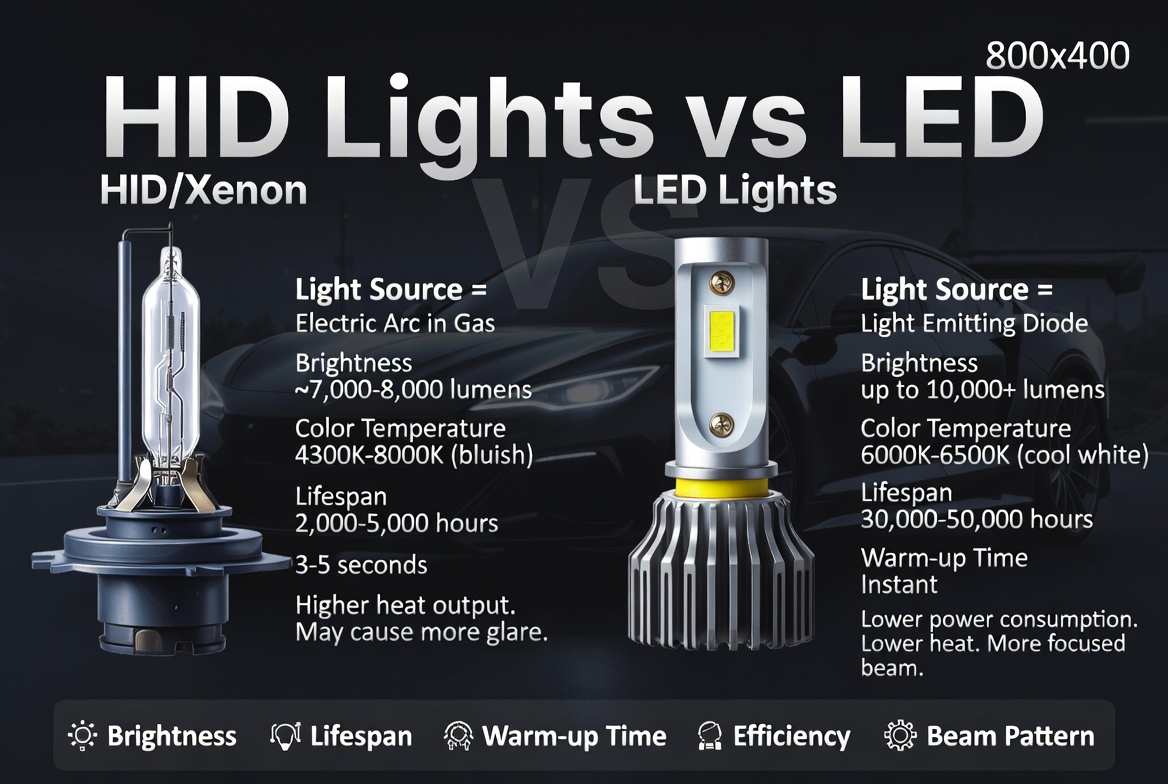
Quick Comparison Chart
Here’s a simple way to remember the main differences:
Brightness: HID very bright, LED very bright (modern versions)
Energy Use: HID high, LED low
Heat Output: HID very hot, LED cool
Lifespan: HID 2000-3000 hours, LED 25,000-100,000 hours
Cost Initially: HID low, LED high
Cost Long-Term: HID high, LED low
Warmup Time: HID slow, LED instant
Maintenance: HID regular, LED minimal
Environmental Impact: HID higher, LED lower
Final Thoughts
HID lights and LED lights both produce light, but they do it very differently. HID lights create light through an electrical arc. They’re bright, hot, and require more maintenance.
LED lights create light through semiconductor technology. They’re efficient, cool, and last a long time.
For most applications today, LED is the better choice. The energy savings alone justify the investment. The longer lifespan means fewer replacements. The instant startup and cool operation make them more practical.
If you’re still using HID lights, you don’t need to panic. They work fine. But when you need to replace them, consider switching to LED. The change is worth it.
The future of lighting is LED. It’s efficient. It’s reliable. It’s affordable. It’s the smart choice for anyone who cares about saving money and helping the environment.
And really, who doesn’t want to save money?