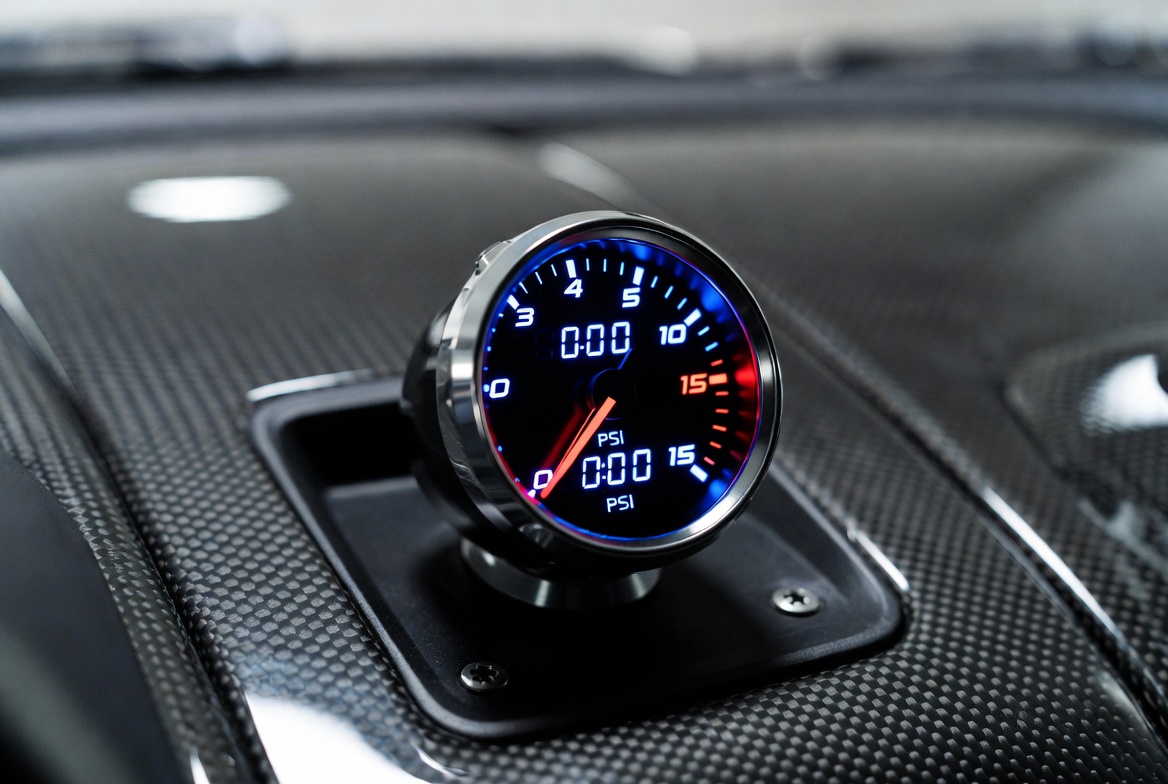
5 Best 0-15 PSI Boost Gauge In 2026
If you drive a turbo or supercharged vehicle, you already know that boost pressure is one of the most important numbers on your dash. Too little boost and your engine feels flat. Too much boost and you’re flirting with blown gaskets, melted pistons, or worse. That’s where a good boost gauge comes in. It gives you a clear, real-time window into what your turbo is actually doing under the hood.
A 0-15 PSI boost gauge is one of the most popular ranges out there because it covers most mild to moderately built turbo setups without wasting half the gauge face on numbers you’ll never touch. It’s simple, it’s readable, and for a huge chunk of daily-driven turbo cars, it’s exactly the range needed.
In this guide, we’re going to walk through five solid options that fall into or near this range, break down what makes each one tick, and help you figure out which one actually fits your build, your budget, and your dash. We’ll cover mechanical gauges from Auto Meter, a colorful electrical option from GlowShift, and a pressure gauge from SENCTRL that serves a slightly different purpose but still deserves a spot on this list for certain use cases.
By the end, you’ll have a clear picture of which gauge suits a track-focused build, which one works best for a daily driver, and which one might not be the right fit at all depending on what you’re trying to measure.
Let’s get into it.
Why a Boost Gauge Matters in the First Place
Before we jump into the reviews, it helps to slow down and talk about why this little gauge matters so much.
Your engine’s factory computer usually has some way to track boost internally, but it doesn’t always show you a live, easy-to-read number on the dash. Aftermarket boost gauges fill that gap. They sit right in your line of sight, usually mounted on the A-pillar, in a pod on the dash, or in a gauge pod near the steering column, and they give you instant feedback.
Here’s a simple way to think about it: your boost gauge is like a speedometer for your turbo. Without it, you’re driving blind, guessing whether your setup is running safe or running hot. With it, you can catch a boost spike before it turns into an expensive repair bill.
A gauge in the 0-15 PSI range works great for most bolt-on turbo setups, mild tunes, and stock-ish turbo systems. If your build pushes past 15 PSI regularly, you’ll want to look at a gauge with a higher ceiling, such as a 0-30 or 0-35 PSI unit. But for the average street car or light performance build, 15 PSI covers the bases nicely.
How We Picked These Gauges
We looked at a mix of factors that actually matter to real drivers, not just spec sheets. Here’s what we paid attention to:
- Accuracy and readability — can you glance at it while driving and get the number instantly?
- Build quality — is the housing solid, are the internals reliable, will it last?
- Ease of install — mechanical vs electrical, hose routing, wiring needs
- Value for money — does the price match what you’re getting?
- Real-world use cases — daily driver, weekend track car, or show car
- Brand reputation — long-term reliability based on how these brands are generally regarded in the automotive aftermarket space
With that out of the way, let’s break down each product one by one.
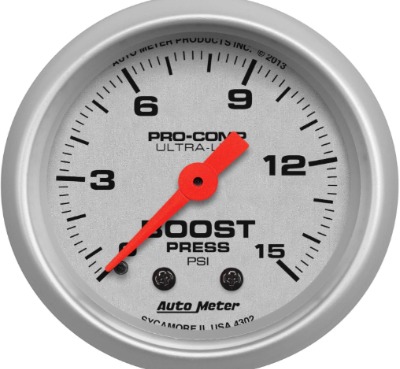
1. Auto Meter (4302) Ultra-Lite 2-1/16″ 0-15 PSI Mechanical Boost Gauge
Product Description
The Auto Meter Ultra-Lite 4302 is a mechanical boost gauge that reads from 0 to 15 PSI on a 2-1/16 inch face, which is the standard size for most aftermarket gauge pods. This one runs on a direct mechanical hose connection instead of electronics, meaning there’s no wiring involved for the reading itself, just a small hose that runs from your intake manifold or boost source straight to the back of the gauge.
The Ultra-Lite line is known for its silver dial face with black lettering, which gives it a clean, classic look that fits nicely with a lot of interior color schemes. It’s a no-nonsense gauge built for people who want a reliable reading without a bunch of extra bells and whistles.
Key Features Explained Simply
- Mechanical operation: Since it’s not electrical, there’s less to go wrong. Air pressure physically moves the needle, so what you see is a direct, real-time reaction.
- Full sweep electric lighting: Even though the reading itself is mechanical, the gauge still lights up at night thanks to an internal lighting setup, so visibility isn’t an issue after dark.
- Precision air-core movement: This keeps the needle steady and prevents it from bouncing around too much, even when your boost fluctuates quickly.
- Standard 2-1/16 inch size: Fits almost any universal gauge pod on the market, so mounting options are wide open.
Real-Life Usage Insight
This gauge tends to shine on daily-driven turbo cars where the owner wants a straightforward reading without worrying about wiring gremlins down the road. Since it’s mechanical, it holds up well over long stretches of driving and doesn’t rely on a sensor that could drift out of calibration over time.
One thing to keep in mind with any mechanical boost gauge is hose routing. The hose needs a clean path from the engine bay into the cabin, and it should avoid sharp bends that could kink the line. Once it’s routed properly, though, it tends to be a “set it and forget it” kind of install.
Pros
- Simple, reliable mechanical design with fewer points of failure
- Classic, clean dial face that looks good in most interiors
- Solid needle response with minimal jitter
- Backed by a brand with a long track record in the gauge market
- Standard size fits most universal pods
Cons
- Mechanical hose routing takes a bit more planning than a plug-and-play electrical gauge
- No peak-recall memory function on this particular model
- Silver face may not match darker or blacked-out interior themes as well as a black-faced gauge would
Performance Discussion
In terms of raw accuracy, mechanical gauges generally have a reputation for being extremely responsive since there’s no sensor lag or electrical conversion happening. The needle reacts almost instantly to pressure changes, which is a big plus if you’re watching for boost spikes on a spirited drive or a dyno pull.
Ease of Use
Reading the gauge is dead simple thanks to bold numbers and clear tick marks. The install does require a bit more mechanical know-how than an electrical gauge since you’re running a physical hose rather than a plug-and-play sensor wire, but most people with basic tools can handle it in an afternoon.
Value for Money
Given the reputation Auto Meter carries in the gauge world, this is a solid investment for someone who wants a long-lasting, accurate reading without chasing electronic upgrades later. It sits at a mid-range price point that reflects the quality of the internals.
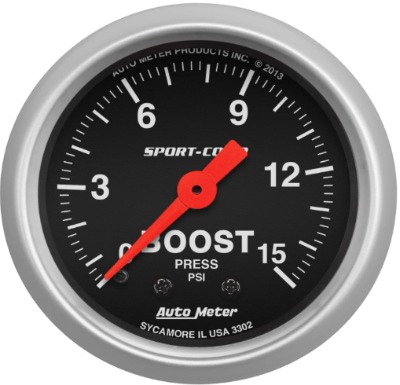
2. Auto Meter (3302) Sport Comp 2-1/16″ 0-15 PSI Mechanical Boost Gauge
Product Description
The Sport Comp 3302 is another mechanical boost gauge from Auto Meter, but it comes with a different look and finish compared to the Ultra-Lite. The Sport Comp line typically has a black dial face with white lettering, giving it a bolder, more aggressive appearance that a lot of performance-minded drivers gravitate toward.
Like the 4302, this one also uses a direct mechanical hose connection rather than an electrical sensor, so the operating principle is very similar. The main difference comes down to styling and, in some cases, small internal build variations.
Key Features Explained Simply
- Mechanical air-core movement: Same core tech as the Ultra-Lite, giving you fast, accurate needle response tied directly to pressure changes.
- Black face design: This tends to pop more visually and can be easier to read in bright daylight thanks to the contrast between the dark background and white numbers.
- Full sweep lighting: Nighttime visibility is handled through internal lighting so the gauge stays readable after sundown.
- Durable housing: Built with a sturdy case designed to handle vibration and daily wear from regular driving.
Real-Life Usage Insight
Drivers who want a more aggressive dash theme often lean toward the Sport Comp line because the black face pairs well with dark gauge pods, race seats, and blacked-out interior trim. Functionally, it performs almost identically to the Ultra-Lite since the internal mechanism is the same basic mechanical setup.
For someone building a car with a sportier or more track-oriented look, this gauge tends to blend in nicely without looking out of place next to other black-faced gauges like a tach or an air-fuel ratio meter.
Pros
- Bold black face is easy to read in strong sunlight
- Reliable mechanical movement with quick response time
- Matches well with other Sport Comp series gauges for a unified dash look
- Trusted brand reputation for long-term durability
- Standard 2-1/16 inch size for universal pod compatibility
Cons
- Still requires mechanical hose routing, which takes a little extra install time
- No digital memory or peak hold feature
- Black face might get too dark to read clearly in dim daylight without the internal light on
Performance Discussion
Performance-wise, this gauge behaves almost exactly like its Ultra-Lite sibling since they share the same mechanical foundation. You get quick, honest needle movement without any lag from electronic processing. For anyone who wants to watch boost in real time during a pull or a spirited drive, that immediacy really counts.
Ease of Use
The gauge face is bold and easy to glance at while driving thanks to the strong color contrast. Installation follows the same process as most mechanical gauges: run the hose, mount the gauge, wire up the lighting circuit, and you’re set.
Value for Money
This gauge lands in a similar price bracket as the Ultra-Lite, so the decision between the two often comes down to styling preference rather than performance differences. Either way, you’re getting a dependable mechanical unit from a well-known name in the gauge business.
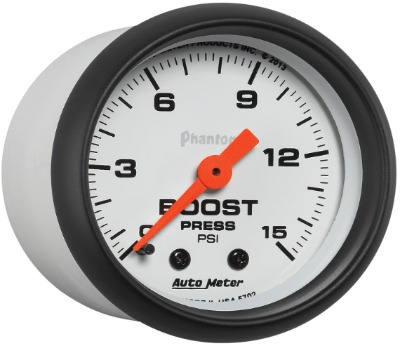
3. Auto Meter (5702) Phantom 2-1/16″ 0-15 PSI Mechanical Boost Gauge
Product Description
The Phantom series from Auto Meter takes a slightly different visual approach. It typically features a black face with a unique lighting effect and a more modern, sleek design compared to the traditional look of the Ultra-Lite or Sport Comp lines. It still runs on the same trusted mechanical operation, using a direct hose connection to physically move the needle based on actual pressure.
This line tends to appeal to drivers who want something a bit more stylish for their dash without stepping away from the reliability of a mechanical gauge.
Key Features Explained Simply
- Modern styling: The Phantom series has a distinct look with unique typography and a sleek bezel, setting it apart from more traditional gauge designs.
- Mechanical needle movement: Same trustworthy air-core mechanism found in the other Auto Meter mechanical gauges on this list.
- Digital stepper motor lighting on some Phantom models gives a smoother, more even glow at night compared to older lighting setups.
- Standard sizing: Fits the common 2-1/16 inch pod, keeping mounting simple and universal.
Real-Life Usage Insight
This gauge tends to appeal to people who care as much about how their dash looks as how it performs. Since the underlying mechanism is mechanical and proven, you’re not sacrificing accuracy for style here. It’s a good pick for someone building a clean, modern-looking cockpit while still wanting dependable, old-school mechanical reliability.
Pros
- Stylish, modern face design that stands out from more traditional gauges
- Reliable mechanical operation with fast needle response
- Smooth lighting at night for easy visibility
- Backed by a well-established gauge manufacturer
- Standard universal sizing for easy mounting
Cons
- Slightly pricier than the more basic Ultra-Lite or Sport Comp options in some cases
- Style-focused design may not appeal to drivers who prefer a more classic look
- Still requires mechanical hose routing for install
Performance Discussion
Functionally, this gauge performs on par with the other Auto Meter mechanical options on this list. The needle response is quick and honest since it’s driven directly by pressure rather than through an electronic sensor and processor. If you’re chasing precise, real-time feedback, this mechanical family of gauges consistently delivers.
Ease of Use
Reading the gauge is straightforward thanks to bold markings and good contrast, especially at night with the lighting turned on. Install steps mirror the other mechanical gauges: hose routing, mounting, and a simple lighting wire connection.
Value for Money
You’re paying a bit of a premium for the styling here compared to the more basic Auto Meter lines, but for someone who wants their gauge to double as a visual centerpiece on the dash, it’s a fair trade-off.
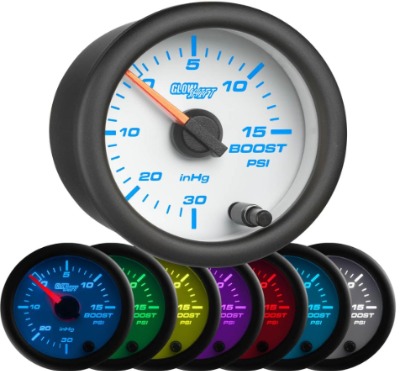
4. GlowShift White 7 Color 15 PSI Turbo Boost Vac Gauge Kit
Product Description
The GlowShift kit takes a totally different approach compared to the three Auto Meter gauges above. Instead of a single-color mechanical setup, this one is an electrical gauge with a white dial and a seven-color LED lighting system, meaning you can cycle through different colors to match your car’s interior theme or your mood. It reads boost as well as vacuum, giving you a slightly wider picture of what’s happening in your intake system, not just boost pressure alone.
This kit comes with everything needed for install, including the hose, a T-fitting, and wiring, which makes it a convenient all-in-one package for someone who doesn’t want to hunt down extra parts separately.
Key Features Explained Simply
- 7-color LED display: You can switch between colors like red, blue, green, and more, giving you flexibility to match your dash lighting theme.
- Boost and vacuum reading: This gauge shows both positive boost pressure and negative vacuum readings, which is handy for diagnosing vacuum leaks or partial throttle behavior, not just full boost situations.
- Complete kit: Comes with the mechanical hose, a T-fitting for splicing into your vacuum or boost line, and the wiring harness needed for the lighting, so you’re not stuck sourcing extra parts.
- Clear lens: Helps keep the white dial crisp and easy to read from a distance.
Real-Life Usage Insight
This gauge tends to be a favorite among people who want their dash to have some visual flair alongside solid function. Since it can display vacuum readings too, it’s genuinely useful for troubleshooting engine vacuum issues, not just watching boost numbers during a hard pull.
Because it comes as a full kit, installation tends to be simpler for beginners since most of the small parts are already included in the box. That said, since the lighting is electrical, you will need to run a wire back to a switched power source, which adds a small extra step compared to a purely mechanical gauge that only needs lighting power and not sensor power.
Pros
- Fun, customizable lighting with seven color options
- Reads both boost and vacuum, giving more diagnostic value
- Comes as a complete kit with hose, fitting, and wiring included
- Clean white dial with a clear lens for good daytime readability
- Budget-friendly compared to some premium gauge brands
Cons
- Some drivers report the color-cycling feature feels more like a novelty than a necessity
- Wiring for the lighting adds a bit more install complexity than a purely mechanical gauge
- Long-term durability reputation isn’t quite as established as legacy brands like Auto Meter
Performance Discussion
Since the pressure reading itself is still mechanical (the hose physically connects to the pressure source), the actual boost and vacuum readings tend to be responsive and reliable. The multi-color lighting is a separate electrical feature layered on top of that mechanical reading, so you’re not sacrificing accuracy for the fun lighting effects.
Ease of Use
The included kit makes this one of the easier gauges to install on this list since you’re not sourcing hoses or fittings separately. Reading the white dial is easy in daylight, and the LED lighting keeps it visible at night too.
Value for Money
This is one of the more affordable options in this roundup while still giving you a full kit and colorful customization. For someone on a budget who still wants boost and vacuum readings plus some style, it’s a strong value pick.
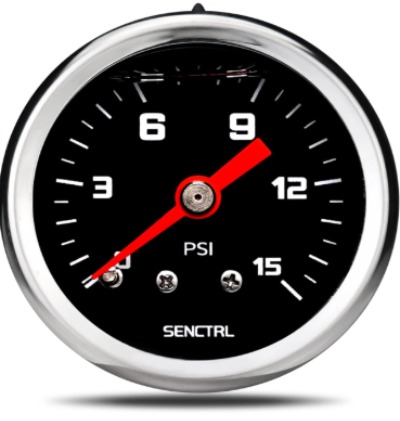
5. SENCTRL 0-15 PSI Fuel Pressure Gauge, 1-1/2″ Black Dial
Product Description
This one is a bit different from the rest of the list, and it’s worth being upfront about that. The SENCTRL gauge is marketed primarily as a fuel or liquid pressure gauge rather than a dedicated turbo boost gauge. It’s a smaller 1-1/2 inch gauge with a black dial, a 1/8 inch NPT back mount fitting, and it’s liquid filled with silicone oil to dampen needle vibration.
While it does read in the 0-15 PSI range, its main built purpose leans toward monitoring fuel pressure, oil pressure, or water pressure in smaller test setups rather than sitting on a car’s dash as a boost gauge for turbo monitoring.
Key Features Explained Simply
- Liquid-filled design: The silicone oil inside dampens needle vibration, which is great for keeping the reading steady in high-vibration environments like near a pump or compressor.
- Stainless steel case: Adds durability and resistance to corrosion, which matters a lot if it’s mounted somewhere exposed to moisture or engine bay grime.
- 1/8 inch NPT back mount: This threading style is common for direct inline mounting into test rigs, small equipment, or fuel systems.
- Compact 1-1/2 inch size: Much smaller than the standard 2-1/16 inch gauges used for dash-mounted boost monitoring.
Real-Life Usage Insight
Because of its small size and back-mount fitting, this gauge tends to work best for inline testing setups, small pressure test rigs, water pump monitoring, or a secondary fuel pressure check point rather than as your main dash-mounted boost gauge. If you’re building a test bench, checking a fuel system’s pressure, or working on a compressor rig, this gauge fits that role well.
If your goal is specifically to watch turbo boost pressure while driving, this isn’t the ideal pick since the small size and back-mount design aren’t built for dash visibility the way the Auto Meter or GlowShift options are.
Pros
- Liquid-filled design keeps the needle steady in vibration-heavy environments
- Stainless steel housing resists corrosion and rough conditions
- Compact size fits tight spaces where a big dash gauge wouldn’t
- Solid pick for fuel, oil, or water pressure testing tasks
- Simple, no-frills design that just works for its intended purpose
Cons
- Not designed as a dash-mounted turbo boost gauge, so it’s a poor match if that’s your main goal
- Small 1-1/2 inch face is harder to read from a driver’s seat at a glance
- Back-mount NPT fitting isn’t as beginner-friendly for dash pod installs as a front-mount gauge
Performance Discussion
For its intended purpose of monitoring fuel, oil, or water pressure in a test setup, this gauge performs reliably thanks to the liquid-filled dampening. It holds steady readings even with pump vibration nearby, which is exactly what you want in that kind of application.
Ease of Use
If you’re using it for its intended purpose, mounting is simple thanks to the back-mount threading. If you’re trying to force it into a dash-mounted turbo boost role, though, you’ll run into practical challenges with visibility and mounting style.
Value for Money
For fuel or fluid pressure testing, this is a solid, affordable option. Just don’t expect it to replace a proper dash boost gauge for turbo monitoring, since that’s simply not what it’s built for.
Comparison Insights
Let’s line these up side by side in plain terms.
Auto Meter Ultra-Lite (4302) is your classic, no-frills mechanical gauge with a silver face. Great for drivers who want proven reliability and a clean traditional look.
Auto Meter Sport Comp (3302) shares the same mechanical guts as the Ultra-Lite but wears a bold black face, making it a better match for darker interior themes and sportier builds.
Auto Meter Phantom (5702) steps up the styling game with a more modern face design and smooth lighting, while keeping the same trustworthy mechanical operation under the hood.
GlowShift 7 Color Kit breaks from the mechanical single-color mold with customizable LED lighting and dual boost/vacuum readings, all wrapped in a complete kit that’s friendly for first-time installers on a budget.
SENCTRL Fuel Pressure Gauge stands apart from the other four since it’s really built for fuel, oil, or water pressure testing rather than dash-mounted turbo boost monitoring. It’s a great tool for the right job, just not a direct swap for the others on this list if your goal is watching turbo boost while driving.
If you’re comparing purely on mechanical reliability and classic gauge feel, the three Auto Meter options lead the pack. If you want flair, color options, and a complete install kit at a friendlier price, GlowShift takes that spot. And if your actual need is fuel or fluid pressure testing rather than turbo boost, the SENCTRL is the right tool, just for a different job entirely.
Buying Guide: What to Look for in a 0-15 PSI Boost Gauge
Shopping for a boost gauge isn’t complicated once you know what actually matters. Here’s a rundown of the main things to think through before you buy.
1. Mechanical vs Electrical
Mechanical gauges use a direct hose connection to physically move the needle with real pressure. They tend to be simple, accurate, and don’t rely on a sensor or wiring for the reading itself. Electrical gauges use a pressure sensor and a wire to send that data to the gauge face, which can allow extra features like digital readouts, color-changing lighting, or peak recall. Both styles work well; it really comes down to personal preference and how much wiring work you want to take on.
2. Gauge Size
Most dash-mounted boost gauges come in the standard 2-1/16 inch size, which fits universal gauge pods sold for nearly every car on the road. Smaller gauges, like 1-1/2 inch units, are usually meant for test rigs or tighter mounting spots rather than a driver-facing dash pod.
3. Face Color and Lighting
This one’s mostly about personal taste and how well the gauge blends with the rest of your interior. Silver faces tend to look classic, black faces look bolder and pop more in daylight, and color-changing options like the GlowShift kit let you customize based on mood or interior theme.
4. Mounting Style
Front-mount gauges are the norm for dash pods since they’re built to sit facing the driver. Back-mount gauges, like the SENCTRL fuel gauge, thread in from behind and are more common in test setups or engine bay mounting where you’re not viewing them from a normal driving position.
5. Range Suitability
A 0-15 PSI range works great for mild bolt-on turbo setups and most stock-based turbo systems. If your build runs boost levels above that regularly, you’ll want to bump up to a gauge with a higher ceiling so you’re not pegging the needle constantly.
6. Install Complexity
Mechanical gauges need hose routing from the pressure source to the gauge, and that hose has to avoid sharp bends or pinch points. Electrical gauges need a sensor installed at the pressure source and a wire run back to the gauge, plus a power source for the lighting and display. Kits like the GlowShift one simplify this by bundling most of the needed parts together.
7. Budget
Set a realistic budget before shopping. Premium mechanical gauges from long-standing brands often cost a bit more but tend to hold their accuracy and build quality over the long run. Budget-friendly kits can still perform well, especially for casual driving and mild builds, but might not have quite the same reputation for long-term durability.
Who Should Buy These Products
Daily drivers with a mild turbo setup will likely be happiest with a classic mechanical gauge like the Ultra-Lite or Sport Comp. They’re simple, dependable, and don’t ask for much maintenance once installed.
Style-focused builds where the interior look matters as much as function should lean toward the Phantom or the GlowShift kit, since both bring a bit more visual flair to the dash.
Budget-conscious builders who still want a full kit with hose, fittings, and wiring included will likely find the GlowShift option to be the easiest entry point without needing to buy separate parts.
Anyone working on fuel systems, oil pressure checks, or a small test rig should look at the SENCTRL gauge instead of the boost-focused options, since it’s built specifically for that kind of fluid pressure monitoring rather than dash-mounted turbo watching.
Track day enthusiasts or spirited drivers who want instant, lag-free feedback should lean toward any of the mechanical Auto Meter options since the direct hose connection gives that immediate needle response during hard pulls.
Common Mistakes to Avoid
Mounting the gauge somewhere you can’t glance at quickly. A boost gauge only helps if you can read it fast without taking your eyes off the road for too long. A-pillar pods and dash-top pods near your normal line of sight tend to work best.
Kinking or pinching the mechanical hose. Sharp bends can restrict airflow to the gauge, causing slow or inaccurate readings. Route the hose with gentle curves and secure it along the way so it doesn’t rub against hot or moving parts.
Skipping a proper vacuum or boost source connection. Tapping into the wrong port on your intake manifold can give you a reading that doesn’t match reality. Always tap into a source that reflects true manifold pressure.
Ignoring wiring for lighting on electrical gauges. Even gauges with mechanical pressure readings, like the GlowShift kit, still need proper wiring for the lighting function. Skipping a fused, switched power source can lead to lighting issues or drained batteries over time.
Buying the wrong gauge for the job. As we saw with the SENCTRL gauge, not every 0-15 PSI gauge is meant for dash-mounted turbo boost watching. Always double check that the product is actually designed for the use case you have in mind before buying.
Forgetting about needle range headroom. If your build is likely to grow past 15 PSI down the road, it might make sense to start with a higher-range gauge from the beginning rather than swapping it out later.
Not securing the gauge pod properly. A loose or rattling gauge pod is annoying and can eventually damage the gauge itself. Take the time to mount it firmly so it stays steady while driving.
Final Verdict
All five products here serve a purpose, but they’re not all direct competitors, and that’s actually the most useful thing to understand before you buy.
If you want a classic, dependable mechanical boost gauge with a track record of reliability, any of the three Auto Meter options — the Ultra-Lite, Sport Comp, or Phantom — will serve you well. The choice between them mostly comes down to styling preference since all three share a similar mechanical foundation. The Ultra-Lite suits a clean, traditional look. The Sport Comp brings bold contrast for sportier interiors. The Phantom leans into modern styling for someone who wants their dash to look as sharp as their build performs.
If you’re after a more budget-friendly, all-in-one kit with some color customization and dual boost/vacuum functionality, the GlowShift option is a strong pick, especially for first-time installers who want everything included in one box.
And if your actual need is fuel, oil, or water pressure monitoring rather than dash-mounted turbo boost watching, the SENCTRL gauge fits that specific job well, just remember it’s not a stand-in for a proper boost gauge on your dash.
At the end of the day, the best gauge for you comes down to matching the product’s actual purpose with your actual goal. Get that match right, and any of these five will do exactly what you need them to do.