How to Know If a Fuse Is Bad?
Fuses are small but mighty. They protect your electrical devices and circuits from getting fried. When something goes wrong with your home’s power or a device stops working, a blown fuse might be the culprit. The good news? You can learn to spot a bad fuse yourself. No special tools needed. No expensive electrician required.
In this guide, I’ll walk you through everything you need to know about recognizing a faulty fuse.
What Is a Fuse Anyway?
Let’s start with the basics. A fuse is a safety device. Think of it like a tiny bodyguard for your electrical system. When electricity flows through at an unsafe level, the fuse breaks the circuit. It stops the power from flowing. This protects your wiring and devices from damage.
Fuses are simple. They contain a thin wire made of metal. When too much electricity tries to pass through, that wire heats up and melts. Once it melts, it breaks the circuit. No more power flows through.
Different fuses handle different amounts of electricity. A fuse rated for 15 amps can only handle 15 amps of current. A 20-amp fuse handles 20 amps. This rating tells you how much power that fuse is designed to protect.
Where You’ll Find Fuses
Fuses show up in many places. Your house probably has a fuse box. Cars have them too. Old electronics often use them. Even extension cords sometimes have tiny fuses built in.
In homes, fuses live in the main electrical panel, usually in the basement or on the side of the house. Your car’s fuses hide under the dashboard or under the hood. Older appliances like TVs and refrigerators might have them inside.
Signs Your Fuse Has Gone Bad
A bad fuse sends out warning signals. Watch for these clues.
The Power Goes Out
The most obvious sign is a power failure. Lights go dark. Outlets stop working. An appliance shuts off suddenly. If an entire room loses power but the rest of your house works fine, a blown fuse is the likely cause.
A Burning Smell
Do you smell something scorched or burnt? That’s a red flag. A fuse that’s overheating or melting gives off a distinct burnt smell. If you smell this near your fuse box, that’s your signal to check things out.
A Tripped Breaker or Missing Fuse
In older homes with fuse boxes, you might notice a fuse is completely gone or pulled out. Newer homes use circuit breakers, which flip to the off position when something goes wrong. If a breaker keeps switching off, or if a fuse socket is empty, that’s a problem.
Flickering Lights
Lights that flicker on and off tell you something’s unstable. A failing fuse can cause this. The fuse might be on its way out. It’s not totally dead yet, but it’s dying.
Buzzing or Humming Sounds
Hear strange noises from your fuse box? A buzzing or humming sound near your electrical panel suggests trouble. A fuse might be struggling to handle the current flowing through it.
Scorch Marks
Look at the actual fuse. Do you see blackened spots or scorch marks? These burn marks appear when the fuse has blown or overheated. Black discoloration on a fuse means it’s done its job and sacrificed itself to protect your circuit.
How to Check if a Fuse Is Bad
Now that you know what signs to look for, let’s talk about how to actually examine a fuse.
Step One: Turn Off the Power
Safety comes first. Before you touch anything in your fuse box, flip the main breaker to the off position. This cuts all power to the panel. You won’t get shocked this way.
If your house uses an older fuse system and you can’t find a main breaker, turn off power to the whole house at the meter. Better safe than sorry.
Step Two: Locate Your Fuse Box
Find where your fuses live. In houses, it’s usually in the basement, a utility closet, or a garage. Look at any wall that faces the outside of the building. The panel will be a gray or metal box. It might have a door you need to open.
Step Three: Look for a Blown Fuse
Once you find the box, open it and take a look inside. You’re hunting for a fuse that looks different from the others.
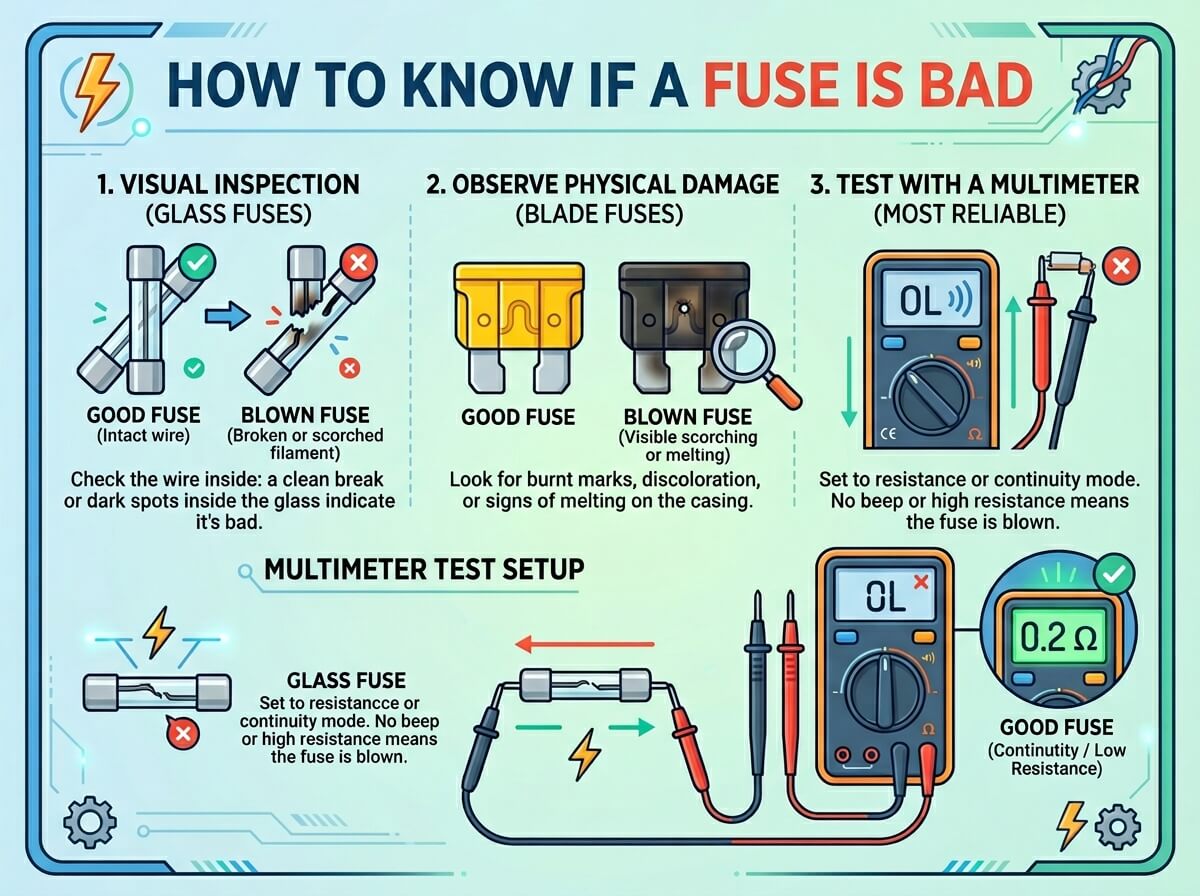
A good fuse looks clean. The glass or plastic top is clear. You can see the thin metal wire inside, and it’s intact and unbroken.
A blown fuse looks damaged. The wire inside is broken or melted. The glass might be cloudy or filled with dark powder. There might be scorch marks on the top or sides.
Step Four: Check the Wire
The metal wire inside is key. In a good fuse, this wire runs straight from one end to the other. It’s shiny and complete.
In a blown fuse, the wire is gone. You see a gap where it was. Sometimes the wire is still there but burnt and blackened. Sometimes it’s completely vaporized.
This is the easiest way to tell if a fuse is bad. Just look at that wire. If it’s broken or missing, the fuse has blown.
Step Five: Inspect for Discoloration
A good fuse is clean. A bad fuse shows damage. Look for:
- Black or dark spots on the inside glass or plastic
- Cloudiness or haziness inside the fuse
- Scorch marks on the outside or top
- A loose metal piece rattling inside
All of these signs point to a fuse that’s failed.
Different Types of Fuses
Fuses come in different styles. You should know the main types.
Plug Fuses
These are old-school. They screw in like a lightbulb. You’ll find them in older houses. They have a threaded base and a clear top. The wire inside is easy to see. If it’s broken, the fuse is bad.
Cartridge Fuses
These look like little cylinders. They slide in and out of their holders instead of screwing. You see them in older electrical panels and sometimes in cars. These are less obvious to inspect because the wire is hidden inside a metal tube.
Blade Fuses
Cars use these a lot. They look like tiny plastic rectangles with two prongs. You pull them straight out. Looking at them is easy because you can see right through the plastic top. The wire inside is visible.
Glass Fuses
These look like tiny glass tubes with metal caps on each end. The wire inside is easy to spot. These are common in electronics and some older homes.
Why Fuses Blow in the First Place
Understanding why a fuse blows helps you prevent future problems.
Too Much Current
This is the most common reason. When a circuit demands more power than it’s designed for, the fuse blows. Plugging too many devices into one outlet can do this. An overloaded circuit makes the wire inside the fuse heat up and melt.
A Short Circuit
Sometimes wires touch each other when they shouldn’t. This creates a shortcut for electricity. A massive amount of current flows instantly. The fuse blows fast to stop damage. A short circuit often happens because of damaged wires or faulty appliances.
An Aging Fuse
Fuses don’t last forever. Over time, the metal wire inside gets weaker. Temperature changes stress it. Eventually, it breaks. Old fuses just give up.
Wrong Fuse Rating
Never use a fuse with a higher rating than the circuit needs. If a circuit has a 15-amp fuse but you replace it with a 20-amp fuse, you’ve created a fire hazard. The higher-rated fuse might not blow even when the circuit is overloaded. This lets too much electricity flow and causes dangerous heat.
Environmental Factors
Humidity, heat, and cold all affect fuses. Extreme temperatures can cause the metal wire to become brittle. Moisture can damage the internal components. If your fuse box is in a damp basement, fuses might fail sooner.
The Difference Between a Bad Fuse and a Bad Circuit Breaker
Modern homes use circuit breakers instead of fuses. These devices work differently, and they show problems differently.
A circuit breaker flips to the off position when there’s trouble. You can flip it back on. But if the same breaker keeps tripping, something’s wrong. Maybe there’s a short circuit. Maybe the circuit is overloaded. Maybe the breaker itself is failing.
A fuse, on the other hand, dies completely. Once blown, it’s dead. You have to replace it with a new one.
If your circuit breaker flips constantly, it’s trying to tell you something’s wrong. Don’t ignore it. It’s doing its job, protecting your home. But you need to find the real problem. Is something plugged in that shouldn’t be? Is there a damaged wire? Call an electrician if you can’t figure it out.
Testing a Fuse (For the Brave)
If you want to test a fuse to be absolutely sure it’s bad, you have a couple of options. But remember, safety matters. If you’re not comfortable with electricity, skip this and ask a professional.
The Visual Test
This is the safest test. Just look at the fuse. Turn off the power. Pull out the fuse. Hold it up to the light. Is the wire broken? Is there discoloration? Black marks? If you answer yes to any of these, the fuse is bad.
The Continuity Test
This requires a multimeter. A multimeter is a device that measures electrical properties. Set it to the continuity setting. Touch the probes to the two ends of the fuse. If the multimeter beeps, the fuse is good. If it doesn’t beep, the fuse is blown.
The Replacement Test
The simplest test is just to replace the fuse. Put a new one in. If the lights come back on and everything works, the old fuse was bad. If the new fuse blows immediately, you have a different problem. Don’t keep replacing fuses. That’s a sign something else is wrong.
What to Do When You Find a Bad Fuse
Once you’ve confirmed the fuse is bad, it’s time to replace it.
Gather Your Materials
You’ll need a replacement fuse. Make sure it has the same rating as the one you’re replacing. Check the amp rating. Check the voltage rating. Check the type and size.
Turn Off the Power
Before you touch anything, switch off the main breaker. Safety first, always.
Remove the Bad Fuse
For plug fuses, unscrew them. Turn them left like you’re opening a jar. For cartridge fuses, pull them straight out. For blade fuses, grab them and pull them out of their slots.
Install the New Fuse
For plug fuses, screw the new one in. Don’t force it. For cartridge and blade fuses, line them up and push them in. They should fit snugly.
Restore Power
Turn the main breaker back on. Check if everything works. If it does, great! If not, you might have another problem.
When It’s Time to Call a Professional
Some situations call for expert help. Don’t be stubborn about this.
Call an electrician if:
- You see scorch marks or burn damage in your fuse box
- Fuses keep blowing repeatedly
- You smell burnt plastic or wire
- You’re not comfortable working near electrical panels
- You have multiple blown fuses
- Lights keep flickering after you replace a fuse
- You’re not sure what type of fuse you need
- Your fuse box looks old or damaged
A good electrician can find the real cause of the problem. They can fix underlying issues. They have the training and tools to work safely.
Prevention Tips
The best fuse is one that never blows. Here’s how to prevent problems.
Don’t Overload Circuits
Don’t plug too many devices into one outlet. Spread the load. Use different outlets in different rooms.
Fix Damaged Wires Immediately
If you see frayed or damaged wires, that’s a fire hazard. Don’t use that device. Replace the cord or throw it away.
Keep Your Fuse Box Dry
Make sure your electrical panel isn’t in a damp area. Water and electricity don’t mix. If moisture is a problem, consider moving the panel or improving ventilation.
Maintain Your Appliances
Broken appliances draw too much power. Fix them or replace them. Don’t keep using something that’s clearly damaged.
Use the Right Fuse Rating
Never use a fuse with a higher amp rating than the circuit requires. This defeats the protection the fuse provides.
Have Older Systems Inspected
If your home has an old fuse box, have an electrician check it out. Old systems might need upgrading.
Common Myths About Fuses
Let’s clear up some confusion.
Myth: You can use a higher-rated fuse if lower ones keep blowing.
False. If a fuse keeps blowing, something is wrong. A higher-rated fuse won’t solve the problem. It makes it worse. Higher-rated fuses might not blow even when they should. This creates a fire risk.
Myth: Fuses last forever.
False. Fuses age. They weaken over time. Eventually, they fail. This is normal.
Myth: All fuses are the same.
False. Fuses come in different sizes, shapes, and amp ratings. You need the right fuse for your circuit.
Myth: It’s okay to replace a fuse with anything.
False. You need the correct replacement. Wrong fuses cause problems.
Myth: Blown fuses mean your wiring is fine.
False. A blown fuse can mean your wiring is overloaded. It can mean there’s a short circuit. Find the real cause.
Summary
A bad fuse shows itself in clear ways. Blown fuses are a safety feature, not just an inconvenience. They protect your home from electrical fires and damage.
You can learn to spot a bad fuse by:
- Looking for a broken wire inside the fuse
- Checking for scorch marks or discoloration
- Noticing power outages in specific circuits
- Smelling burnt plastic or wire
- Seeing flickering lights
- Hearing buzzing sounds from the electrical panel
When you find a bad fuse, replace it with one that has the same rating. But if fuses keep blowing, that’s a sign of a deeper problem. Don’t ignore it. Call an electrician.
Taking care of your electrical system keeps your home safe. A little knowledge about fuses goes a long way. You don’t need to be an expert electrician to understand the basics. You just need to pay attention to the signs your home gives you.
Stay safe. Check your fuses. And when in doubt, ask a professional. Your home and family are worth it.