How to Bypass a Starter Solenoid?
Let’s start simple. Your car’s engine won’t crank by itself. You need something to get it going, right? That’s where the starter solenoid comes in.
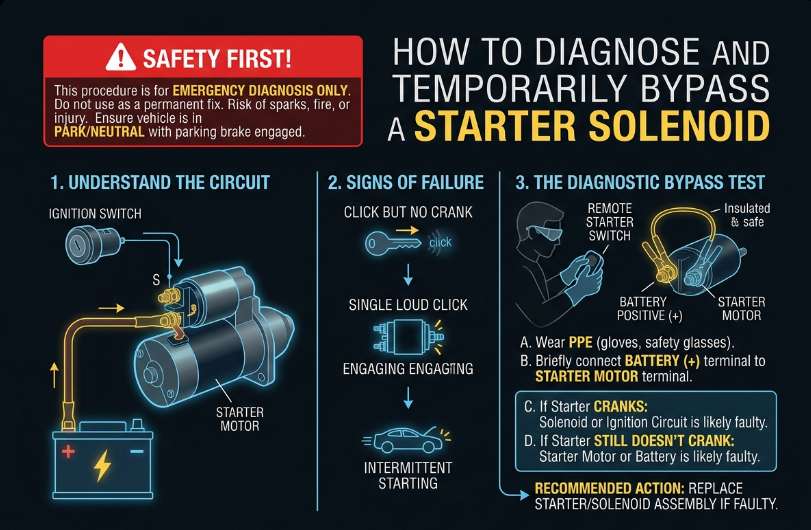
Think of the starter solenoid as a relay switch. When you turn your key in the ignition, it sends a small electrical signal. The solenoid picks up that signal and engages the starter motor. The starter motor then spins your engine, which gets it running.
A starter solenoid is basically an electromagnet that controls power flow. It sits between your battery and your starter motor. When voltage hits it, it closes a switch that lets battery power flow to the starter. Pretty clever, isn’t it?
The solenoid does two jobs at once. It moves a plunger that engages the starter gear. At the same time, it closes electrical contacts that send power to the starter motor. Both actions happen together.
Why Would You Need to Bypass One?
Okay, so when does the solenoid go bad? Several things can happen.
The solenoid might get stuck. This means it won’t engage or disengage properly. Your engine cranks constantly, even when you release the key. Or the opposite happens—the engine won’t crank at all.
Sometimes the contacts inside burn up. When that happens, electricity can’t flow through it anymore. Your starter won’t work, but it’s not the starter’s fault. The solenoid is blocking power.
Water damage happens too. If your car sits in moisture for a long time, rust builds up inside the solenoid. Corrosion eats away at the connections.
Other times, the solenoid’s coil burns out. This is the electromagnet part. If it fails, you lose all magnetic force, and the plunger won’t move.
So what do you do? You could replace the whole thing. That costs money and takes time. Or you can bypass it.
Bypassing the solenoid means you skip it entirely. You send power directly from the battery to the starter motor. This is a temporary fix, but it works.
Safety First: What You Need to Know
Before you touch anything, let’s talk safety. Your car’s electrical system carries real power. The battery alone can deliver hundreds of amps. That’s dangerous.
Here’s what you need to do:
Disconnect the battery first. Always. Unplug the negative cable from the negative terminal. This stops all electrical flow. Wait a few minutes for the system to discharge completely.
Wear safety glasses. Sparks can happen. Your eyes matter more than your car.
Use insulated tools. Metal wrenches can create short circuits. Get tools with rubber handles.
Don’t work in wet conditions. Wet hands plus electricity equals bad news.
Keep the engine off. Don’t try this with the engine running or even warm.
Have someone else present. Never work alone on electrical stuff.
Know where your fire extinguisher is. It should be close by.
Take pictures before you start. Use your phone to photograph how wires connect. This saves you later.
These rules aren’t suggestions. They’re keeping you alive and keeping your car safe.
Tools You’ll Need
You don’t need much to bypass a solenoid. Here’s what to gather before you start:
Socket set or wrench set – You need various sizes. The solenoid bolts come in different sizes.
Screwdrivers – Both flathead and Phillips work best. Some wire connections use screws.
Wire strippers – These cut through insulation without damaging the wire underneath. They’re cheap and essential.
Wire crimpers – You’ll attach new connections. Crimpers squeeze connectors onto wires.
Electrical connectors – Get various sizes. You need something to connect wires safely.
Insulated wire – Get wire that matches your car’s thickness. Bigger is safer than smaller.
Electrical tape – This wraps around connections for extra safety.
A multimeter – This checks if power flows where it should. They cost thirty bucks or less.
Work gloves – Leather gloves protect your hands from sharp edges and burns.
A creeper or floor jack – You might need to get under the car. Stay safe.
A flashlight or headlamp – Under the hood is dark. See what you’re doing.
A notebook and pen – Write down wire colors and connections. Your memory will fail you.
Don’t cheap out on tools. Buy quality equipment that lasts. Your safety depends on it.
Finding Your Starter Solenoid
Now let’s locate this thing. Where does the solenoid live?
On most cars, the solenoid mounts right on top of the starter motor. It’s usually under the hood, bolted to the engine block or transmission. Look near the front of the engine, down low.
If you can’t find it, check your owner’s manual. Your car’s manual has a diagram showing everything. It’s the best resource you have.
The solenoid is typically a cylinder about four to six inches long. It’s black or gray. Wires connect to it on top. You’ll see at least three wire connections.
Some cars hide the solenoid in a different spot. On rear-wheel-drive vehicles, it might be on the side of the starter. On front-wheel-drive cars, look on the passenger side of the engine bay.
Here’s a tip: Start with the battery. All power comes from there. Trace the large red wire going from your positive battery terminal. It usually goes to the solenoid first, then to the starter. Follow that wire and you’ll find your solenoid.
Take your time. Getting lost under the hood is normal. Be patient.
Understanding the Solenoid’s Wiring
Before you touch anything, know what those wires do.
The large red wire comes from the positive battery terminal. This carries heavy current. It’s thick and red. This wire powers the starter motor when the solenoid engages.
The thin red or brown wire comes from your ignition switch. When you turn the key, this sends a small signal to the solenoid. It tells the solenoid to close.
The ground wire is black or brown. It returns power to the battery’s negative side. Every electrical circuit needs a ground.
Sometimes there’s a second large wire. This goes directly to the starter motor. It carries the power that spins the engine.
The trick to bypassing is this: You want to skip the solenoid’s signal wire. You’ll connect the battery directly to the starter instead.
Write down which wire is which. Take pictures. Mark them with tape. Use different colored tape for different wires. Red for the battery wire, yellow for the signal wire, black for ground.
The Bypass Method: Step by Step
Alright, here we go. This is the actual process.
Step One: Prepare Your Workspace
Disconnect the battery’s negative cable. Use a socket wrench. Turn it counterclockwise. Let the cable rest away from the terminal. Don’t let it touch metal.
Wait five minutes. This lets all power drain.
Clean the area around the solenoid. Use a wire brush to remove dirt and corrosion. You need clear access to everything.
Step Two: Identify and Label the Wires
Look at the solenoid. You should see three wires at the top.
Take your phone and photograph these wires. Get close. Make sure you can see the colors clearly.
Now label them. Use small pieces of tape. Write on the tape with a marker. Put the tape next to each wire. Write what that wire does: “Battery,” “Ignition,” “Ground.”
Step Three: Disconnect the Wires
Use your socket wrench or screwdriver. Start with the thin wire from the ignition switch. This one is safe. It carries no real power.
Turn it counterclockwise or unscrew it. Set it aside.
Next, disconnect the black ground wire. Same process.
Finally, disconnect the large red battery wire. This is the important one. Be careful. This wire is hot. If it touches metal while the battery is connected, it’ll spark. That’s why you already disconnected the negative cable.
Put those wires somewhere they won’t fall on the engine. Tape them back if needed.
Step Four: Remove the Solenoid
Find the bolts holding the solenoid to the engine or starter. There are usually two or three.
Use your socket wrench. Turn them counterclockwise. They come right out.
Slide the solenoid away from the starter. Some solenoids twist off. Others slide straight out. Go slow and steady.
You’ve now removed the solenoid from the circuit. Congratulations.
Step Five: Run the Bypass Wire
Get a piece of insulated wire. Thick wire works best. It should handle the current the starter needs.
Strip about half an inch of insulation from both ends. Use your wire stripper.
Crimp a connector onto each end. Use your crimper tool. Make sure it’s tight. Test it by pulling on the connector. If it slides off, it wasn’t crimped properly. Do it again.
Step Six: Connect the Bypass
This is where you connect power straight to the starter.
Take the large red wire that came from the battery. This still connects to the battery positive terminal under the hood. It’s your power source.
Attach the crimped end of your new bypass wire to this battery wire. Use a connector that fits both wires. Crimp them together. Use electrical tape to wrap it up.
Now take the other end of your bypass wire. It goes directly to the starter motor’s terminal. This is usually a large stud on top of the starter.
Crimp another connector onto it. Attach it to the starter terminal. Tighten it down.
Double-check every connection. Pull on each one. They should be solid.
Step Seven: Test the Ground
Make sure the starter motor has a good ground connection. Use your multimeter.
Set it to check for continuity. Touch one probe to the starter body. Touch the other to the negative battery terminal (the one you disconnected).
You should get a reading showing good connection. If not, the ground is bad. Add a ground wire from the starter to the battery’s negative terminal.
Step Eight: Reconnect the Battery
Slide the negative cable back onto the negative battery terminal. Tighten the clamp. Make sure it’s snug.
Step Nine: Test Your Work
Don’t start the car yet. Test the solenoid bypass.
Turn on the ignition but don’t turn the key all the way. The dashboard lights up but the engine doesn’t crank.
This is normal. The ignition switch no longer controls the solenoid because there is no solenoid.
Now here’s the issue: Without a solenoid, how do you start the car?
You’ll use a remote switch or a manual switch instead.
Installing a Remote Bypass Switch
Since you removed the solenoid’s control signal, you need a new way to trigger the starter.
The solution is a remote switch. This is a simple relay or push button.
Getting the Switch
Buy a starter interrupt relay from any auto parts store. These cost ten to twenty dollars. They’re designed for exactly this job.
Or get a simple push button switch. The kind that toggles on and off. Nothing fancy.
Installing It
The thin ignition signal wire still connects to the solenoid spot. You now need to make it control your bypass relay instead.
Run the ignition signal wire to your relay. Connect it to the relay’s input. This tells the relay when to send power.
The relay’s output connects to the bypass wire you just ran. When the relay gets the signal, it closes a connection that sends power down your bypass wire to the starter.
This all sounds complex, but it’s not. The relay does one thing: It waits for a signal, then it sends power. That’s it.
Using the Remote Switch
If you installed a push button switch instead, here’s how it works:
Connect the push button to your bypass wire. Route the wire into your car’s cabin through the firewall.
Now when you want to start the engine, turn the ignition to the run position. Then push the button under your dash.
The button sends power down your bypass wire. This spins the starter motor. The engine cranks.
Release the button once the engine fires up.
This method works, but it’s inconvenient. You’ll get used to it.
What About the Original Signal Wire?
Remember that thin ignition wire? What do you do with it now?
You have a few options.
Option One: Remove It
Just disconnect it from the solenoid area. Wrap the end with electrical tape. Coil it up somewhere safe. It won’t hurt anything sitting unused.
Option Two: Use It
Connect it to your relay or switch. This keeps the original ignition switch working. When you turn the key, it triggers your new relay, which then sends power to the starter.
This is the cleaner solution. Your car still works like it’s supposed to. The ignition switch still controls everything.
Option Three: Modify It
Some people get creative. They run the signal wire to a hidden switch. This gives them a secret way to start the car. It’s like an anti-theft device.
Pick whatever option makes sense for your situation.
Troubleshooting Your Bypass
Stuff goes wrong. That’s life. Here’s how to fix common problems.
The Starter Won’t Engage
Check your connections. Use the multimeter. Test for power at the starter terminal.
If there’s no power, your bypass wire has a break. Trace it from the battery to the starter. Find the break. Strip both ends. Crimp a new connector onto them. Connect them together. Test again.
If power is there but the starter doesn’t turn, the starter itself is dead. That’s a different problem.
The Starter Keeps Spinning
This happens when your relay or switch gets stuck. It keeps sending power even after you release the button.
Get a better relay. The one you have is defective. Buy a new one. Install it.
Or if you’re using a mechanical switch, make sure it’s a momentary switch, not a maintained switch. Momentary only sends power while you hold the button. Maintained keeps sending power until you press it again. You need momentary.
Sparks Happen
Sparks mean a short circuit. Stop immediately. Disconnect the battery.
Look for bare wires touching metal. Find the problem. Fix it by wrapping wires with electrical tape or repositioning them.
Check all your crimped connections. If any are loose, redo them.
The Battery Dies Quickly
Your bypass wire is draining power when the engine is off.
This happens if your switch or relay doesn’t have a good off position. Current is leaking through somehow.
Replace the switch or relay. Get one designed for this job. It should have a solid off position that blocks all current flow.
Important Limitations to Know
Bypassing a solenoid works, but it’s not perfect. Understand these limits.
You Lose Starter Protection
The solenoid has a built-in safety feature. It prevents power from flowing to the starter except when needed. Without it, you could accidentally engage the starter while the engine is running. This causes serious damage.
Be careful. Only activate your switch or relay when you want to start. Never touch it while the engine runs.
You Lose Engine Cutoff
When the engine starts, it spins the starter gear. That gear meshes with a ring gear on the engine. Once the engine fires up, it spins faster than the starter. A solenoid has a feature that disengages the starter at this point. It prevents damage.
Without a solenoid, the starter stays engaged. If the engine spins up before you release your switch, bad things happen.
Watch for the engine to start. Release your switch or button immediately. Don’t hold it.
No Reverse Function
The solenoid can engage and disengage. Your bypass can’t. Once power flows, it flows until you cut it.
This is fine for starting. Just understand the difference.
Heat Buildup
The bypass wire carries heavy current. It gets hot. The insulation melts if it gets too hot.
Space your wire away from hot engine parts. Don’t let it touch the manifold or radiator. Route it carefully.
Add insulation if needed. Wrap it with heat-resistant tape. Keep it safe.
When to Replace Instead of Bypass
Sometimes bypassing isn’t the best answer. Consider replacement if:
You drive the car daily. Bypassing is inconvenient for regular use. A new solenoid is worth it.
Your warranty is still valid. Bypassing might void it. Replacement keeps you covered.
You plan to keep the car for years. A proper fix is smarter than a temporary hack.
You’re not comfortable with electrical work. Get a professional to replace it. They do it right.
You can’t afford to do it wrong. If you mess up the bypass, the car won’t start. A mechanic can fix it. Do you want that expense?
A new solenoid costs maybe one hundred to three hundred dollars. Labor adds another hour or two. It’s not cheap, but it’s permanent.
Regular Maintenance to Prevent Solenoid Problems
You can keep your solenoid alive longer. Here’s how.
Keep Moisture Out
Store your car in a dry place. Use a car cover if it’s outside. Keep water away from the engine bay.
Clean Corrosion
Every season, inspect your battery terminals and solenoid connections. Wipe away any white or blue crusty stuff. Use a wire brush and some baking soda mixed with water.
Check Connections
Make sure all wires stay tight. Vibration loosens connections. Loose connections corrode.
Use Quality Fuel
Bad fuel creates varnish in your fuel system. This stresses every component, including the solenoid’s electrical system.
Drive Regularly
Cars that sit unused develop electrical problems. Drive yours at least weekly. Charge the battery fully.
Protect from Damage
Don’t slam things into the solenoid area. Don’t spill fluids on it. Accidents happen fast. Prevention is simple.
Conclusion: You Can Do This
Bypassing a starter solenoid seems intimidating. But you’ve read this guide. You know it’s just wiring.
You’re connecting a wire from the battery to the starter. You’re using a switch to control the power. That’s literally all you’re doing.
Take your time. Label everything. Take pictures. Ask questions. There’s no shame in needing help.
Your solenoid might be dead. Your car might not start. But now you know what to do.
Do the work yourself and save money. Feel proud when your engine cranks to life. You fixed it.
Or hire a professional. There’s no wrong choice. Either way, you now understand what happened and why.
Your car’s electrical system isn’t magic. It’s just switches and wires and power. You’ve got this.
Stay safe. Keep learning. Keep driving.

Peterson is an automotive enthusiast and auto parts reviewer with a passion for vehicle maintenance, upgrades, and performance. He enjoys researching and testing car parts, tools, and accessories to help drivers make informed buying decisions. Through AutoPartsTalk.com, Peterson shares honest reviews, practical maintenance tips, and expert guides to keep vehicles running safely and efficiently.