5 Best Scratch Remover For Black Cars In 2026
As an Amazon Associate we earn from qualifying purchases.
Black cars show scratches and swirl marks more clearly than most other colors. This guide helps beginners who want to find the best scratch remover for black cars without wading through jargon. It covers five products that are sold for dark paint repair, from a small touch-up pen to a full polishing kit with a towel.
The five products share a common goal: making light scratches, swirls and dull paint look better. They differ in how they work, how much effort they need and what kind of damage they handle. The comparison below rests on the listed features and typical use of each product, not on personal testing.
Before you buy anything, it helps to know what kind of mark you are dealing with. A scratch that catches your fingernail usually goes through the clear coat and may need filling. A light haze or spiderweb pattern that only shows in sunlight is usually a swirl mark, which polishing can often reduce. Matching the product to the damage saves money and avoids disappointment.



1. Black Touch Up Paint: best for small chips and narrow scratches
This product is a black touch-up paint pen made for small areas of damage. It suits car owners who have a few narrow scratches or small paint chips and want to fill them rather than polish them. It is a paint product, not a polish, so it works differently from the other four options in this list.
How it works in practice
The pen has a metal tip for small chips and a brush for larger scratches. The product description says to clean the area, remove loose paint, shake for 30 seconds and apply in one direction. For deeper marks, you add layers until the scratch is filled.
Washing and drying the area first is worth the extra minute. Dirt or wax left under the paint can stop it from bonding well. Thin layers applied with light, even strokes usually look better than one thick blob.
Key features in plain words
The listing says the paint is thick enough for a smooth, glossy finish and that it is waterproof and UV-resistant. It also says the color is matched to the original paint, and that it matches 90% of black cars. The listing says it can be used on other surfaces too, including motorcycles and bicycles.
A match rate of 90% means that some black cars may have a shade that does not line up perfectly. Check your car’s paint code, usually found on a door-jamb sticker, before you buy. That helps you judge if the listed color is likely to suit your vehicle.
Daily use and drying time
Most buyers will use this product on one or two spots at a time, since it is meant for small jobs. The listing says it dries in about 10 minutes, so you can drive the car soon after. Because it is a fill product, the repaired spot may look slightly different from the rest of the paint in strong sunlight.
Keep the pen somewhere cool and sealed between uses. Paint that thickens in the bottle can make smooth strokes harder to achieve. Shake it again before each session to keep the consistency even.
Ease of use and value
The steps are simple, and a beginner can follow them without training. Taking care with the layers and the even strokes matters most for a clean result. At the listed price, it is one of the lower-cost options here, which makes it a useful choice for filling isolated chips.
Patience is the main skill. Rushing to add another layer before the last one has set can leave bumps. Waiting for each coat to dry gives you a flatter, more even fill.
Pros
- Low price for a targeted repair
- Simple steps with a fast drying time
- Works on small chips and narrow scratches
- Listed as waterproof and UV-resistant
Cons
- Fills scratches rather than polishing paint, so it does not address swirls
- Repairs may be visible in direct light on some spots
- Works best on small areas, not whole panels
- Color match is stated to suit 90% of black cars, so a perfect match is not guaranteed
2. Turtle Wax Hybrid Solutions Ceramic Black Car Polish: best for dull paint and light marks
This is a black-tinted polish and wax combined in one bottle. It suits owners who want to refresh a dark finish, reduce light swirl marks and add a layer of protection in a single step. It is best for light surface marks rather than deep scratches.
Dark paint shows every imperfection, so a product like this can make a visible difference on a car that looks tired. The key is to set expectations. A refresh can improve gloss and soften faint marks, but it will not rebuild damaged paint.
What the formula is designed to do
The product is described as a polishing compound for light scratch repair and swirl marks. It also contains black pigmented carnauba wax, a natural wax often used to add depth and shine. The label says it leaves a high-gloss finish in one step.
Because the polish and wax work together, you remove light imperfections and add gloss during the same pass. This saves time compared with using two separate products. The pigment is intended to help the paint look richer, especially on black or dark blue finishes.
Protection and everyday benefits
The listing mentions ceramic polymers, which it describes as offering benefits similar to a ceramic coating. These help water bead and make dirt easier to wash off. The product also contains an acrylic layer described as shielding paint from UV damage and fading.
In practice, beading and easier washing are the benefits most drivers notice first. Protection from UV exposure builds up over time, so regular use of a wax or sealant helps keep paint looking fresh. A ceramic-style layer from a polish is not the same as a professionally applied multi-year coating, so treat these claims as everyday protection rather than a permanent shield.
Application and cure time
You can apply it by hand or with a machine polisher, so it suits a beginner who wants to start by hand. The listing advises allowing 24 hours for the product to fully cure before exposing the paint to rain or washing. Following that timing helps the protection set properly.
Work on a cool panel, out of direct sunlight, and in small sections. Apply a thin layer, let it haze slightly as directed, and then buff it off with a clean microfiber towel. Using too much product makes it harder to remove and can leave residue behind.
Ease of use and value
Hand application is straightforward, but the work still takes some patience and an even touch. Because it combines polish and wax, you do not need a separate product for the protection step. At the listed price, it sits in the middle of the group.
Compared with a dedicated compound, this type of product is gentler and quicker to finish. Compared with a standalone wax, it adds correction for light marks. Buyers who want heavy defect removal will likely need a more aggressive compound and a machine polisher.
Pros
- Polish and wax in one step
- Black pigment is designed to enhance dark paint depth
- Ceramic-style and UV-protective layers add everyday benefits
- Works by hand or with a machine polisher
Cons
- Designed for light marks, so deep scratches will not disappear
- A full cure time of 24 hours is needed before the protection is fully set
- Works best as a refresh, not a heavy correction
- Results depend on how well the paint is prepared beforehand
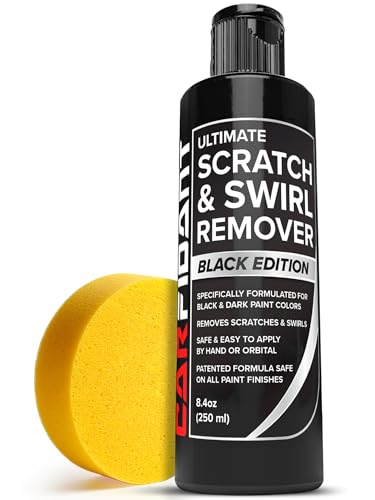
3. Carfidant Black Scratch and Swirl Remover: best for swirl marks on dark paint
This is a polishing kit made for black and dark paint. It includes a buffer pad and a rubbing compound, so it suits owners who want a complete set in one box. It is aimed at swirl marks, light scratches and the general dullness that builds up over time.
Swirl marks often come from washing with dirty towels or brushes and from drying with rough materials. A kit like this targets those surface marks directly. It is a practical choice for someone who wants to tackle a dull dark car without buying each item separately.
What the kit includes
The kit comes with a buffer pad and a compound formulated for dark finishes. The listing says the compound can be used on clear coat, single-stage and multi-stage paint. Buyers get everything they need to start the job without buying extra items.
Having the pad and compound together helps you start quickly, since you do not need to match products yourself. You will still want clean microfiber towels for wiping off residue, and good lighting makes it easier to see what you have corrected.
Working through the surface
The listing says you can buff the compound by hand with the included pad. It also says the compound removes water spots and oxidation. A polishing job like this usually takes a little time, since you work the panel in sections and wipe away residue as you go.
Wash and dry the car before you start, so you are not grinding dirt into the paint. Work one small area at a time, using overlapping passes. Check your progress under good light between passes, and stop when the marks are no longer visible.
Limits to keep in mind
The listing states that very deep scratches, the kind you can feel with a fingernail, may not improve much. This kit works best on light marks and swirls. Expecting it to remove heavy damage can lead to disappointment.
Deep scratches that go through the clear coat usually need touch-up paint or professional repair. Water spots and light oxidation are more realistic targets for this kit. A simple test is to run your fingernail across the mark. If it catches, the scratch is likely beyond what a compound can fix.
Ease of use and value
The kit is described as professional grade but easy enough for a beginner. Hand buffing is simple once you understand the motion, although it does take some effort on larger panels. The listed price is above the touch-up options and below the largest kit here.
For a single car, a complete kit can cost less than repeated visits to a detailer. The trade-off is time and physical effort. Buyers who expect fast, machine-level results on a full car may find hand work slow.
Pros
- Complete kit with a buffer pad included
- Designed specifically for black and dark paint
- Usable on several paint systems, according to the listing
- Can address swirls, light scratches and oxidation
Cons
- Not effective on very deep scratches
- Hand buffing takes effort on larger areas
- Results depend on careful, even work
- The listing relies on general claims, so buyers should set realistic expectations
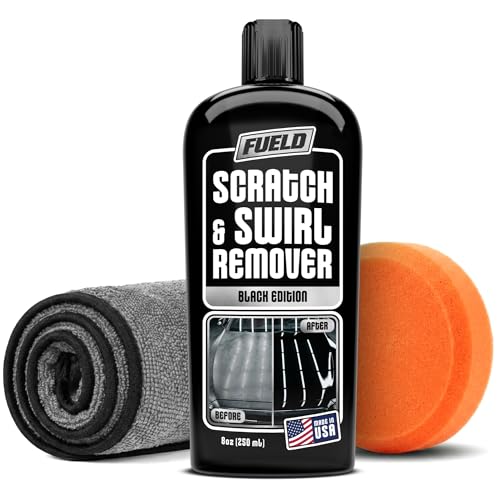
4. Fueld Black Scratch Remover: best for deeper scratches and full restoration
This is a polishing compound for removing light to moderate scratches and restoring tired paint. It suits owners who want a compound that can handle slightly deeper marks than basic polishes. It works by hand or with a machine polisher, which gives buyers some flexibility in how they approach the job.
Compounds sit between basic polishes and heavy-duty cutting products. They use fine abrasives to level the top layer of paint, so the surface reflects light more evenly. A compound like this one is a common choice when a simple swirl remover no longer makes a visible difference.
Deeper repair and restoration
The listing describes the formula as designed for deeper paint imperfections, while still aiming to restore clarity and shine. It also says the compound removes oxidation and revives faded paint. Oxidation is the chalky, dull look that builds up on paint exposed to sun and weather over time. In practice, this means the product targets a wider range of problems than a simple swirl remover.
Deeper scratches that catch a fingernail usually go past the clear coat. A compound can improve their appearance, but it cannot fill them. Buyers should expect improvement in lighter marks and set realistic goals for heavier damage.
Flexible application
You can apply the compound by hand, which suits small areas and careful work. A machine polisher can cover larger panels faster, though it requires more skill to use well. Too much pressure or too high a speed can leave holes, haze or uneven spots in the paint.
Buyers should match the method to the size of the job and their comfort level. A small area, such as a door edge or a bumper corner, is a sensible place to practice. Working in small sections also helps keep the results consistent across the panel.
Compatibility and everyday care
The listing says the compound works on clear coat, single-stage and multi-stage paint, and on cars, trucks and motorcycles. That range makes it a flexible choice for a household with more than one vehicle. Still, the listing offers general claims, so results will vary with the paint condition.
Checking the paint type before buying can help set expectations. Single-stage paint has color and protection in one layer, while multi-stage paint uses a separate clear coat on top. Both can respond well to a compound, but older or heavily weathered paint may need more care.
Ease of use and value
The compound is meant to be simple to apply and wipe off. A beginner can start with a small test area to learn how the product behaves on the paint. Wiping away residue with a clean microfiber cloth before it dries helps avoid streaks and smears.
At the listed price, it sits above the touch-up pen and the polish-and-wax option. Buyers should weigh that cost against how many panels they plan to treat. A product used across the whole car can cost more than a small pen used on one spot.
Pros
- Designed for light to moderate scratches and swirls
- Works by hand or with a machine polisher
- Listed as suitable for several paint systems and vehicle types
- Aims to restore gloss and remove oxidation
Cons
- Deep damage may still need professional attention
- Machine use requires some skill to avoid uneven results
- Costs more than the simpler options in this list
- Performance depends heavily on the condition of the paint
5. T-Cut Color Fast 3-in-1 Paint Restorer: best for a broad, all-in-one restore
This is a three-in-one product that combines a scratch remover, a ceramic-style wax and a color enhancer. It suits owners who want one bottle to handle oxidation, minor blemishes and shine. It is available in many colors, including black, which makes it easy to choose a version for a dark car.
Products that combine several steps can save time and shelf space. They also trade some precision for convenience. A dedicated compound or wax may do one job better, but a combined product can cover several basic needs at once.
What the three functions do
The listing describes the product as removing surface oxidation, blemishes and minor scratches. The wax layer is meant to leave a lasting gloss, and the color enhancer is designed to bring back depth. Together, these functions aim to refresh the paint in a single pass.
Color enhancers typically add a light tint or filler that makes the paint look richer. This effect is cosmetic and tends to fade as the product wears off. Buyers who want longer protection may still need to reapply the wax layer more often.
Suitability for different finishes
The listing says the product suits most paint finishes, including metallic paint. It also says it restores shine without much effort. Because the formula is broad, it may not target a single problem as precisely as a dedicated compound.
Metallic paint contains small flakes that can make swirls and haze more visible. A gentle, all-round formula can suit this type of finish well, though very worn metallic paint may still need a more specialized product.
Everyday use and results
Most buyers will use this product for periodic care rather than heavy repair. Applying it by hand is the usual method for a product of this type. Results tend to look most even on panels that are already in reasonable condition.
Working on a cool surface out of direct sunlight helps the product spread and wipe off cleanly. Applying a thin, even layer and buffing it in straight lines or small circles usually gives a tidier finish. Checking the result under good light shows if another pass is needed.
Ease of use and value
The product is described as an easy way to clean, restore and wax the car. The bottle is relatively large, which can make it cost-effective over several uses. The listed price sits in the middle of the group, close to the polish-and-wax option.
Buyers should compare the bottle size with how often they plan to care for the car. A single product that covers cleaning, restoring and waxing can reduce the number of items to store. It works best for owners who want a simple routine rather than separate steps for each task.
Pros
- Combines scratch removal, wax and color enhancement
- Suits a wide range of paint finishes
- Available in a black version for dark cars
- Large bottle size for repeated care
Cons
- Broad formula may be less precise for single problems
- Deep scratches are not the main target
- Results depend on paint condition and technique
- Claims are general, so buyers should test on a small area first
Comparison insights: how the five products differ
The five products fall into three groups. Two are paint repair tools for small chips, one is a dedicated scratch remover kit, and two are polishing compounds with some extra protection. Each group suits a different level of damage and a different level of effort.
Performance depends on the type of damage. Touch-up paint fills small chips, while polishing compounds work on the surface to reduce swirls and light scratches. Deeper marks usually need a different approach, and the listings are clear that the polishes are not designed for very deep damage.
Ease of use is simple for most products. The touch-up pen asks for a steady hand and patience with thin layers that each need time to dry. Polishing kits and compounds need an even motion and careful wiping. Machine polishing adds speed but also adds a learning curve, since too much pressure or heat can cause problems on the paint.
Value for money depends on how much work you need. A single chip repair is cheap with the touch-up pen. A broader restore may justify a larger product, especially one with a complete kit or a larger bottle. Buyers should weigh the price against the job they plan to do and how often they expect to repeat it.
In short, no single product covers every problem. The right choice depends on if you need to fill chips, polish swirls or refresh the whole finish.
Buying guide: key factors explained in plain words
Start by looking at the damage. A small chip down to bare metal or primer needs a touch-up product that fills the spot. Light swirls and fine scratches respond better to a polish or compound. Run your fingernail across the mark: if it catches, the damage is likely deeper than a polish can fix.
Check the paint type. Most modern cars have clear coat, and many of the products here list support for clear coat, single-stage and multi-stage paint. Confirm the listing matches your car before you buy, and check the color code on the sticker in your door jamb if you need a touch-up match.
Think about the method. Hand application is slower but gives more control. A machine polisher covers large areas faster but needs more practice. Beginners often do well starting by hand on a small test area, such as a section of the trunk lid, before tackling the hood or doors.
Consider protection. Some products add a wax or ceramic-style layer after polishing. This can help water bead and make washing easier, although it does not replace regular care. Read the listing to see what protection is included and how long the manufacturer says it lasts.
Look at size and value. A small pen is cheap for one repair. A larger bottle or full kit costs more up front but may suit repeated care across several vehicles or panels. Compare the price with how much work you expect to do.
Set realistic expectations. Most products in this group handle light marks well and deep scratches poorly. A product that is clearly described for light damage will not remove heavy gouges, and a deep scratch may still show a faint line even after a careful repair.
Who should buy these products
If you have a few small chips on a black car, the Black Touch Up Paint pen is the most direct match. It suits someone who wants to fill spots quickly and keep costs low. Chips on panels like doors and bonnets edges are a typical case. It is less suited to swirl removal.
If your paint looks dull and has light marks, the Turtle Wax Hybrid Solutions polish and wax is a good fit. It suits someone who wants to refresh the finish and add a protective layer in one step. Many owners use it after a regular wash to bring back some gloss. It is best for owners who do not need heavy correction.
If you want a complete kit with everything in one box, the Carfidant Black Scratch and Swirl Remover suits a beginner who plans to work by hand on swirl marks. Having the materials together means you do not have to match separate products yourself. It is a good match for black or dark cars with light surface wear.
If your car has slightly deeper marks and you want a compound that can handle them, the Fueld Black Scratch Remover suits someone who may use either hand or machine methods. A compound is more abrasive than a polish, so it removes more paint from the surface. It is better for owners willing to practise first.
If you want a single bottle for oxidation, minor blemishes and shine, the T-Cut Color Fast 3-in-1 Paint Restorer suits someone who prefers one routine product. Cleaning, polishing and protecting are combined in one step, which keeps the process simple. It is a fit for owners who want broad, periodic care rather than targeted repairs.
Final verdict
For small chips, the touch-up pen is the most practical choice. For swirls and dull paint, the polish and wax, the complete kit or the T-Cut restorer are all sensible options. The Fueld compound fits owners who want to address somewhat deeper marks.
No product in this list removes deep scratches completely. Buyers should match the product to the damage they can see and test on a small area first. Work in a shaded spot, follow the label directions and stop if the paint looks worse. With realistic expectations and careful work, most of these products can improve the look of a black car.
Frequently Asked Questions about the best scratch remover for black cars
Can a scratch remover fix deep scratches on a black car?
Most products here are designed for light scratches and swirls. Deep scratches that you can feel with a fingernail usually need more than a polish, and the touch-up pen may only fill them partly. In those cases, a body shop assessment is often the more reliable route.
What is the difference between a touch-up pen and a polish?
A touch-up pen adds paint to fill chips and narrow scratches. A polish works on the surface of the paint to smooth out swirls and dull areas. They solve different problems, so you may need one, the other, or neither depending on the damage.
Do I need a machine polisher to use these products?
No. Several products can be used by hand, which is a good starting point for beginners. A machine polisher can cover larger areas faster but takes more skill, and using too much pressure or the wrong pad can damage the paint.
How long should I wait before washing the car after a repair?
Drying times vary. The touch-up pen is listed as drying in about 10 minutes, while the Turtle Wax product advises 24 hours for a full cure. Always check the label of the specific product you bought and follow its waiting period before washing.
Are these products safe for other paint colors?
Most products here are sold for dark or black paint, but some listings also mention other colors. Check the listing for the paint types it covers before you use it on a different car color. Using a product outside its stated range can leave visible marks.
Should beginners test a product first?
Yes. Testing on a small, hidden area lets you see how the paint reacts and how the product looks once dry. This simple step can prevent unwanted results on a visible panel, such as a door or the bonnet.

Peterson is an automotive enthusiast and auto parts reviewer with a passion for vehicle maintenance, upgrades, and performance. He enjoys researching and testing car parts, tools, and accessories to help drivers make informed buying decisions. Through AutoPartsTalk.com, Peterson shares honest reviews, practical maintenance tips, and expert guides to keep vehicles running safely and efficiently.