Cerakote vs Powder Coat
If you’re looking to protect and beautify your metal parts, you’ve probably stumbled across two names that keep popping up: Cerakote and powder coat. Both are popular finishes that look awesome and protect metal from damage. But they’re different in some important ways, and picking the wrong one could leave you disappointed.
Let me break down everything you need to know about these two coating options so you can make the right call for your specific project.
What Is Cerakote?
Cerakote is a ceramic-based coating that has become incredibly popular in recent years. It’s a liquid finish that comes in two parts – a base and a catalyst. You mix them together, and then the coating is applied to your metal parts, usually through spraying.
The magic happens after application. Cerakote cures through a chemical process that creates an extremely hard ceramic layer on top of your metal. This ceramic coating is bonded at a molecular level, which means it’s not just sitting on the surface – it’s actually fused with the material underneath.
Where Cerakote Shines
Cerakote really excels in certain situations. If you have intricate parts with lots of small details and tight spaces, Cerakote flows into those areas beautifully. It levels out on its own, creating a smooth, uniform finish without brush marks or drips.
The color options are insane. Cerakote comes in hundreds of different colors, including metallics, candy colors, and even effects that change color depending on the angle. Gun owners love Cerakote because of this – you can have a rifle that looks like it came from a video game.
Cerakote also performs incredibly well in harsh environments. Once it’s fully cured, it stands up to chemicals, saltwater, extreme temperatures, and UV rays better than many other coatings. If you’re coating motorcycle parts, automotive components, or anything that lives outside, Cerakote holds up remarkably well.
The Time Investment
Here’s the catch with Cerakote: it requires proper equipment and space to apply correctly. You need a spray gun, an air compressor, and ventilation to handle the fumes safely. The application process is technical, and if you mess it up, you’re stuck with a mediocre finish.
Cerakote also takes longer to cure completely. While it might feel dry to the touch in a few hours, it needs days to fully harden. Some people speed this up by baking the coated parts in an oven, but that’s an extra step and extra cost.
What Is Powder Coat?
Powder coat is a completely different animal. Instead of a liquid, powder coat is actually a fine powder – think of it like colored talc that sticks to metal through static electricity.
The application process is wildly different from Cerakote. A spray gun charges the powder particles with static electricity, then blasts them onto your metal part. The powder sticks to the part because of the opposite charge. After that, the coated part goes into an oven where heat melts and fuses the powder into a solid, durable finish.
Where Powder Coat Excels
Powder coat has been around for decades, and it’s the industry standard for a reason. It creates a thick, even coating that’s incredibly durable. The finish is uniform every single time because the curing process is controlled – you’re baking the parts to specific temperatures.
The protection you get from powder coat is fantastic. It resists chipping, scratches, and impacts better than Cerakote in many cases because the coating is thicker. Want to coat a bicycle frame, metal furniture, or industrial equipment? Powder coat is often the go-to choice.
Cost-wise, powder coat is usually cheaper per part when you’re doing volume work. The equipment is less expensive than Cerakote equipment, and the powder itself is cheaper than the Cerakote liquid and hardener.
Cleanup is also refreshingly simple. Powder coat doesn’t use solvents, so cleanup is basically just compressed air. There are no toxic fumes to worry about, which makes it safer for the environment and for the people applying it.
The Limitations
Powder coat has some real drawbacks that make it unsuitable for certain projects. First, you absolutely need an oven to cure powder coat. This means you can’t do it at home in most cases. You need access to a proper industrial space with a powder coat oven.
Intricate, detailed parts are a nightmare with powder coat. The powder has trouble settling into tight crevices and small spaces. Complex shapes with lots of angles can end up with uneven coverage or bare spots.
The color selection, while decent, doesn’t compare to Cerakote. You get solid colors and some metallic options, but you’re not getting that wild variety of specialty finishes. If you want something unique and colorful, powder coat might not deliver.
Durability Showdown: Which Lasts Longer?
This is where things get interesting. Both finishes are durable, but they fail in different ways.
Cerakote protection is excellent against chemicals, saltwater, and UV damage. If you live near the ocean or your parts face harsh chemical exposure, Cerakote often wins. The ceramic nature of the coating makes it chemically resistant in ways powder coat can’t match.
However, Cerakote can scratch and chip more easily than powder coat because the coating is thinner. Once you damage the ceramic layer, corrosion can start creeping in underneath.
Powder coat is thicker, so it absorbs impacts and scratches better. Your parts have to take serious abuse before the coating fails. But powder coat isn’t as chemically resistant as Cerakote. Certain solvents and chemicals can eat through powder coat, whereas Cerakote laughs at them.
Temperature resistance is another story. Cerakote handles extreme heat better than powder coat. If your parts live in an engine bay or anywhere super hot, Cerakote is the smarter choice.
The real answer is that durability depends on your specific environment. Think about what your parts will face. Then pick the coating that handles those conditions best.
Cost Comparison
Let’s talk money because this matters for most people.
Cerakote costs more per part, typically. The material is expensive, application requires skill, and the process takes longer. You’re probably looking at $10 to $25 per part, depending on size and complexity. Some specialists charge more.
Powder coat is cheaper. You might pay $5 to $15 per part, sometimes even less if you’re doing volume work. The material is inexpensive, and once you have the equipment, the process is efficient.
However, you need to account for setup and learning. If you’re only coating one or two parts, Cerakote from a professional might actually be cheaper than driving to a powder coat facility multiple times or investing in equipment.
For DIY work, Cerakote is more accessible. You can spray it yourself with basic equipment. Powder coat requires facilities and equipment that most home garages don’t have.
Application Method Matters
The way these coatings get applied is night and day different, and this affects your options.
Cerakote application is pretty forgiving. You spray it on, and it flows out beautifully. Even if your spraying technique isn’t perfect, you can still get decent results. The liquid nature means it fills in small gaps and self-levels.
Homeowners can apply Cerakote with a basic HVLP spray gun, some compressed air, and good ventilation. It’s totally doable as a DIY project if you’re willing to spend an afternoon learning the technique.
Powder coat application requires more specialized equipment. You need a powder spray gun (which costs serious money), a booth to contain the powder, a way to ground the parts, and an oven to cure everything. This is professional territory for most people.
The upside to powder coat’s complexity is that once it’s applied, the result is always professional-grade. The oven process removes all the variables that come with spray application.
Color and Aesthetic Options
If you care about how your parts look – and most people do – this matters.
Cerakote offers an almost overwhelming selection of colors. We’re talking hundreds of options. You want a color-shifting pearl? Done. A deep candy color? Cerakote has it. A custom color matched to your vision? Totally possible. The finish quality is also beautiful – you get mirror-smooth surfaces that look like glass.
Powder coat gives you solid colors, metallics, and some specialty finishes. The selection is good, but it’s nowhere near Cerakote’s level. However, the finish is incredibly durable and professional-looking. You won’t see brush strokes or imperfections – just a perfect, even coat of color.
For aesthetic projects where you want your parts to look really special, Cerakote usually wins. For functional parts where you want them to look good enough and protected, powder coat is fine.
Prep Work: Getting Your Parts Ready
Both coatings need properly prepared surfaces. You can’t just spray them onto dirty, rusty metal and expect great results.
For Cerakote, you need to clean the parts thoroughly and remove any oils or residue. Most people use a degreaser and then let the parts air dry. Some people use isopropyl alcohol for a final wipe-down. A light surface prep is usually enough – you don’t need to sand everything down to bare metal.
Powder coat requires more aggressive prep. You typically need to blast the parts with sand, media, or beads to create a clean, slightly roughened surface. This gives the powder something to grip. The more thorough your prep, the better your results.
Both processes benefit from masking areas you don’t want coated. Cerakote masking is easier because you’re just spraying a liquid. Powder coat masking is trickier because powder is so fine that it sneaks into tiny gaps.
Curing and Setup Time
If you need your parts ready to use quickly, this is crucial information.
Cerakote cures relatively fast compared to some finishes. You can usually handle parts after a few hours, but the coating keeps hardening for days. For maximum durability and hardness, you want to wait at least a week. Some people oven-cure Cerakote at low temperatures to speed this up.
Powder coat cures as soon as it comes out of the oven – you can use your parts immediately. The oven process ensures that the cure is complete and uniform. This is huge for industrial applications where you can’t wait around.
If you’re in a hurry, powder coat wins. If you have time, both are fine.
Environmental and Safety Concerns
This is getting more important to people, and rightfully so.
Cerakote contains solvents that create fumes. You absolutely need ventilation when applying it. Spray booths or outdoor spraying are ideal. The fumes aren’t toxic at normal exposure levels with proper ventilation, but you don’t want to breathe them all day. Protective equipment like respirators is smart.
Powder coat is way more environmentally friendly. No solvents, no toxic fumes, no volatile organic compounds (VOCs). If you’re concerned about the environment or you’re applying coatings in a space without great ventilation, powder coat is the better choice.
Cleanup is cleaner too. With powder coat, you’re just handling powder and compressed air. No solvent cleanup means less mess and faster turnaround.
Which One Should You Choose?
Alright, so which coating is right for your project? Here’s how to think about it.
Choose Cerakote if:
- You care deeply about color options and aesthetics
- Your parts will face harsh chemical exposure or saltwater
- You have intricate, detailed parts with tight spaces
- You’re doing a one-off project and want professional results without a facility
- Your parts will see extreme temperature variations
- You’re willing to invest in proper equipment for a DIY project
Choose powder coat if:
- You want maximum durability against impacts and scratches
- You need a quick turnaround with professional results
- You’re coating simple, straightforward parts
- Cost is a major factor
- You have access to a powder coat facility
- You’re coating multiple parts and want consistency
- Environmental impact matters to you
Real-World Examples
Let’s look at how these coatings work in actual situations.
Firearms and tactical gear: Cerakote dominates here. Gun owners love the color options, and the chemical and temperature resistance is perfect for weapons that need to be tough and look cool.
Motorcycle and car parts: Depends on the part. Engine components? Cerakote. Structural frame parts that might take impacts? Powder coat. Visible cosmetic parts where you want color options? Cerakote.
Industrial equipment and machinery: Powder coat wins for durability and cost. Parts that don’t move and don’t need to be pretty – powder coat is perfect.
Furniture and decorative pieces: Powder coat if you want traditional protection. Cerakote if you want colors that pop and a finishing touch that looks incredible.
Outdoor metal fixtures: Depends on your local climate. Salty air? Cerakote. Regular outdoor use? Powder coat works fine.
The Hybrid Approach
Here’s something people don’t talk about much: you don’t have to choose. Some projects benefit from using both coatings.
For example, you could powder coat the main structural parts for durability and cost savings, then Cerakote smaller accent pieces that benefit from color options and aesthetic treatment. This lets you get the best of both worlds.
Maintenance After Coating
Both coatings are low-maintenance, but there are some things you should know.
Cerakote parts should be cleaned gently with mild soap and water. Harsh chemicals can degrade the coating over time. Avoid abrasive scrubbing pads that might scratch the surface.
Powder coat parts are tougher. You can clean them with stronger solutions and more aggressive methods. The thicker coating can handle it.
Neither coating needs waxing or special care in most cases. Just keep them clean and avoid deliberate abuse, and they’ll last for years.
Making Your Final Decision
At the end of the day, both Cerakote and powder coat are excellent finishes. The best choice depends on your specific needs, budget, and timeline.
If you’re unsure, think about these questions:
- What environment will these parts live in?
- How much does appearance matter?
- Do I need this done quickly?
- What’s my budget?
- Do I have access to specialized equipment?
- How important is environmental impact?
Get honest answers to these questions, and the right choice will become obvious.
Common Mistakes People Make
Before you commit to a coating, watch out for these pitfalls.
Don’t apply Cerakote in humid conditions. It won’t cure properly. Don’t expect either coating to fix a poorly prepped surface. The coating will fail if the base metal isn’t clean and prepared. Don’t assume cheaper always means worse. Both coatings can deliver amazing results at reasonable prices if you work with competent professionals.
Don’t neglect safety when applying coatings yourself. Proper ventilation and protective equipment aren’t optional – they’re essential.
The Bottom Line
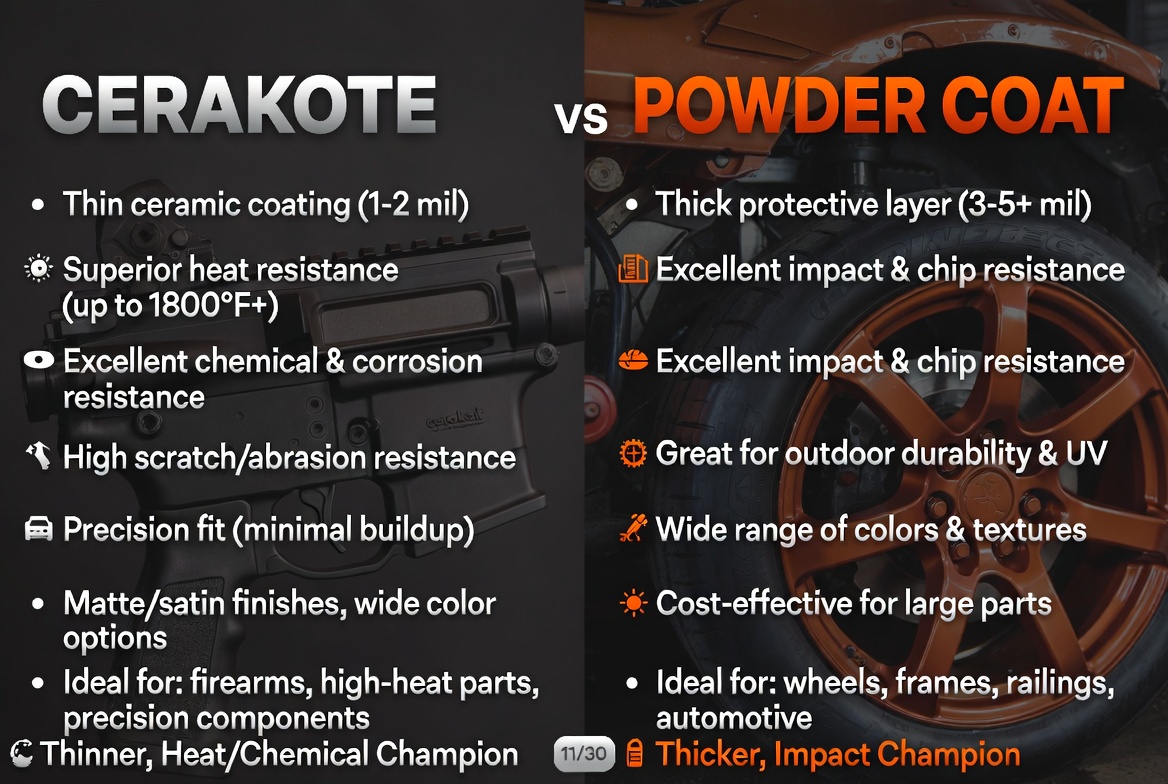
Cerakote and powder coat are both fantastic finishes that will protect your metal parts and make them look great. Cerakote excels at color variety, chemical resistance, and aesthetic impact. Powder coat delivers cost savings, thickness, and durability against impacts.
For most people, choosing between them comes down to your specific application, budget, and priorities. There’s no universal “better” choice – just the better choice for your particular project.
Do your research, talk to professionals, look at examples, and think carefully about what your parts need. You’ll make the right decision, and your parts will look amazing and last for years.
Your metal deserves protection. Pick the coating that’s right for your vision, and you won’t regret it.