V6 vs V8 Engines
When you’re shopping for a new car, the engine choice matters a lot. You’ll see “V6” and “V8” everywhere. Both are great engines. But they work differently. They perform differently too. So which one should you pick? Let’s dive deep into this engine comparison and help you understand what makes each one special.
What Does the V Actually Mean?
Before we get into the details, let’s clear up what “V” means. The V stands for the shape of the engine. The cylinders are arranged in two rows. These rows face each other. They form the letter V when you look at the engine from above. It’s pretty simple once you visualize it.
An engine with six cylinders arranged this way is a V6. An engine with eight cylinders arranged this way is a V8. The number tells you how many pistons move up and down inside the engine. More cylinders mean more power strokes happening at once.
V6 Engines: The Efficient Choice
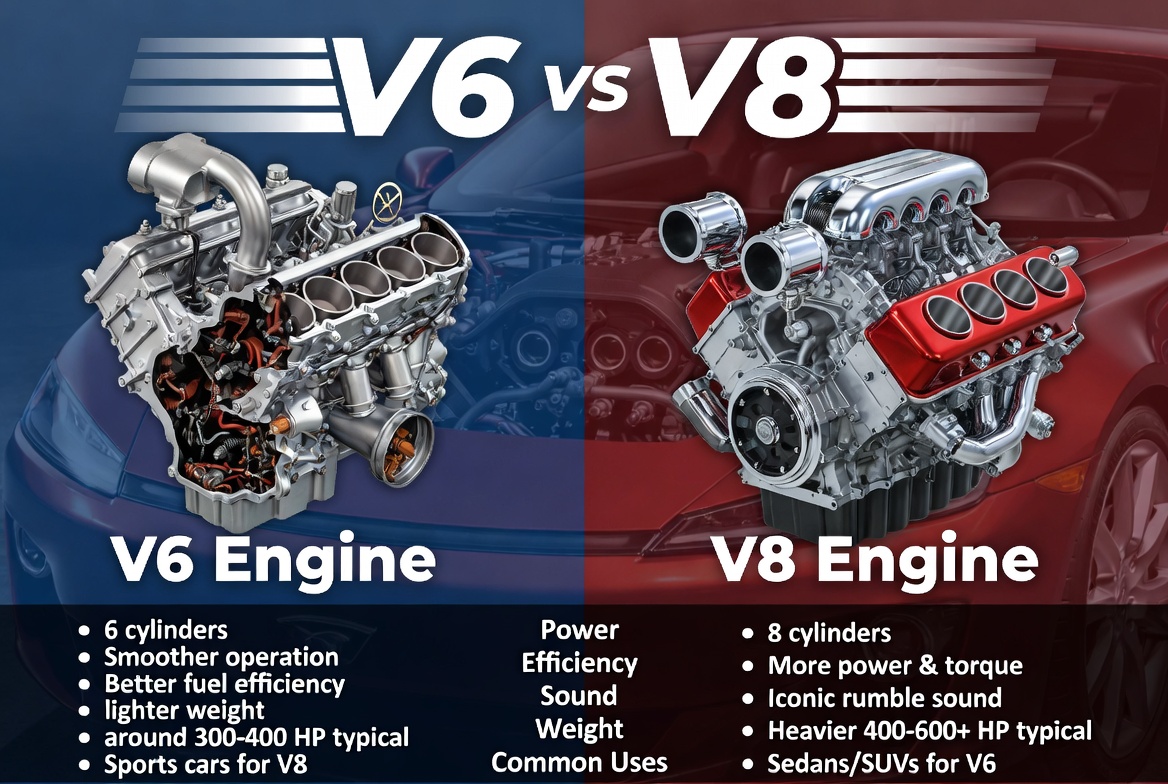
V6 engines are popular in cars all over the world. They pack a good balance of power and fuel economy. These engines have six cylinders. Each cylinder fires once every two rotations of the crankshaft. This creates a steady, reliable power delivery.
How a V6 Works
A V6 engine burns fuel in all six cylinders. The cylinders fire in a specific order. This order keeps the engine running smooth. Power flows constantly to the wheels. You won’t feel big jerks or vibrations like you might with smaller engines.
The V6 is compact. It fits into many different car models. Sedans use them. SUVs use them. Even some trucks use V6 engines. The compact design saves space in the engine bay. This leaves room for other important stuff.
Real-World V6 Performance
In real driving, a V6 feels peppy. It accelerates decently. It’s not slow. Most V6 engines produce somewhere between 200 and 310 horsepower. That’s enough for daily driving. Highway merges feel easy. Passing other cars is no problem.
The torque numbers matter too. Torque is the twisting force. V6 engines typically deliver between 180 and 280 pound-feet of torque. This helps with acceleration and towing. If you need to pull a boat or trailer, a V6 can handle it.
Fuel Economy with a V6
One big advantage of V6 engines is fuel efficiency. They burn less gas than larger engines. The smaller engine means fewer explosions happening. Fewer explosions equals less fuel needed. Many V6 vehicles get 25 to 32 miles per gallon on the highway. Some get even better numbers.
The cost of fuel adds up fast. If you drive a lot, the V6 saves you real money. Over several years, you might save thousands of dollars. That’s money you can spend elsewhere.
Maintenance Costs
V6 engines are simpler than V8 engines. They have fewer parts. Fewer parts means fewer things can break. Oil changes are regular maintenance. Spark plugs last thousands of miles. Most repairs cost less than V8 work.
Insurance companies like V6 engines too. Your insurance rates might be lower. Some insurers charge less for six-cylinder vehicles. Ask your agent about the specific numbers.
V8 Engines: The Power Player
V8 engines are legendary. They’re known for brute force and raw speed. Eight cylinders firing create serious muscle. V8 engines dominate in sports cars and trucks. High-performance vehicles almost always have V8 engines.
How a V8 Works
A V8 engine has eight cylinders instead of six. Each one fires in a specific order. This creates more explosions per revolution. More explosions mean more power. The power is immense.
With eight cylinders working, the firing strokes happen constantly. There’s barely any gap between power pulses. The engine feels incredibly smooth. There’s no vibration. Just pure, relentless power delivery.
V8 engines are larger than V6 engines. They take up more space. They weigh more. The engine sits heavy in the vehicle. Some people can feel this extra weight when the car accelerates.
Real-World V8 Performance
V8 performance is thrilling. Most V8 engines produce between 300 and 600 horsepower. Some produce even more. A 400-horsepower V8 feels completely different than a 280-horsepower V6. The acceleration is instant. The car jumps forward.
Torque numbers are impressive too. V8 engines deliver between 300 and 500 pound-feet of torque. Sometimes more. This torque helps everything from launching to highway passing. Towing capacity is huge. A V8 truck can tow massive loads.
The sound is iconic. V8 engines rumble and growl. That V8 rumble is music to car lovers’ ears. It’s distinct and unmistakable. You hear it coming from a mile away.
Fuel Economy with a V8
Here’s the trade-off: V8 engines drink more gas. More cylinders burn more fuel. That’s just physics. A typical V8 gets 15 to 25 miles per gallon on the highway. City driving is usually worse.
Over time, this adds up. A V8 driver might spend thousands more on gas each year. If you drive 15,000 miles yearly, the fuel cost difference is real. Some people say the fun is worth it. Others disagree.
Modern V8 engines are getting better. New technology helps them run more efficiently. Direct fuel injection makes them cleaner. Some V8s now match the efficiency of older V6 engines. But they still use more fuel overall.
Maintenance Costs
V8 engines are more complex. Eight cylinders mean eight spark plugs. More moving parts exist. More things can need repair. Oil changes use more oil. Filters and fluids cost more.
When something breaks, repair bills climb faster. A V8 engine repair can cost more. Parts are sometimes pricier. Labor hours add up. Over the life of the vehicle, V8 ownership typically costs more to maintain.
Direct Comparison: V6 vs V8
Let’s break down the key differences so you can compare side by side.
Horsepower and Acceleration
V8 wins here easily. V8 engines make more horsepower. The acceleration difference is noticeable. A V6 car takes longer to reach highway speeds. A V8 gets there faster. In a standing start race, the V8 destroys the V6. But in everyday driving, both feel quick enough.
Towing Capacity
V8s tow more weight. If you regularly tow heavy trailers, a V8 is better. Pickup trucks with V8s handle large loads. V6 trucks can tow too, but not as much. Check the specific specs for each vehicle.
Fuel Efficiency
V6 wins here. V6 engines get better gas mileage. Your wallet feels it. Over a decade of driving, the savings mount up. If fuel costs matter to you, the V6 is the smarter choice.
Reliability
Both are reliable. Both can last 200,000 miles or more if maintained. V6s might be slightly more reliable due to simplicity. But a well-maintained V8 is just as dependable. It depends on the specific vehicle.
Price
V6 vehicles cost less to buy. V8 vehicles cost more. The price difference can be significant. A V8 truck might cost $5,000 to $10,000 more than the V6 version. That’s a real chunk of money.
Maintenance Costs
V6 costs less to maintain. Oil changes are cheaper. Repairs cost less. Over the life of the vehicle, V6 ownership is cheaper. V8 ownership racks up bigger repair bills.
Sound
V8 sounds better to most people. That deep rumble is iconic. V6 engines sound more refined and quiet. It depends on what you like. Some people love the quiet. Others crave that V8 growl.
Driving Feel
V8 feels more powerful. Acceleration is thrilling. Passing feels effortless. V6 feels adequate. It’s fun enough. But it doesn’t have that extra punch. Both feel good in different ways.
Which Engine Should You Choose?
The answer depends on your needs.
Pick a V6 If:
You care about fuel economy. Your budget is tight. You don’t tow much. You drive mostly in the city. You like lower insurance costs. You don’t need maximum power. You want lower maintenance bills. You prefer reliability and simplicity.
Pick a V8 If:
You love speed and acceleration. You have money for extra gas. You tow heavy loads regularly. You drive mostly on highways. You want that iconic V8 sound. You enjoy spirited driving. You don’t mind higher maintenance costs. You want the ultimate performance feeling.
Real-World Scenarios
Scenario One: Daily Commuting
You drive 30 minutes to work and back. You want to save money. Choose the V6. You’ll spend less on gas. You’ll save on maintenance. The V6 performance is perfect for commuting. You’ll never feel like you’re missing out.
Scenario Two: Highway Driving
You take long road trips weekly. You value speed and comfort. The V8 might be better. You’ll enjoy the acceleration during passing. The V8 will make highway driving feel more luxurious. The extra fuel cost becomes acceptable.
Scenario Three: Towing a Boat
You own a large boat. You need serious towing power. Pick the V8. A V6 might handle it, but barely. The V8 makes towing feel effortless. Safety improves. You’ll feel confident on the road.
Scenario Four: Budget Shopping
Your money is limited. You want a reliable vehicle. Go with the V6. You’ll get a dependable car. Insurance costs less. Gas costs less. Repairs cost less. The V6 stretches your budget further.
The Technical Differences
Let’s get a bit more technical without losing the casual tone.
Displacement
V6 engines typically have a displacement of 2.5 to 3.5 liters. V8 engines range from 4.0 to 7.0 liters. Displacement is the total volume of air and fuel mixed in all cylinders. More displacement means bigger explosions. Bigger explosions make more power.
Compression Ratio
This is how much the fuel mixture gets squeezed before ignition. Higher compression ratios make more power. V8 engines often run higher compression ratios. This is one reason they produce more power.
Valve Configuration
Modern V6 and V8 engines use multiple valves per cylinder. More valves mean better air flow. Better air flow creates more power. Most V6s use two valves per cylinder. V8s often use two or four valves per cylinder.
Fuel Injection
Both use fuel injection now. Gone are the days of carburetors. Fuel injectors spray fuel directly into cylinders. They time it perfectly. This creates better combustion. Modern engines burn fuel more completely.
Turbocharging
Some V6 engines use turbochargers. These force extra air into the engine. Extra air plus fuel makes more power. A turbocharged V6 might rival a naturally aspirated V8 in power. This technology is becoming more common. It helps V6s compete with V8s on performance.
Future of Engine Technology
The engine world is changing. Electric cars are coming. But gasoline engines will be around for a while. V6 and V8 engines continue to improve.
Engines are getting smaller and more efficient. Turbocharging helps. Direct fuel injection helps. Computer controls fine-tune everything. A modern V6 can do what an old V8 did while using less gas.
Hybrid engines combine gas engines with electric motors. You get the power of a V8 with better fuel economy. The best of both worlds. Hybrids are becoming popular.
V8 engines will stay around in performance cars and trucks. They’re too cool to disappear. But they’ll evolve. They’ll become cleaner. They’ll become more efficient. The rumble might sound different someday.
Common Questions Answered
Q: Can a V6 outrun a V8?
Not usually. A V8 is faster off the line and in a straight line. But a lightweight V6 sports car with a turbo might beat a heavy V8 SUV. Vehicle weight matters too.
Q: Is a V8 worth the extra cost?
That’s personal. If you love driving and have the money, yes. If you care only about reliability and cost, the V6 is smarter.
Q: How long do V6 and V8 engines last?
Both can last 200,000 miles or more. The key is maintenance. Regular oil changes keep engines happy. Most V6s and V8s will outlast the rest of the car.
Q: Are V6 engines good for trucks?
Yes. V6 trucks have become popular. They tow okay and use less gas. They’re great for people who don’t need maximum towing capacity.
Q: Will V8 engines become extinct?
Not soon. They might become less common. But car enthusiasts will always want them. Manufacturers will keep making them. They’re too iconic to disappear.
Q: Which costs more to insure?
V8s usually cost more. They’re seen as higher risk. They’re more powerful. They’re involved in more accidents. Talk to your insurance agent about specific rates.
Q: Can a V6 get better gas mileage than some V8s?
Yes. A very efficient V6 might match a very inefficient V8. But generally, V6s get better mileage. Modern engines blur these lines though.
What Matters Most?
Here’s the truth: both engines are good. The V6 is smart and practical. The V8 is powerful and fun. Neither is objectively better. It depends on what you value.
If you drive mostly to work and back, a V6 is perfect. You’ll save money and have no regrets. If you love speed and driving thrills, save for the V8. The experience is worth it.
Think about your budget. Think about your driving habits. Think about what makes you happy. Then choose based on that.
The Bottom Line
A V6 engine is ideal for most people. It offers excellent performance. It’s reliable. It’s affordable. Maintenance is reasonable. Fuel costs are manageable. Insurance is cheaper. For practical, smart car buyers, the V6 wins.
A V8 engine is for enthusiasts. It’s more powerful. It sounds incredible. It accelerates like nothing else. But it costs more to buy, insure, and maintain. It drinks gas faster. You need to love driving to justify the extra expense.
Both will get you where you need to go. Both are proven technologies. Both come in great vehicles. The choice really comes down to your personal priorities.
Making Your Final Decision
Start by listing what matters most. Is fuel economy important? Is towing capacity essential? Do you have a budget limit? How much driving do you do yearly? Will you keep the car long-term or trade it in?
Answer these questions honestly. Your answers point toward the right engine type. Don’t pick based on what sounds cool. Pick based on what fits your life.
Test drive both if you can. Feel how each accelerates. Listen to the engine sounds. Get a sense of how it feels in traffic. Your gut instinct matters. If you fall in love with one, that matters too.
Talk to owners of both types. Ask about their fuel costs. Ask about maintenance. Ask about reliability. Real-world experiences from actual owners are gold.
Check online forums. Car enthusiasts discuss these engines constantly. Read their opinions. Learn from their experiences. People are usually honest about what they love and hate.
Compare insurance quotes. Call your agent. Get specific numbers for each vehicle. Insurance costs are real costs. Factor them into your decision.
Look at total cost of ownership. This includes purchase price, fuel, insurance, and maintenance. Some calculators online do this math for you. Over five or ten years, the V6 might cost thousands less. That’s worth knowing.
Final Thoughts
V6 and V8 engines represent different philosophies. V6 is about efficiency and practicality. V8 is about power and passion. Neither is wrong. They’re just different.
The automotive world needs both. People with different needs drive different cars. Some people love maximizing economy. Others love maximizing thrills. The beauty of the market is that both options exist.
Your perfect car might have a V6 or a V8. Or it might have something else entirely. The engine type is just one factor. The whole car matters. The reliability matters. The design matters. How it feels to drive matters.
So do your homework. Think about your needs. Consider your budget. Test drive options. Then make your choice with confidence. Whether you pick the practical V6 or the powerful V8, you’ll end up with a great vehicle. Both engines have earned their reputation over decades of use.
The roads have room for both types of engines. The V6 driver and the V8 driver both enjoy their cars. That’s what really matters. Drive what makes you happy. Drive what fits your life. That’s the real answer to the V6 versus V8 question.