X-Pipe vs H-Pipe Exhaust
So you want your car to sound mean. Or maybe you just want more power. Either way, you’ve probably heard about X-pipes and H-pipes. And now you’re wondering — what’s the difference? Which one do you pick?
Don’t worry. This guide breaks it all down in plain language. No jargon. No confusing engineering talk. Just the facts you need to make a smart decision.
Let’s get into it.
What Is an Exhaust Crossover Pipe?
Before we talk about X-pipes and H-pipes, let’s cover the basics.
Most performance cars have a dual exhaust system. That means two separate pipes running from the engine to the back of the car. One pipe handles the exhaust from one side of the engine. The other handles the rest.
These two pipes usually work on their own. But here’s the thing — they can actually help each other out. That’s where a crossover pipe comes in.
A crossover pipe connects the two sides of the exhaust system. It lets exhaust gases move between both pipes. This connection changes how the exhaust flows, how the engine breathes, and how your car sounds.
There are two main types of crossover pipes: the X-pipe and the H-pipe.
They look different. They sound different. They perform differently too.
What Is an X-Pipe?
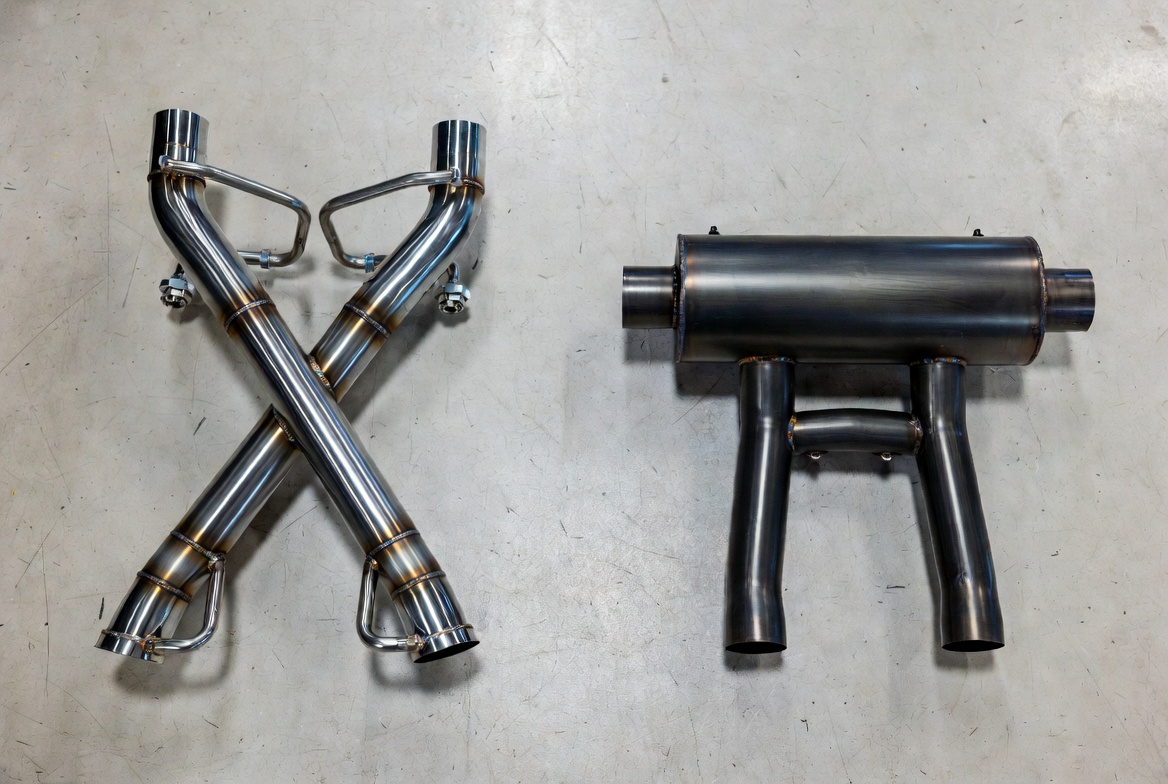
An X-pipe is exactly what it sounds like. The two exhaust pipes cross each other in the shape of an X.
At the crossover point, the pipes actually merge. Exhaust gases from both sides mix together and then split back out. This creates a smooth, even flow of exhaust through the entire system.
Think of it like two rivers flowing into each other and then splitting into two streams again. The water mixes. It blends. It flows out more smoothly.
That’s what an X-pipe does for exhaust gases.
Sound of an X-Pipe
Here’s what most car enthusiasts notice first — the sound.
An X-pipe gives your car a high-pitched, raspy, aggressive exhaust note. It’s the kind of sound you hear from exotic sports cars and race-ready machines. Some people describe it as a “wail” or a “scream.”
If you want your car to sound like it means business at high RPMs, the X-pipe delivers that.
The tone tends to get sharper as the engine revs climb. At idle, it’s still aggressive. At full throttle? It gets loud and intense in a way that turns heads.
What Is an H-Pipe?
An H-pipe also connects the two exhaust pipes. But instead of crossing them, it runs a straight tube between them. This forms the shape of the letter H.
The two exhaust pipes stay parallel. The connecting tube sits in the middle, like the crossbar of the letter H. Exhaust gases can pass through this tube from one side to the other. But they don’t blend together the same way they do in an X-pipe.
The flow is more controlled. More balanced. Less chaotic.
Sound of an H-Pipe
The H-pipe gives your car a deep, throaty, rumbling exhaust note. It’s the classic muscle car sound that most people grew up hearing.
That low, heavy growl at idle. That strong, powerful tone under hard acceleration. That’s the H-pipe doing its thing.
If you love the sound of old-school American muscle — think big V8s and tire-smoking classics — the H-pipe is what gave those cars their voice.
It’s not as raspy or sharp as the X-pipe. It’s more smooth. More bass-heavy. More old-school cool.
X-Pipe vs H-Pipe: The Key Differences
Now let’s put them side by side and look at the main differences.
1. Exhaust Flow
The X-pipe creates a scavenging effect. This is a fancy term for something pretty simple. When exhaust gases move through the X, they create a low-pressure zone. This low pressure actually helps pull fresh exhaust out of the engine faster.
Less resistance. Better flow. The engine can breathe out more easily.
The H-pipe doesn’t create this scavenging effect as strongly. The flow is more balanced and steady. It equalizes pressure between both sides of the exhaust. But it doesn’t pull exhaust gases through quite as aggressively.
2. Horsepower and Torque Gains
Here’s where things get interesting for performance fans.
The X-pipe tends to make more top-end horsepower. Because it flows better at high RPMs, it helps the engine make more power when you’re pushing hard. Racers and sports car owners love this.
The H-pipe tends to make more low-end torque. It helps the engine pull stronger at lower RPMs. This is great for daily driving, towing, or cars that spend more time at normal speeds.
In real-world tests, the difference between the two isn’t always massive. But it’s real. And depending on how you drive, it can matter.
If you live for high-RPM pulls and track days, go with the X-pipe. If you want strong off-the-line grunt and everyday performance, the H-pipe has the edge.
3. Sound Character
We touched on this already. But it’s worth repeating because sound is a big deal for most enthusiasts.
| Feature | X-Pipe | H-Pipe |
|---|---|---|
| Tone | High-pitched, raspy, sharp | Deep, throaty, rumbling |
| Character | European sports car | American muscle car |
| Idle sound | Aggressive | Heavy and smooth |
| High-RPM sound | Loud, wailing | Strong and bassy |
Neither one is better than the other in absolute terms. It’s 100% personal preference. Ask yourself — what do you want your car to sound like?
4. Exhaust Drone
Exhaust drone is that annoying buzzing sound you sometimes hear inside the cabin at highway speeds. It can drive you crazy on long drives.
The X-pipe tends to produce less drone compared to the H-pipe. Because of how exhaust pulses cancel each other out in the X design, the sound inside the car stays more bearable on long road trips.
The H-pipe can sometimes create more noticeable drone at certain RPM ranges. This depends a lot on the specific car, the exhaust system, and the mufflers used. But it’s something to keep in mind if you spend a lot of time on the highway.
5. Installation and Fitment
Both pipes are available as universal fit or vehicle-specific options.
Vehicle-specific pipes are easier to install. They’re made to fit your exact car. No cutting. No custom bending. Just bolt-on and you’re done.
Universal pipes are cheaper but require more work. You’ll likely need a professional exhaust shop to cut and weld them into place.
The X-pipe can sometimes be trickier to fit in tight engine bays because of its crossing design. The H-pipe is often a simpler, more straightforward fitment. But again, this depends on your specific car and the brand you buy.
6. Price
In general, X-pipes and H-pipes are similarly priced. You can find decent options starting from affordable ranges, and premium options going much higher depending on the material (stainless steel vs mild steel) and the brand.
Stainless steel lasts longer and resists rust. It costs more upfront but saves money in the long run. Mild steel is cheaper but won’t last as long, especially in wet climates.
What Kind of Car Do You Have?
This is actually one of the most important questions to ask.
V8 Engines
V8 engines are where this debate really matters. A V8 fires on both banks of the engine in an alternating pattern. The firing order creates exhaust pulses that can actually be used to your advantage.
The X-pipe is very effective on V8s with a cross-plane crankshaft (like most American V8s). The scavenging effect works really well here. You get better flow and a noticeable bump in top-end power.
The H-pipe is also popular on V8s. It’s the traditional choice for muscle cars and trucks. It keeps that iconic rumble and delivers strong torque.
V6 and Other Engines
On V6 engines, 4-cylinders with forced induction, or flat engines, the performance differences between X-pipe and H-pipe get smaller. The exhaust system setup changes, and the crossover pipe matters less than the headers, mufflers, and cat-back exhaust.
Still, the sound difference remains. So even on a V6, you can pick your preferred exhaust note with the right pipe.
X-Pipe vs H-Pipe for Daily Driving
Let’s say you’re not a track rat. You just want your daily driver to sound and perform a little better. Which pipe makes more sense?
For daily driving, the H-pipe is often the more comfortable choice. Here’s why:
- Less drone issues on some setups aside, the low-end torque helps in everyday traffic situations
- The deep, smooth rumble is pleasant without being too harsh
- It’s a tried-and-true setup that works well in all conditions
That said, the X-pipe is totally driveable every day too. Many people run X-pipes on their daily cars and love the sound. The drone concern depends heavily on your muffler choice and overall exhaust setup.
X-Pipe vs H-Pipe for Track Use
If you’re building a track car or a dedicated performance machine, the X-pipe usually wins.
The top-end horsepower gains matter more at the track. You’re spending more time at high RPMs. The scavenging effect does more work. And on a track, exhaust drone doesn’t matter because you’re not cruising at highway speeds for hours.
Racers and performance tuners tend to favor the X-pipe for exactly these reasons. It just flows better when you’re pushing hard.
What About Mufflers?
Here’s something important — the crossover pipe doesn’t work alone.
Your mufflers play a huge role in the final sound and performance of your exhaust system. A great X-pipe paired with poor mufflers won’t sound amazing. A well-chosen H-pipe with quality mufflers can sound incredible.
When you upgrade your crossover pipe, think about the whole system. Headers, mid-pipes, crossover pipe, mufflers, and exhaust tips all work together. Changing one part without thinking about the others gives you incomplete results.
If you’re going for a full exhaust upgrade, talk to an exhaust specialist. They can help you pick parts that work together for the sound and power you want.
Popular Brands to Know
There are a lot of exhaust brands out there. Here are some well-known ones that make quality X-pipes and H-pipes:
- Bassani — Known for muscle car exhaust systems, great H-pipe options
- Magnaflow — Popular for clean-sounding X-pipe setups with less drone
- Flowmaster — Famous for that classic American muscle sound, great H-pipe reputation
- Borla — Premium stainless steel options, both X and H available
- Corsa — Known for drone-canceling technology, works well with X-pipe setups
- SLP Performance — Strong reputation in the Camaro and Firebird community
Always buy from reputable brands. Cheap exhaust parts can crack, rust, or leak. They can also cause noise issues and fail inspections.
Does It Affect Emissions?
This is a real concern for a lot of car owners.
The crossover pipe itself doesn’t directly affect emissions. It’s just connecting two pipes. But if your exhaust system removes or bypasses catalytic converters, you’ll have emissions problems.
Catted X-pipes and H-pipes include catalytic converters in the pipe. They keep your car street-legal and passing emissions tests.
Catless pipes remove the catalytic converters. They flow better and often sound more aggressive. But they’re not street-legal in most places and will cause your car to fail emissions inspections.
Always check your local laws before going catless. For most daily drivers, a catted crossover pipe is the smarter, legal choice.
Installation: DIY or Shop?
Can you install an X-pipe or H-pipe yourself?
If it’s a bolt-on, vehicle-specific kit, and you have basic mechanical skills and tools, yes. You can do it in your driveway with a jack, jack stands, and some wrenches.
If it’s a universal fit pipe, you’ll need cutting and welding. That means going to an exhaust shop. Don’t try to weld exhaust pipes without proper experience and equipment. A bad weld can cause dangerous exhaust leaks that let carbon monoxide into your cabin.
Exhaust shops charge anywhere from a modest amount to higher rates depending on complexity. For a full custom exhaust job, get quotes from a few shops before committing.
Quick Decision Guide
Still not sure which one to pick? Use this simple breakdown:
Go with an X-Pipe if:
- You want higher-pitched, raspy, sporty exhaust sound
- You’re building a track or performance-focused car
- You want top-end horsepower gains
- You prefer the European sports car exhaust character
- You’re concerned about highway drone
Go with an H-Pipe if:
- You want a deep, throaty, old-school muscle car sound
- You drive mostly on the street and want strong low-end torque
- You have a classic muscle car or American V8
- You want a traditional, proven exhaust setup
- You love that iconic rumbling idle
Final Thoughts
Both the X-pipe and H-pipe are great upgrades. Neither one is perfect for everyone. It all comes down to what you want from your car.
Want that screaming, high-revving sports car sound and maximum top-end power? Go X-pipe.
Want that deep, rumbling, classic muscle car sound with strong everyday torque? Go H-pipe.
The best advice? Listen to sound clips of both on a car similar to yours. Your ears will tell you which one feels right.
And if you’re still unsure, talk to an exhaust shop that works on performance cars. They’ve heard both. They know your car. They can point you in the right direction.
Whatever you pick, a crossover pipe upgrade is one of the most satisfying mods you can do. You’ll hear the difference every time you start the engine. And that never gets old.

Peterson is an automotive enthusiast and auto parts reviewer with a passion for vehicle maintenance, upgrades, and performance. He enjoys researching and testing car parts, tools, and accessories to help drivers make informed buying decisions. Through AutoPartsTalk.com, Peterson shares honest reviews, practical maintenance tips, and expert guides to keep vehicles running safely and efficiently.