Dry Sump vs Wet Sump
Introduction: Why Your Engine’s Oil System Matters
Your car’s engine is basically a bunch of metal parts spinning around at crazy speeds. All that friction creates heat. Too much heat, and your engine is done for. That’s where your oil comes in. The oil keeps everything cool and running smooth.
But here’s the thing: there are two main ways engines handle oil. One way is called a wet sump. The other is a dry sump. Most regular cars use the wet sump system. But high-performance machines and sports cars often use the dry sump setup.
Want to know which one is right for what job? Let’s dive in.
What Is a Wet Sump System? (And Why It’s So Common)
A wet sump is the traditional way cars handle oil. It’s simple. It’s cheap. It works.
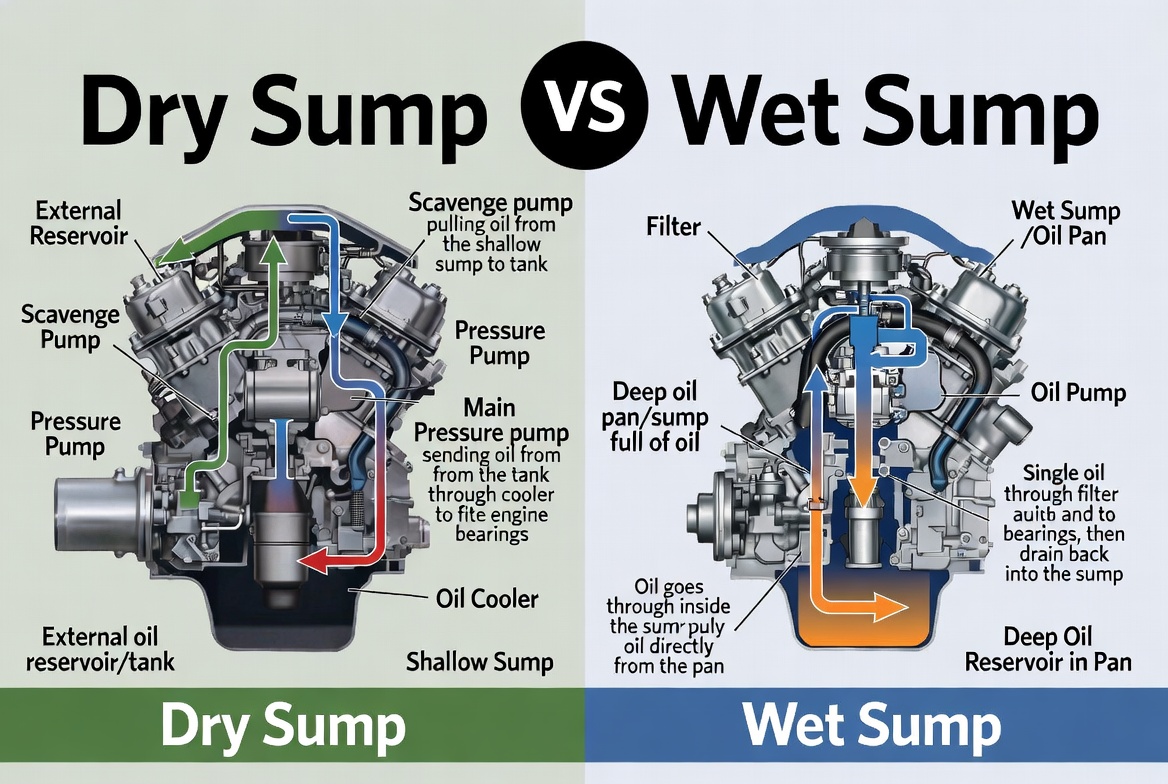
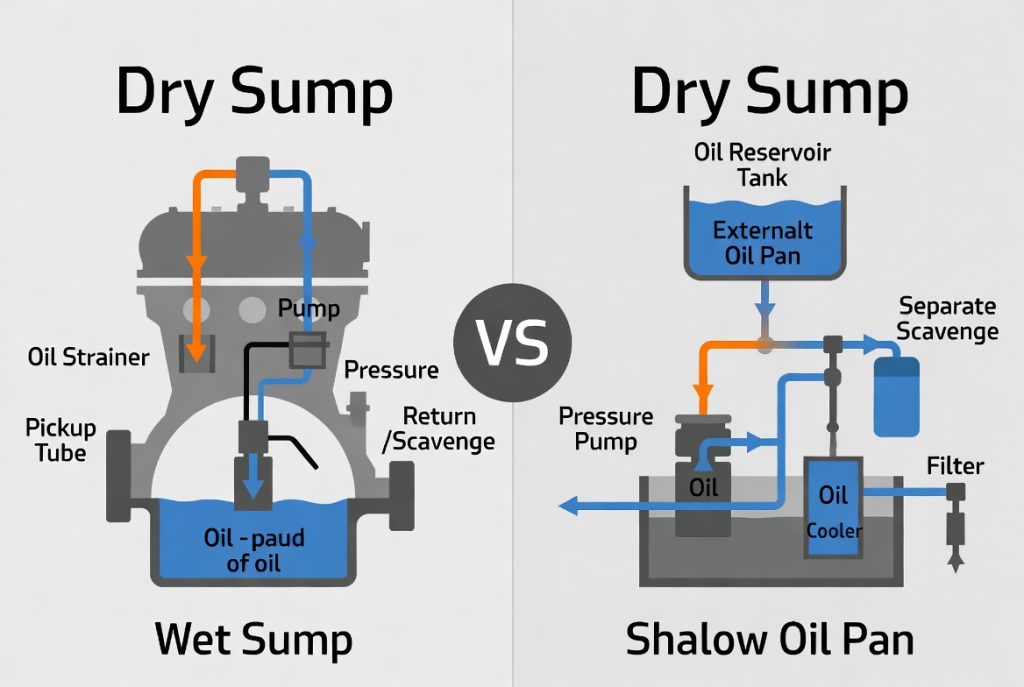
In a wet sump system, all the oil sits in a tank at the bottom of your engine. This tank is called the oil pan. The oil pump pulls oil from this pan and sends it up through the engine. The oil does its job—cooling and lubricating everything. Then gravity brings it back down to the pan.
That’s it. That’s the whole system.
How the Wet Sump Works
Let’s break it down step by step:
- Oil Storage: Oil hangs out in the oil pan beneath the engine
- The Pump: An oil pump (powered by the engine) sucks oil from the pan
- Delivery: Oil travels through passages to lubricate bearings, pistons, and valve train components
- Cooling: The oil absorbs heat as it circulates
- Return: Used oil falls back down to the pan by gravity
- The Cycle Repeats: The pump keeps working as long as the engine runs
The wet sump method is incredibly reliable. It’s been used in cars since engines were first invented. There’s a reason it’s still the standard today.
Advantages of Wet Sump Systems
Cost-Friendly: Wet sump setups are cheap to manufacture and easy to maintain. You won’t break the bank at the shop.
Simple Design: No complicated extra parts. Just a pan, a pump, and some tubes. Even beginners can understand it.
Space-Saving: Everything fits under the engine. No need for extra tanks or lines sticking out.
Maintenance: Oil changes are straightforward. You drain the pan, swap the filter, and refill.
Reliable: It’s been tested for decades. Millions of cars run on wet sump systems without problems.
Disadvantages of Wet Sump Systems
Slosh and Starvation: This is the big problem. When you corner hard, accelerate, or go off-road, the oil sloshes around in the pan. During hard cornering, the oil can move away from the pump inlet. For a split second, the pump sucks air instead of oil. Your engine doesn’t get lubricated. This is called oil starvation.
G-Force Issues: Sports cars and race cars pull crazy G-forces. A wet sump can’t handle it. The oil pool moves around too much.
Performance Limits: You can’t run a high-revving engine on a wet sump without risking oil starvation. The faster the engine spins, the worse the problem gets.
Engine Height: The oil pan sits below the engine. This makes the whole car sit higher. Lower cars perform better. A bigger oil pan can’t hang as low.
What Is a Dry Sump System? (The High-Performance Option)
A dry sump is more complicated. It’s engineered for extreme conditions. Think race cars, supercars, and high-output performance engines.
In a dry sump system, there’s no big oil pool under the engine. Instead, oil gets stored in a separate tank somewhere else—maybe in the frame, the trunk, or the side of the car. Pumps work overtime to move oil to the engine and pull it back out.
It sounds more complex because it is. But that complexity buys you serious advantages.
How the Dry Sump Works
Here’s the basic process:
- Remote Storage: Oil lives in a tank mounted away from the engine
- Pressure Pump: A pump pushes oil from the tank to the engine
- Scavenging Pumps: Multiple pumps pull oil away from the engine and send it back to the tank
- Cooling: Oil gets cooled (usually with an external cooler) before going back to the engine
- Filtering: Oil passes through filters before returning to the tank
- Pressure Control: Special valves keep pressure balanced throughout
The scavenging pumps are the real trick. They actively suck oil out of the engine and back to the tank. Gravity can’t do it alone.
Why Scavenging Pumps Matter
Most of the time, oil naturally falls back down from the engine. But in extreme situations—hard cornering, acceleration, or high-speed driving—oil doesn’t fall straight down. The scavenging pumps grab that oil and pull it out anyway.
This means the oil never runs out. The pump never sucks air. The engine always has oil. Even at 8,000 RPM while cornering at full throttle.
Advantages of Dry Sump Systems
Oil Control: You control exactly how much oil is in the engine at any moment. Add a little bit, the engine runs thin and light. That’s better for performance.
No Starvation: Scavenging pumps remove oil no matter what. Cornering hard? No problem. The pumps are working.
Better Cooling: Oil spends time in the external tank. It cools down more than in a wet sump. Hot oil breaks down faster. Cool oil lasts longer.
Lower Engine Mounting: Without a giant sump underneath, the engine sits lower in the car. This lowers the center of gravity. Better handling. Better performance.
Extreme Performance: Racecars, supercars, and high-revving machines all need dry sumps. No ifs, ands, or buts.
Pressure Management: You can fine-tune oil pressure for different driving conditions. This helps engines perform their best.
Higher Capacity: The external tank can be enormous. More oil means better cooling and longer life between changes.
Disadvantages of Dry Sump Systems
Cost: Dry sumps are expensive. Really expensive. The extra pumps, tank, lines, and controls add thousands to the price.
Complexity: More parts means more things can go wrong. Maintenance becomes harder.
Packaging: You need room for a separate tank. That space can’t be used for other stuff. In small cars, this is a problem.
Weight: More pumps and plumbing add weight. Modern engineering minimizes this, but it’s still there.
Noise: The scavenging pumps make noise. Some people don’t like it.
Service Requirements: If something breaks, fixing it costs real money. Technicians need special training.
Direct Comparison: Wet Sump vs Dry Sump
Let’s line them up side by side and see how they really stack up.
| Factor | Wet Sump | Dry Sump |
|---|---|---|
| Cost | Cheap | Expensive |
| Complexity | Simple | Complex |
| Engine Height | Taller (pan hangs low) | Lower (no pan underneath) |
| Performance Limit | Moderate | Extreme |
| Oil Starvation Risk | Yes (during hard driving) | No |
| Cooling Efficiency | Good | Excellent |
| Maintenance | Easy | Hard |
| Best For | Daily drivers, regular cars | Race cars, supercars |
| Space Requirements | Just under engine | Separate tank needed |
| Noise Level | Quiet | Louder pumps |
Which System Should Your Car Use?
Most people driving to work don’t need a dry sump. Seriously. A wet sump does the job perfectly fine.
Wet Sump Is Right If You:
- Drive a normal car to work and back
- Don’t push your engine to extreme RPMs
- Want simple, cheap maintenance
- Park in tight spaces (no room for extra tanks)
- Just want reliable oil lubrication without drama
Basically, if you’re not a racer, stick with wet sump.
Dry Sump Is Right If You:
- Drive a high-performance sports car or supercar
- Race on tracks
- Push your engine hard in corners and acceleration
- Want the absolute best cooling performance
- Have the budget for sophisticated systems
- Drive a car that was engineered with a dry sump in mind
High-end manufacturers like Ferrari, Lamborghini, and Porsche use dry sumps for good reason. Their cars operate at performance levels that wet sumps simply can’t handle.
Performance Implications: How These Systems Affect Driving
Here’s where things get real. The choice between these two systems actually changes how a car drives.
Wet Sump Performance Characteristics
In a regular car with a wet sump, you feel the oil moving around. Corner hard, and the engine is working with whatever oil happens to be on the pump’s intake. Push the accelerator aggressively while turning, and oil sloshes away from the pump. The engine loses lubrication for a moment. Not long—usually just a fraction of a second. But it happens.
This limitation is built into the system. Engineers design engines knowing this. They keep RPMs reasonable. They don’t expect extreme lateral G-forces.
For normal driving, you never notice. The engine is designed for this. Everything works fine.
Dry Sump Performance Characteristics
In a car with a dry sump, scavenging pumps are always working. Oil stays in the engine no matter what you do. Corner at 1.5 Gs? Oil is still there. Accelerate hard while turning? Still there. Pull 2.5 Gs on a track? Still there.
This means the engine can rev higher without worrying about starvation. You can push harder into corners. The car responds to aggressive driving the way the engineers intended.
For normal driving, you barely notice the difference. The car just works. But when you actually push it, the dry sump system lets the engine deliver full power without any hesitation.
Racing and Extreme Performance
In racing, the difference is huge.
Race engines often run at 8,000 to 10,000 RPM for hours straight. They pull multiple Gs while cornering. They accelerate hard on top of that. A wet sump would fail instantly. Oil starvation would damage the engine within minutes.
Dry sumps were invented for this reason. Racers needed a system that could handle these extremes. Dry sumps delivered. Now they’re standard in motorsports.
As high-performance street cars became faster and faster, manufacturers started using dry sumps on them too. A Ferrari or Lamborghini needs to handle track driving safely. A wet sump wouldn’t cut it.
Oil Movement and Aeration
There’s a technical term worth understanding: aeration. This is when air gets mixed into your oil. Air bubbles in your oil are bad news. They don’t cool or lubricate as well as liquid oil.
Aeration in Wet Sump Systems
During hard driving, the oil in a wet sump gets churned up. The crankshaft dips into the oil pan, spinning fast. This agitates the oil. Air gets mixed in. The oil picks up more air as it sloshes around.
Aerated oil doesn’t protect as well. Your engine runs slightly hotter. Parts wear faster.
Good engineers design wet sump pans to minimize this. They add baffles to keep the oil calm. But it’s always a compromise.
Aeration in Dry Sump Systems
Scavenging pumps pull oil out quickly and efficiently. The external tank lets air bubbles rise out of the oil. The oil settles and cools. By the time it goes back to the engine, it’s calm and bubble-free.
Aeration is almost never a problem in a dry sump. The system is designed to prevent it.
Maintenance and Real-World Costs
Let’s talk money. This matters to most people.
Wet Sump Maintenance
An oil change in a wet sump is cheap and easy. Pop under the car. Unscrew the drain plug. Let the oil drain. Screw it back in. Change the filter. Add new oil. Done.
Parts are cheap. Labor is minimal. An oil change costs fifty bucks or less at most shops.
If something goes wrong with a wet sump, fixing it is straightforward. The pump dies? Replace the pump. It’s bolted on and accessible. A few hours of labor.
Dry Sump Maintenance
An oil change on a dry sump is more involved. There are more filters. The tank is in a weird location. Draining and refilling takes longer. You’re probably paying a hundred dollars or more.
If something fails, repairs get pricey fast. The scavenging pump system is integrated into the engine. A failed pump might require tearing into the engine. You’re talking thousands of dollars.
Regular maintenance is crucial. Skip an oil change on a dry sump, and things get expensive real fast. The external cooler needs to be kept clean. Lines need to be checked for leaks.
It’s not terrible, but it’s definitely not cheap.
Real-World Application: Which Cars Use What
Let’s look at what you’ll actually see on the road.
Wet Sump Cars (Most Everything)
Your Honda Civic? Wet sump. Your Toyota Camry? Wet sump. Your Ford F-150? Wet sump. Your Chevy Malibu? Wet sump.
Basically, if it’s a regular person car, it’s got a wet sump. Millions of them run perfectly fine every single day.
Even some performance cars use wet sumps. A Dodge Challenger RT? Wet sump. A Chevy Camaro? Wet sump. These cars don’t need the extreme capability of a dry sump for normal driving. A good wet sump design handles their performance needs.
Dry Sump Cars (High-End Performance)
Ferrari? Dry sump. Lamborghini? Dry sump. Porsche 911? Mostly dry sump on newer models. McLaren? Dry sump. Bugatti? Dry sump.
The most expensive, most extreme performance cars use dry sumps because they have to.
Some sports cars are at the borderline. A Chevrolet Corvette Z06? Dry sump. A Nissan GT-R? Dry sump. These cars push performance hard enough that engineers decided a dry sump was necessary.
Common Misconceptions About These Systems
People get confused about this stuff. Let me clear up some myths.
Myth #1: Dry sumps are always better.
Nope. They’re better for specific situations—high performance, extreme driving, racing. For normal cars, they’re overkill and expensive.
Myth #2: Wet sumps will always have oil starvation problems.
Also not true. Modern wet sump designs are smart. Engineers have gotten really good at minimizing starvation. Most wet sump cars never experience it.
Myth #3: Dry sumps never leak.
Wrong again. Dry sumps have more lines and connections. More connections mean more places to leak. They actually leak more often than wet sumps.
Myth #4: You need a dry sump for a fast car.
False. Plenty of fast cars use wet sumps just fine. A well-designed wet sump can handle real performance.
Myth #5: Dry sumps need oil changes more often.
They might need them more often in extreme conditions, but in normal driving, the interval is similar to wet sumps.
The Technical Deep Dive: Why Oil Starvation Happens
Let’s get a bit technical here. This explains why dry sumps exist.
Your engine has an oil pump. This pump has an intake port. The port sits in the oil in the sump. As long as oil covers this intake, the pump works fine.
But when you corner hard or accelerate, the oil shifts. The whole pool of oil moves toward one side of the pan. For a moment, the intake port might end up above the oil level. The pump sucks air. No oil reaches the bearings. The engine runs dry.
This happens in fractions of a second. But that’s enough time to damage the engine if it happens repeatedly.
The solution: multiple scavenging pumps that pull oil out and keep it coming. The pump intake never runs dry because the oil is being managed actively.
Temperature Management and Engine Longevity
Temperature matters hugely for engine life.
Wet Sump Cooling
In a wet sump, oil cools down as it sits in the pan. The pan has lots of surface area exposed to air. As the car drives, air flows past it, carrying heat away.
But the oil still gets hot. Race cars pushing limits can boil the oil in a wet sump. The hotter it gets, the thinner it becomes. Thin oil doesn’t protect as well.
Dry Sump Cooling
A dry sump system includes an external cooler—basically a radiator for oil. The oil passes through this cooler every cycle. It removes way more heat than sitting in a pan.
The external tank also lets oil cool down between cycles. The result is much lower oil temperatures.
Lower temperatures mean thinner oil breaks down slower. Your engine lasts longer.
Modern Engineering and Hybrid Approaches
Newer cars are getting creative. Some manufacturers are developing hybrid systems that try to get benefits of both approaches.
Some use modified wet sump setups with baffles and multiple pumps to reduce starvation risk. Others use dry sumps on track cars but regular wet sumps on street versions of the same car.
Ford GT? It uses a dry sump. But most Fords use traditional wet sumps. The decision depends on what the car needs to do.
Making the Right Choice for Your Situation
Here’s the bottom line: choose based on what you actually do with your car.
Do you daily drive to work? Get a car with a wet sump. It’s cheaper, simpler, and works perfectly.
Do you track your car on weekends? Consider a dry sump setup if the car was designed with one. It’ll protect your engine better under extreme conditions.
Are you building a custom car? Think about your real-world needs. High-revving street car? Maybe dry sump. Daily driver with some spirited driving? Wet sump works fine.
Don’t pay for dry sump complexity if you don’t need it. Don’t cheap out on a wet sump if your car needs more protection.
Conclusion: It’s All About Purpose
Wet sumps and dry sumps both do the same job: get oil to the engine. But they do it differently, and that difference matters.
Wet sumps are simple, cheap, and reliable. They work great for normal cars and normal driving. Millions of cars use them successfully every single day.
Dry sumps are complex, expensive, and engineered for extreme performance. They’re necessary for race cars and high-end supercars. They keep engines alive in conditions where wet sumps would fail.
Neither is “better” overall. They’re just designed for different jobs.
Understand what your car needs. Understand what these systems do. Make informed choices about maintenance and driving. That’s all it takes to keep your engine running strong for years to come.
Whether you’re shopping for a car or just curious about how engines work, now you know the real difference between these two systems. Your next conversation about cars just got a lot smarter.