10W 30 vs 5W 30 Motor Oil
Introduction: Why Your Oil Choice Matters
Your car’s engine is like the heart of your vehicle. It pumps, it works hard, and it needs the right fluid to keep everything running smooth. Motor oil is that fluid. It’s not just some gooey stuff you pour in and forget about. The type of oil you use can change how your car runs, how long it lasts, and even how much you spend on repairs down the road.
But here’s the thing: walk into any auto parts store and you’ll see bottles and bottles of different oils. The numbers on the bottles look confusing. What does 10W 30 mean? What about 5W 30? Are they the same? Should you care about the difference?
You absolutely should. And I’m going to break it down for you in plain language.
What Do These Numbers Actually Mean?
Let’s start with the basics. Those numbers are not random. They tell you something important about how the oil behaves.
The “W” stands for “winter.” It’s the key to understanding the whole thing. The number before the W tells you how thick the oil is when it’s cold. The number after the W tells you how thick it is when your engine is hot.
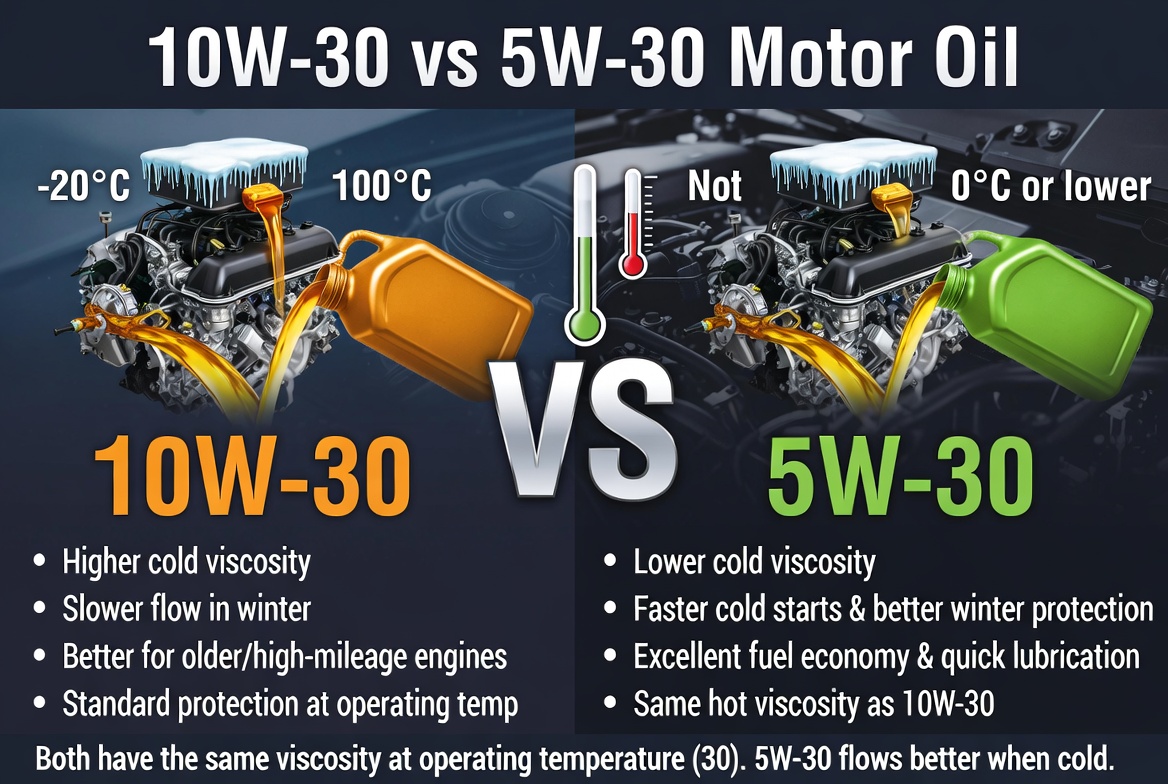
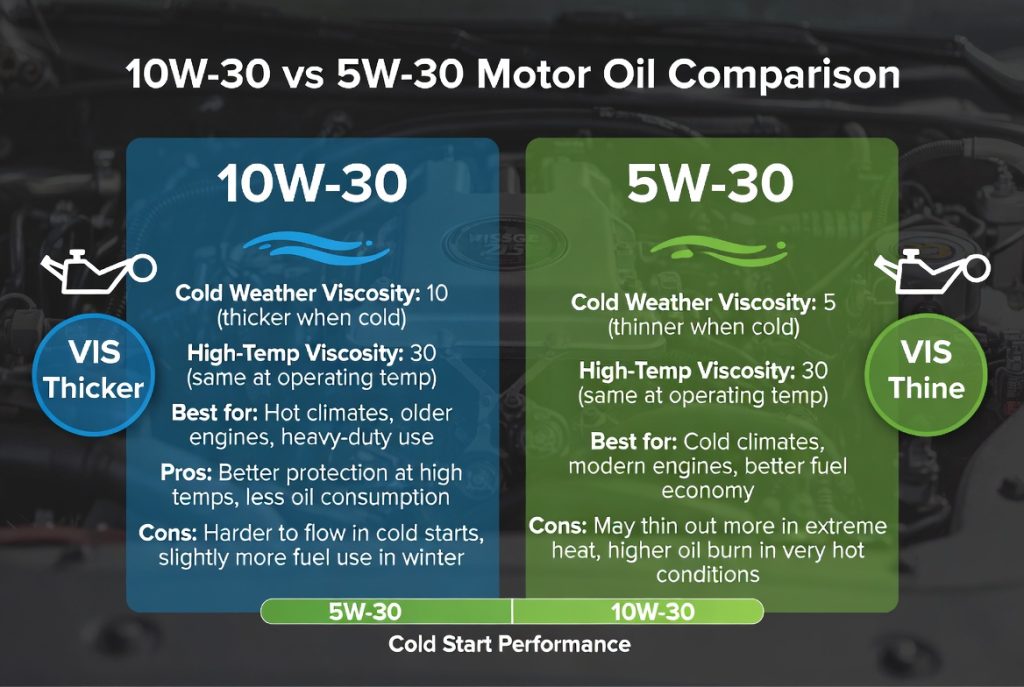
So in 5W 30, the “5” means the oil is thin when it’s cold. In 10W 30, the “10” means the oil is thicker when it’s cold.
Think of it like honey. Cold honey is stiff and moves slowly. Warm honey flows easier. Motor oil works the same way. Cold engines need thinner oil so it can move around and do its job. Hot engines need thicker oil so it doesn’t get too runny and lose its protective power.
The higher the number before the W, the thicker the oil stays in cold weather. The higher the number after the W, the thicker the oil stays when hot.
The Cold Start Advantage: Why Winter Viscosity Matters
When you start your car on a cold morning, something important happens. Your engine is not warm yet. The oil inside is cold and thick. If the oil is too thick, it won’t flow where it needs to go fast enough. Your engine parts won’t get protected right away.
This is where 5W 30 shines. The “5” means it flows like oil with a lower viscosity rating at cold temperatures. Your engine gets lubrication faster. All those moving parts get covered in oil quickly.
With 10W 30, the oil is stiffer when cold. It takes a bit longer to reach all the spots that need protection. Your engine has to work a little harder to pump that thicker oil around.
For people who live in cold climates, this matters a lot. Starting your car in freezing temperatures becomes easier and safer with 5W 30. Your engine won’t have to strain as hard.
But what if you live somewhere warm? The difference becomes less important. A 10W 30 will still flow when it’s 40 degrees outside. It’s just not as quick as 5W 30 would be.
Hot Weather Performance: The Second Number Counts
Now flip the situation. Your engine is running. It’s getting hot. Really hot. We’re talking 200 degrees Fahrenheit or more.
At this temperature, oil that’s too thin breaks down. It stops protecting your engine. It can burn off faster. Your engine might overheat.
This is where the number after the W comes in. Both 5W 30 and 10W 30 have a “30” at the end. This “30” means they have the same thickness when hot. They perform exactly the same way in hot conditions.
So when your engine is running and warm, there’s no difference between these two oils. None. They protect your engine the same way.
The only difference is how they behave when cold.
Engine Type and Oil Recommendations: What Does Your Car Need?
Most car makers have recommendations. Your owner’s manual is like the rule book for your vehicle. It tells you exactly what oil your car wants.
Some cars call for 5W 30. Others want 10W 30. Some can take either one.
Why the difference? It comes down to engine design and how the manufacturer tested the engine. Some engines run fine on thicker oil when cold. Others need thinner oil to work properly.
Here’s the important part: follow what your manual says. Don’t guess. Don’t assume. Look it up. Your car was designed with specific oil in mind.
If your manual says 5W 30, use 5W 30. If it says 10W 30, use that instead. If it says “5W 30 or 10W 30,” then you have a choice.
Using the wrong viscosity can mess things up. You might get worse fuel economy. Your engine might not perform right. In some cases, you could damage your engine over time.
Climate and Location: A Big Factor in Your Decision
Where you live plays a huge role in which oil you should pick.
Cold Climates
If you live somewhere that gets really cold, 5W 30 is probably your best bet. The lower number before the W means better cold flow. Your car starts easier on those freezing mornings. The oil reaches your engine parts faster.
Cold climates mean winter is long and harsh. You might have months of temperatures below 32 degrees. In these conditions, 5W 30 is worth it. Your engine will thank you.
Warm Climates
If you live in a hot place and rarely see freezing temperatures, 10W 30 works just fine. Cold starts aren’t a problem because your car doesn’t sit in freezing weather. The thicker cold-flow rating doesn’t hurt you. And since the hot rating is the same (30), your engine gets the same protection when running.
Mixed Climates
What if you get winter and summer? Both hot and cold throughout the year?
This is where many people are. You might get cold winters but hot summers. In this case, 5W 30 is the safer choice. It handles both situations well. When it’s cold, you get the thinner oil. When it’s hot, the oil thickens to the right level.
You could use 10W 30 too. Your engine will work fine. But you’ll lose some of that cold-start benefit. Many people in mixed climates lean toward 5W 30 just to be safe.
Fuel Economy: Does Oil Viscosity Affect Your Gas Mileage?
Here’s a question a lot of people have: will my choice of oil affect how much gas I use?
The answer is yes, but only a little bit.
Thinner oil creates less drag inside your engine. Less drag means your engine doesn’t have to work as hard. When your engine doesn’t work as hard, it uses less fuel.
The difference between 5W 30 and 10W 30 is small. We’re talking maybe one or two percent better fuel economy with 5W 30. That’s not huge. But over a year, it adds up to real money for some people.
Cold starts matter most for fuel economy. When you first fire up your engine, it’s cold. Thinner oil helps it run more smoothly right away. The engine reaches normal temperature faster. Your car burns less gas during that startup period.
If you do a lot of short trips or live somewhere cold, 5W 30 might give you a tiny advantage with gas mileage.
If you do long highway drives or live somewhere warm, the difference is almost nothing.
Engine Wear and Protection: Are They Different?
Both 5W 30 and 10W 30 protect your engine when it’s running. Remember, they’re both “30” when hot. At operating temperature, your engine gets the same protection from either oil.
The real protection comes from what’s inside the oil itself. Modern oils have additives. These additives:
- Fight rust and corrosion
- Keep dirt and sludge suspended so they don’t clog your engine
- Protect metal surfaces from wear
- Reduce friction
- Help the oil stay clean longer
These additives are the same in quality 5W 30 oils and quality 10W 30 oils. The viscosity rating doesn’t change what’s inside.
So engine wear during normal operation is basically the same with both oils. The only difference is how fast the oil reaches your engine during a cold start.
Synthetic vs. Conventional: More Important Than The Numbers
Here’s something that matters more than whether you pick 5W or 10W: whether you pick synthetic or conventional.
Synthetic oil is made in a lab. It’s designed from the ground up to be the perfect oil. It has better additives. It lasts longer. It handles heat and cold better. It costs more money.
Conventional oil comes from crude oil. It’s refined and has additives mixed in. It works well but doesn’t last as long as synthetic. It costs less money.
You can get 5W 30 or 10W 30 in either synthetic or conventional form.
Here’s the real deal: a quality synthetic 10W 30 will often outperform a cheap conventional 5W 30. The type of oil matters as much as or more than the viscosity rating.
Check your manual. Some modern cars require synthetic oil. Others recommend it but allow conventional oil. Some older cars should stick with conventional.
If your car can take either, synthetic gives you better protection and longer oil change intervals.
Switching Oils: What Happens If You Make A Mistake?
Let’s say you’ve been using 5W 30, but you accidentally buy 10W 30. Or vice versa. What happens?
Don’t panic. You won’t destroy your engine by running one oil change with the wrong viscosity.
Your engine will just work slightly differently. If you put 10W 30 in a car that calls for 5W 30, it will start a bit slower on cold mornings. That’s it. The engine will warm up and work normally once it’s running.
If you put 5W 30 in a car that calls for 10W 30, your engine will start quickly in the cold. But if your car was designed for 10W 30, there might be a reason. It could affect oil pressure or flow rate. But one oil change won’t wreck anything.
The problem comes when you keep using the wrong oil. Over time, you might:
- Get worse fuel economy (if the oil is too thick)
- Have trouble starting in cold weather (if the oil is too thick)
- Potentially affect engine performance
So if you mess up, just switch back at your next oil change. One tank is fine.
Oil Change Intervals: Does Viscosity Change How Often You Change Oil?
The viscosity rating doesn’t affect how often you need to change your oil.
Synthetic and conventional oils have different change intervals. Synthetic lasts longer (sometimes 7,500 to 10,000 miles). Conventional needs changing sooner (usually 3,000 to 5,000 miles).
But 5W 30 and 10W 30? They have the same recommended change interval. Your car’s manual will tell you when to change it.
The only thing that changes when you switch oils is the change interval if you switch between conventional and synthetic.
Cost Comparison: Is One More Expensive Than The Other?
Here’s the simple answer: 5W 30 and 10W 30 cost about the same. The price difference is usually from the brand, not the viscosity rating.
A synthetic 5W 30 from Brand A might cost the same as a synthetic 10W 30 from Brand A. A conventional 5W 30 from the same brand will be similar in price too.
Where prices differ is between brands and between synthetic and conventional. A bottle of synthetic oil costs way more than a bottle of conventional oil. But the viscosity rating doesn’t change the price much.
Real World Scenarios: When Each Oil Shines
Scenario 1: Northern Driver, Cold Winters
You live up north. Winters are brutal. Temperatures drop to 20 degrees and colder. You start your car when it’s freezing.
Best choice: 5W 30.
Your car needs oil that flows at cold temperatures. On a 10-degree morning, 5W 30 will pump through your engine fast. Your engine won’t strain. Your battery won’t work as hard to crank the engine. Everything just works better.
Scenario 2: Warm Climate, Hot Weather
You live in the south or southwest. It’s hot most of the time. Winter is mild, maybe 40 or 50 degrees at the coldest.
Best choice: Either one, but check your manual.
Cold starts aren’t your problem. Thick oil won’t bother you. Both oils will start your engine fine. The hot rating (30) is the same, so your engine gets identical protection once it’s running. Follow what your manual says. If it allows either one, pick the cheaper option.
Scenario 3: Person Who Wants Maximum Protection
You want your car to last forever. You do everything right. You drive carefully. You change your oil on time.
Best choice: Quality synthetic 5W 30.
Why? The synthetic part matters more than the viscosity. Quality synthetic oil lasts longer and protects better. It handles temperature swings well. The 5W part gives you an edge on cold starts. Together, they give your engine the best chance at a long, healthy life.
Scenario 4: Older Car, Not Sure What To Use
You have an older car. The manual is gone. You’re not sure what oil it needs.
Best choice: Ask a mechanic or check online forums for your car model.
Don’t just guess. The wrong oil could cause problems in older engines. A quick call to a mechanic or a search online will get you the answer. Once you know, stick with it.
Common Myths About These Oils
Myth 1: Thinner Oil Means Your Engine Will Get Worn Out Faster
False. Both oils have the same protection when your engine is hot and running. The viscosity only matters when cold. Thinner oil isn’t weaker oil.
Myth 2: You Can Mix Different Viscosity Oils
Not a great idea. Your engine was designed for a specific oil. Mixing different viscosities could affect flow and pressure. If you’re out of oil and emergency top off, use what you have. But don’t make it a habit.
Myth 3: All 30-Weight Oils Are Identical
No. The quality varies between brands. One 10W 30 from Brand A might be much better than a 10W 30 from Brand B. The additives, the refining process, and the quality control matter.
Myth 4: You Don’t Need To Change Your Oil If You’re Not Driving Much
Wrong. Even if your car sits most of the time, your oil breaks down. It gets dirty. Oil still needs changing on the time schedule in your manual, not just mileage.
Reading Your Owner’s Manual: The Definitive Answer
Here’s the truth: your car’s owner’s manual is the final word on oil choice.
Not me. Not your neighbor. Not the guy at the auto parts store. Your manual.
The engineers who designed your engine tested it with specific oils. They figured out what works best. They put that information in your manual for a reason.
Open it up. Find the maintenance section. Look for “engine oil.” It will tell you:
- The exact viscosity your car needs
- Whether synthetic or conventional is okay
- The capacity (how much oil to put in)
- When to change it
Follow these instructions. Your car will run better and last longer.
How To Pick Between Them: Your Decision Tree
Still not sure? Here’s a simple decision process:
Step 1: Check Your Manual
What does it say? Use that. Done.
Step 2: Manual Says “5W 30 or 10W 30”?
Move to Step 3.
Step 3: Where Do You Live?
Cold climate? Pick 5W 30.
Warm climate? Pick either one, but check if one is recommended over the other.
Step 4: How Often Do You Drive?
Lots of short trips in cold weather? Pick 5W 30 for better cold starts.
Mostly highway driving in warm weather? Pick 10W 30 (or either one).
Step 5: Budget?
Prices are basically the same, so this doesn’t matter. Pick the brand that has good reviews.
When To Switch Your Oil Type
You might need to switch oils in certain situations:
- You move to a much colder or warmer climate
- Your car manual recommends a switch for seasonal use (some older cars suggest thinner oil in winter, thicker in summer)
- You want to try synthetic oil for better protection
- Your mechanic recommends a change based on your driving
Don’t switch just because. Have a good reason. And always check your manual first.
Maintaining Your Oil System
No matter which oil you choose, keep it in good shape:
- Check your oil level once a month
- Change your oil on schedule
- Use the right oil filter
- Don’t ignore warning lights
- Have your engine checked if something feels wrong
Good oil maintenance beats picking the perfect oil viscosity. An old car with excellent oil changes will outlast a new car with poor oil maintenance.
The Bottom Line
Here’s what you need to know:
5W 30 is thinner when cold. 10W 30 is thicker when cold. Both are the same when hot.
If you live somewhere cold, 5W 30 is better. If you live somewhere warm and your manual allows either one, pick 10W 30 or 5W 30 based on what’s recommended and available.
The most important thing is to use what your manual says. The second most important thing is to change your oil on time with a quality oil.
Whether you pick 5W 30 or 10W 30, you’re fine as long as your manual approves it. The difference is small. What matters way more is using clean oil and changing it regularly.
Take care of your oil. Your engine will take care of you.
Frequently Asked Questions
Q: Can I switch between 5W 30 and 10W 30?
A: Only if your manual says both are okay. If it specifies one, stick with that one.
Q: Will 5W 30 make my car run faster?
A: No. It just starts easier in cold weather. Performance is the same once the engine warms up.
Q: Is 5W 30 always better?
A: Not always. If your car calls for 10W 30, use that. If you live somewhere warm, 10W 30 works great.
Q: How do I know if I have the wrong oil?
A: Check your receipt. Check your manual. If they don’t match, you might have the wrong oil.
Q: Does brand matter more than viscosity?
A: Both matter. Use the right viscosity first. Then pick a quality brand.
Q: Can I use 0W 30 if I live somewhere very cold?
A: If your manual allows it, yes. 0W 30 is even thinner when cold than 5W 30. But only use it if your manual says it’s okay.
Q: How often should I check my oil level?
A: Once a month is good. More often if you drive a lot or have an older car.
Q: What happens if I overfill my oil?
A: The engine might not work right. Oil could get into parts where it shouldn’t be. Always fill to the “max” line, not above it.
Conclusion: Make The Right Choice For Your Car
Oil viscosity matters, but not as much as you might think. The difference between 5W 30 and 10W 30 is real but small. Both are excellent oils when they’re the right choice for your situation.
The real key is knowing what your car needs and giving it that. Check your manual. Pick the right viscosity. Use a quality brand. Change it on time.
Do these things and your engine will run strong for many years. Your car will be more reliable. You’ll save money on repairs. You’ll drive with confidence.
And that’s all that really matters.
Now go check your owner’s manual. Find out what your car wants. Grab the right oil. Take care of your engine. Simple as that.
Your car is counting on you.