Car Wing vs Spoiler
You’ve seen them on race cars, sports cars, and even some regular street vehicles. Those pieces of metal or carbon fiber sitting on the back of cars look pretty cool. But what are they actually doing there?
Most people use the words “wing” and “spoiler” like they mean the same thing. They don’t. These two parts work in totally different ways. They have different jobs to do on your car.
Let’s break down what makes them different and why you might want one over the other.
What Exactly Is a Spoiler?
A spoiler sits close to the body of your car. You’ll usually find it on the trunk lid or at the top of the rear windshield. It’s called a “spoiler” because it spoils something.
But what does it spoil?
Think about air flowing over your car. As your car moves forward, air flows up the hood, over the roof, and down the back. When air reaches the rear of your car, it starts to get messy. The air creates turbulence and drag.
This messy air isn’t just annoying. It actually slows your car down. Your engine has to work harder to push through all that resistance.
A spoiler breaks up this airflow. It “spoils” the smooth movement of air that would otherwise create drag and lift. The result? Your car becomes more stable and efficient.
Spoilers work by redirecting air. They don’t push your car down like you might think. They just make the airflow cleaner and less chaotic. This helps reduce the lifting force that builds up at higher speeds.
What’s a Wing Then?
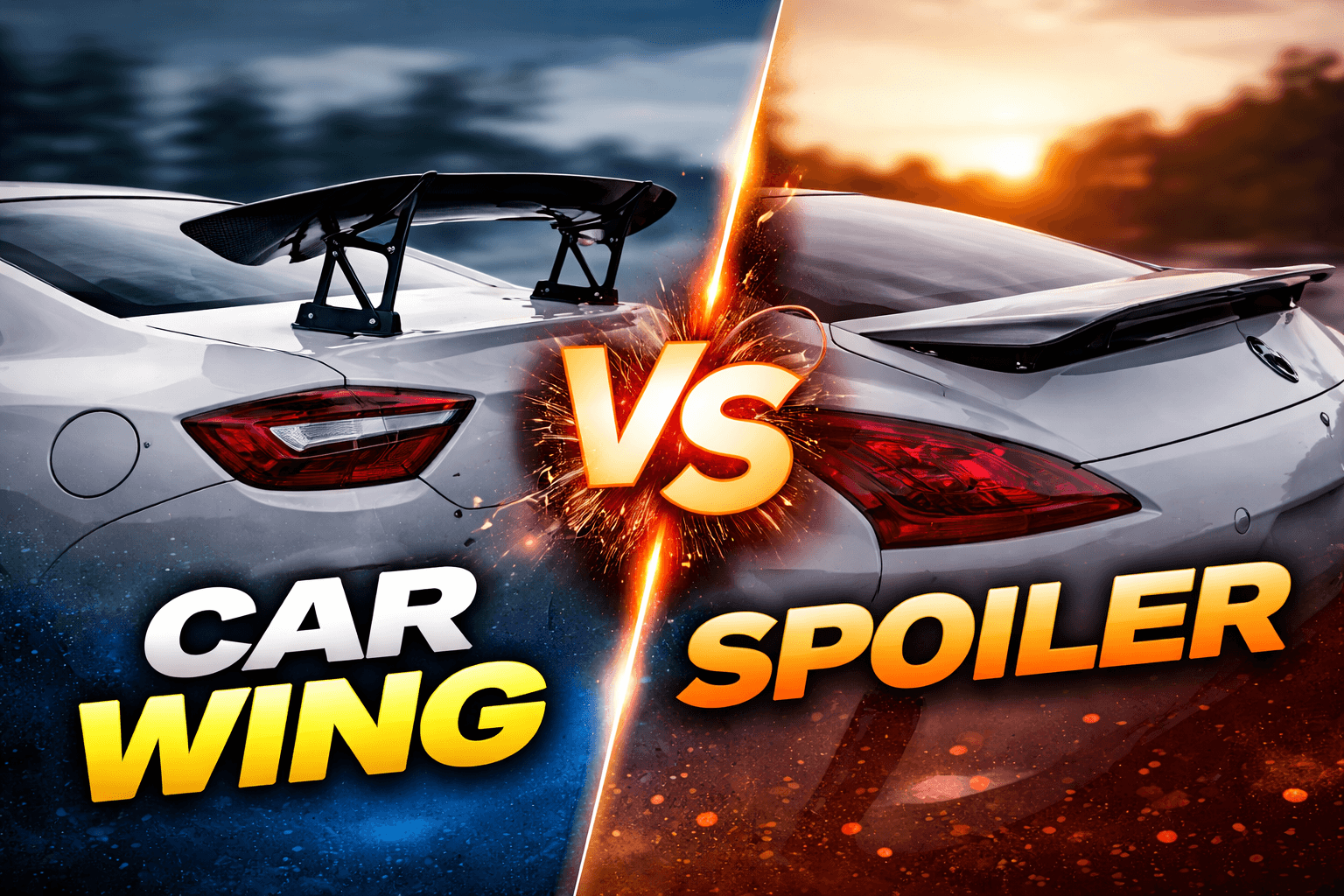
A wing looks different right away. It sticks up from the car’s body on supports or pedestals. There’s actual space between the wing and the trunk.
Wings work using the same principle as airplane wings, just upside down. Airplane wings create lift to get the plane off the ground. Car wings create downforce to keep the car stuck to the road.
Here’s how it works:
Air flows both over and under the wing. The wing’s shape forces air to move faster over the top than underneath. This speed difference creates pressure. Lower pressure on top, higher pressure below. The result pushes the car down toward the road.
This downforce gives your tires more grip. More grip means better handling through corners. You can take turns faster without losing control.
Race cars use wings all the time. That’s because racing is all about cornering speed and traction. The faster you can go through a turn, the better your lap times.
The Key Differences Between Wings and Spoilers
Let’s look at what separates these two parts:
How They’re Mounted
Spoilers attach directly to your car’s body. They’re flat or slightly angled. They hug the rear of the vehicle.
Wings mount on stands or brackets. They sit higher up. There’s a gap between the wing and the car body.
How They Work
Spoilers reduce drag and turbulence. They clean up the airflow. They don’t create much downforce.
Wings generate actual downforce. They push the car toward the ground. They use aerodynamic principles to create grip.
Speed Requirements
Spoilers help at moderate speeds. You’ll notice benefits starting around 50 to 60 miles per hour. They’re useful for everyday driving.
Wings need higher speeds to work well. Below 60 or 70 miles per hour, they don’t do much. At track speeds, they really shine.
Impact on Performance
Spoilers improve fuel efficiency by reducing drag. They make your car more stable. They don’t add much weight.
Wings improve cornering and handling. They let you take turns faster. But they can hurt fuel economy because they create drag along with downforce.
Why Would You Want a Spoiler?
Spoilers make sense for regular street cars. Here’s why:
Your daily driver doesn’t hit track speeds. But you still want stability on the highway. A spoiler gives you that without hurting fuel economy too much.
Many modern cars come with spoilers from the factory. Car makers design them to match the vehicle’s aerodynamics. They’re not just for looks. They actually improve how the car cuts through the air.
A good spoiler can:
- Reduce fuel consumption on highway drives
- Improve stability at highway speeds
- Keep your rear window cleaner by directing air over it
- Add a sporty look without being too flashy
The benefits might seem small. But over time, they add up. Less drag means less work for your engine. Less work means less fuel burned.
When Does a Wing Make Sense?
Wings are for performance driving. If you track your car or race competitively, a wing is your friend.
The downforce from a wing helps you in specific ways:
Your tires grip the road better through corners. You can brake later going into turns. You can get on the throttle earlier coming out of turns. All of this adds up to faster lap times.
Professional race cars have adjustable wings. Drivers can change the wing’s angle. More angle means more downforce but also more drag. Less angle means less downforce but higher top speed.
This adjustability lets drivers tune their car for different tracks. A track with lots of corners needs more downforce. A track with long straights benefits from less drag.
Street cars with wings usually can’t adjust like this. The wing stays at one angle all the time.
The Looks Factor
Let’s be honest. Many people add wings or spoilers just for style. There’s nothing wrong with that. Your car is yours to customize.
But you should know the difference between form and function.
A small trunk spoiler looks subtle and classy. It doesn’t scream for attention. Most people won’t even notice it. But it can provide real benefits.
A huge wing definitely gets noticed. It makes a statement. Some people love the look. Others think it’s too much for a street car.
If you’re adding one just for looks, go with what makes you happy. Just don’t expect performance benefits from a fake wing that’s only held on with tape.
Common Myths and Mistakes
Let’s clear up some confusion.
Myth: Bigger Is Always Better
Not true. A wing that’s too big creates too much drag. Your car becomes slower in a straight line. You use more fuel. The wing needs to match your car and how you drive it.
Myth: Any Spoiler Improves Performance
Also false. Cheap stick-on spoilers from the auto parts store do almost nothing. They’re too light and poorly designed. Real aerodynamic parts need proper engineering.
Myth: Wings Make Your Car Faster
Wings don’t increase top speed. They actually reduce it because of drag. What they do is help you carry more speed through corners. On a track, this makes your lap times faster.
Myth: Spoilers and Wings Are the Same Thing
We’ve covered this, but it’s worth repeating. They’re different parts that work in different ways.
Installation Considerations
If you decide to add a wing or spoiler, installation matters.
For Spoilers:
Most spoilers bolt through the trunk lid. This means drilling holes. Make sure you know where you’re drilling. You don’t want to hit wiring or damage the structure.
Some spoilers use strong adhesive instead of bolts. These work okay for light spoilers. But bolted is better for anything substantial.
The spoiler needs to match your car’s body lines. A poorly fitted spoiler looks terrible and might not work right.
For Wings:
Wings need strong mounting points. They create significant force at speed. Weak mounts can fail, and that’s dangerous.
Most wings bolt through the trunk lid into reinforcements. Some cars need a reinforcement plate underneath the trunk. This spreads the load and prevents damage.
The angle of the wing matters for performance. Make sure it’s mounted level and at the correct pitch.
Professional installation is smart for wings. The forces involved are serious. You don’t want a wing flying off at highway speed.
Materials Matter
Both wings and spoilers come in different materials:
Plastic or ABS:
This is the cheapest option. It’s light and easy to work with. But it’s not as strong or durable. Plastic can crack or warp over time.
Most factory spoilers use high-quality plastic. It’s formed to fit perfectly. Aftermarket plastic parts vary in quality.
Fiberglass:
The middle ground option. Stronger than plastic. Still relatively light. Easier to repair if damaged.
Many aftermarket parts use fiberglass. It can be molded into complex shapes. The quality depends on the manufacturer.
Carbon Fiber:
The premium choice. Very strong for its weight. Looks high-end with the visible weave pattern.
Real carbon fiber costs a lot. Many “carbon fiber” parts are just plastic with a fake carbon pattern. True carbon fiber is mostly for serious performance cars.
Aluminum:
Some wings use aluminum for the main plane. It’s strong and light. It doesn’t flex much under load.
Aluminum works well for adjustable wings. It can handle the stress of changing angles.
Performance vs Street Driving
This is important to understand.
On a race track, every advantage matters. A wing that gives you an extra 100 pounds of downforce at 100 miles per hour helps. You can brake later, turn harder, and go faster.
On the street, you rarely hit those speeds. You don’t corner at the limit. A big wing just adds weight and drag. It hurts your fuel economy for benefits you never use.
A small spoiler makes more sense for street cars. It improves stability without major drawbacks. You get some benefit during normal highway driving.
Think about how you actually drive. If you never see a race track, a massive wing is all show and no go. If you do regular track days, a proper wing makes sense.
The Cost Question
Prices vary wildly.
A basic spoiler for a common car might cost $100 to $300. Installation could be another $100 if you pay someone.
A quality aftermarket wing runs $500 to $2000 or more. Carbon fiber wings can cost $3000 and up. Installation is more complex, so labor costs more too.
Factory options from car manufacturers cost even more. But they’re designed specifically for your car. They’ve been tested and proven to work.
Cheap wings and spoilers exist. They’re tempting if you’re on a budget. But remember: you get what you pay for. A poorly made part can actually hurt your car’s aerodynamics.
Do You Actually Need Either One?
For most people driving regular cars? Probably not.
Modern cars are designed in wind tunnels. Engineers optimize the body shape for aerodynamics. Adding random parts can mess up their careful work.
If your car came with a spoiler from the factory, keep it. It’s there for a reason. If it didn’t come with one, it probably doesn’t need one.
The exceptions:
- You regularly track your car
- You’ve done other performance modifications
- You have a high-performance sports car
- You want the look and don’t mind the tradeoffs
The Future of Aerodynamics
Car technology keeps evolving.
Some new cars have active aerodynamics. Spoilers that move automatically. They deploy at high speed for stability. They retract at low speed to reduce drag.
Wings that adjust their angle based on speed and driving mode. The car’s computer controls them. This gives you the best of both worlds.
These systems are expensive now. They mostly show up on supercars. But like all technology, they’ll get cheaper over time.
Making Your Choice
So which should you get? Here’s a simple guide:
Get a spoiler if:
- You want subtle styling
- You drive mostly on highways
- You want some benefit without drawbacks
- Your car is a daily driver
- You care about fuel economy
Get a wing if:
- You do track days regularly
- You have a dedicated race car
- You prioritize cornering performance
- You don’t care about fuel economy
- You want the aggressive look
Get neither if:
- You’re happy with how your car looks and performs
- You mostly drive in the city
- You want to keep your car stock
- Budget is tight
Remember, these parts don’t make you a better driver. Skill matters more than hardware. Spend money on driver training before expensive aero parts.
Real-World Examples
Let’s look at some actual cars and what they use.
Honda Civic Type R:
The Civic Type R has a massive wing. It looks aggressive and wild. Some people love it. Others think it’s too much.
But that wing isn’t just for show. Honda engineers tested it extensively. At track speeds, it generates real downforce. The car handles better because of it.
The Type R is built for both street and track. The wing makes sense for its purpose.
Porsche 911:
Many 911 models have a rear spoiler that pops up automatically. At low speeds, it stays hidden. Once you hit about 55 miles per hour, it deploys.
This gives you efficiency when cruising. You get stability when pushing harder. The system works great for a car that does both daily driving and spirited runs.
Some 911 GT models have fixed wings instead. These track-focused cars need maximum downforce. Style takes a back seat to function.
Subaru WRX STI:
The STI comes with a prominent wing from the factory. It’s become iconic for the model. Fans recognize the car instantly because of that wing.
Does it help on the street? A little bit. Does it help on the track? Definitely. Is it partly for image? Sure. The wing represents the car’s rally heritage and performance focus.
BMW M Series:
Many M cars use subtle trunk spoilers. They’re small and integrated into the design. You might not even notice them at first glance.
These spoilers improve high-speed stability. They don’t hurt the car’s elegant look. They’re a perfect example of form and function working together.
Dodge Charger Hellcat:
The Hellcat offers different spoiler options. You can get a small lip spoiler or a larger wing.
The car makes over 700 horsepower. At those power levels, keeping the rear planted matters. The larger wing option helps with traction during hard acceleration.
Track Testing Reality
Here’s something interesting. Professional race teams spend huge money on aerodynamics. They test everything in wind tunnels. They use computer simulations. They do real-world track testing.
Why? Because small changes make big differences.
A race team might test 20 different wing angles. They measure lap times for each one. The difference between the best and worst angle could be half a second per lap.
That doesn’t sound like much. But over a 30-lap race, it’s 15 seconds. That’s often the gap between first and tenth place.
Street cars don’t need this level of precision. But it shows how much wings actually matter in racing.
The Ricer Debate
Let’s talk about the elephant in the room.
Some car enthusiasts mock people who add big wings to slow cars. They call it “ricing” or building a “ricer.” The term comes from modified import cars with lots of show and little go.
A huge wing on a base model economy car does look silly to many people. The car can’t go fast enough for the wing to work. It’s pure appearance.
But here’s the thing: people can do what they want with their cars. If someone loves the look of a big wing, that’s their choice. Not every modification needs to be functional.
The problem comes when people think their cosmetic wing actually improves performance. It doesn’t. But as long as you know it’s just for looks, enjoy it.
Insurance and Legal Issues
Something people often forget: modifications can affect insurance.
Adding a wing or spoiler changes your car from stock. Some insurance companies consider this a modification. They might raise your rates. Some require you to report any changes.
Always check with your insurance company first. Failing to report modifications could mean denied claims later.
Legal issues are rare with wings and spoilers. They’re generally allowed everywhere. But there are exceptions:
- Some areas have height restrictions for vehicles
- Extremely large wings might violate these
- Parts must be securely mounted
- Nothing can obstruct your view
A wing that blocks your rear window view could be illegal. Make sure you can still see properly with your mirrors.
Maintenance and Care
Wings and spoilers need attention too.
Cleaning:
They collect dirt, bugs, and road grime like any exterior part. Wash them when you wash your car. Use the same products you use on the paint.
Carbon fiber parts need special care. Some cleaners can damage the clear coat. Use products made for carbon fiber.
Inspection:
Check mounting bolts regularly. Vibration can loosen them over time. A loose wing is dangerous.
Look for cracks in the material. This is especially important for fiberglass parts. Small cracks can grow into big problems.
Check the finish for chips or peeling. These let moisture in. Moisture can damage the material from inside.
Protection:
Wax or seal your wing like you would your paint. This protects the finish. It makes cleaning easier too.
If you have carbon fiber, UV protection matters. Sunlight can yellow the clear coat over time. Good sealants help prevent this.
Winter Considerations:
In snowy climates, ice can build up on wings and spoilers. This adds weight. It can stress the mounting points.
Clear ice off carefully. Don’t whack it with hard tools. You could crack the material.
Road salt is corrosive. It attacks metal mounting hardware. Rinse it off regularly during winter.
Aftermarket vs OEM Parts
You have two main options when adding a wing or spoiler.
OEM (Original Equipment Manufacturer):
These are parts from your car’s maker. They’re designed specifically for your model. Fitment is perfect. Quality is guaranteed.
OEM parts cost more. But you know they work. Many come with warranties. Installation is straightforward because they’re made to fit.
Aftermarket:
These come from third-party companies. You get way more options. Prices range from cheap to very expensive.
Quality varies massively. Top brands make excellent parts. Cheap brands make junk. Research before buying.
Good aftermarket companies do real testing. They provide installation instructions. They offer customer support.
Bad companies copy designs poorly. Their parts don’t fit right. Materials are substandard. Save your money.
Final Thoughts
Wings and spoilers aren’t the same thing. They look different, work differently, and suit different purposes.
Spoilers clean up airflow and reduce drag. They’re practical for everyday cars. Most street vehicles benefit more from a good spoiler than a wing.
Wings create downforce for better grip. They’re built for performance and speed. Race cars and track-focused vehicles need wings. Regular street cars usually don’t.
The right choice depends on how you use your car. Think about your actual driving. Be honest about what you need versus what looks cool.
And if you just want it for style? That’s fine too. It’s your car. Make it look how you want.
Just know the difference between a functional aerodynamic part and a decorative piece. One helps your car perform better. The other just looks good. Both have their place in car culture.
The most important thing is that you enjoy your car. If a wing or spoiler makes you smile every time you see it, that’s worth something too.
Now you know the real difference. You can make an informed choice. You understand what these parts actually do.
Happy driving, and may your car stay planted on the road!