How to Open Honda Civic Bonnet?
Opening your Honda Civic bonnet might seem like a small task, but many drivers feel confused about it. The good news? It’s super simple once you know what to do. This guide will walk you through the entire process step by step.
What You Need to Know Before Starting
Your Honda Civic hood is easy to open. You don’t need any special tools. You also don’t need to be a mechanic. In just a few seconds, you’ll have access to your engine bay.
The bonnet on your Civic is that large metal panel that covers your engine. Under the hood, you’ll find your engine, fluids, and other important car parts. Knowing how to open it is really useful. You’ll need to open it for checking oil, topping up coolant, or inspecting your engine.
The Simple Two-Step Method
Opening your Civic bonnet is a two-step process. Step one is inside your car. Step two is outside at the front. Let’s break this down.
Step One: Find the Hood Release Lever
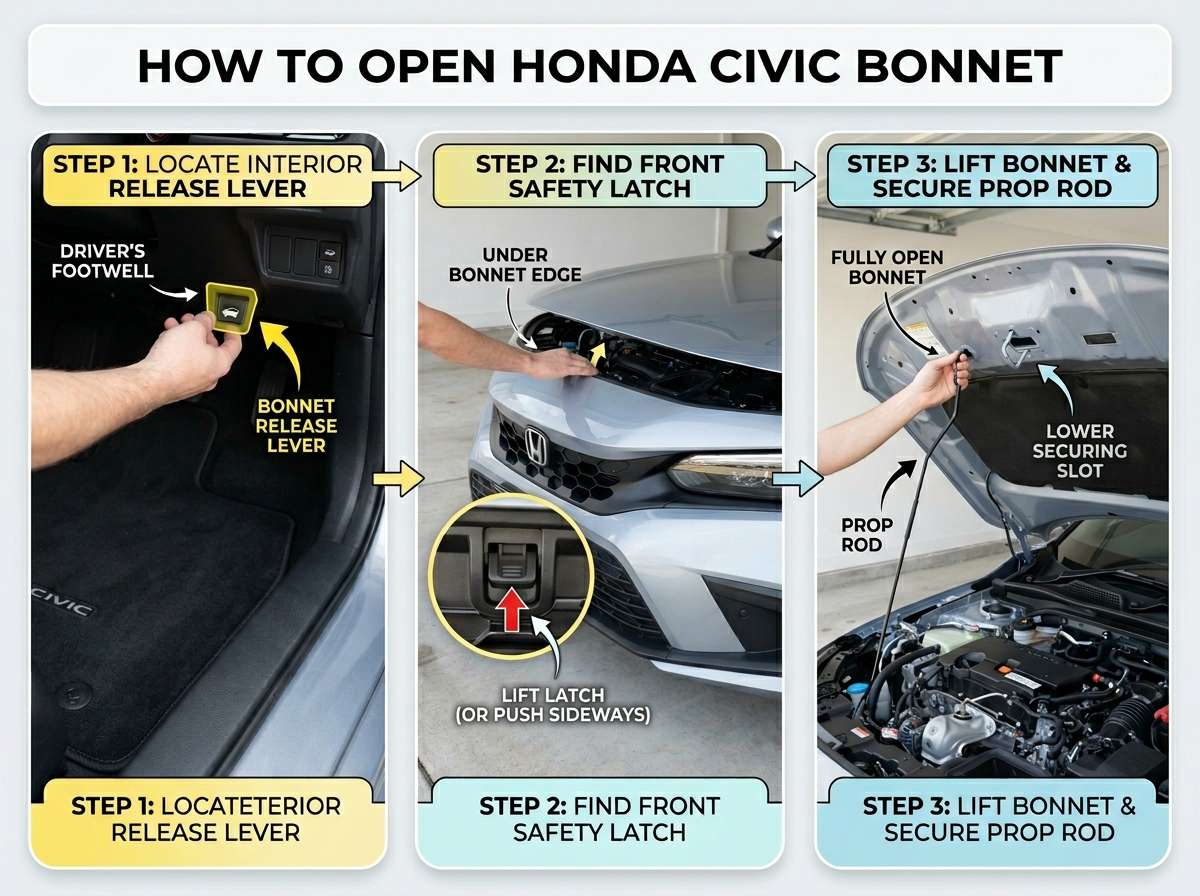
Get inside your Honda Civic. Sit in the driver’s seat. Look down and to the left of your steering wheel. You need to find the hood release lever.
This lever has a small hood icon on it. The icon looks like a car with its bonnet open. This makes it easy to spot. The lever is usually black in color. It sticks out from under the dashboard.
Some newer Civic models have this lever in a slightly different spot. Check your driver’s side area first. If you can’t find it under the dashboard, look near the left side of the dashboard panel.
The release lever is sometimes called the hood pull or bonnet release handle. Different Honda Civic models might have it in slightly different positions. Take a moment to locate it before pulling.
Step Two: Pull the Release Lever Firmly
Once you find the lever, grab it. Pull it toward you with a firm motion. You should hear a click sound. This click means the hood has released.
Don’t pull gently. The lever needs a good tug. The spring inside is strong, so a firm pull works best. After you pull, you’ll hear the bonnet unlock.
That’s really it for the inside of your car. The hood is now released. You can let go of the lever.
Step Three: Go to the Front of Your Car
Now leave your car and walk to the front. Stand facing the bonnet. You should see a small gap between the bonnet and the rest of the car’s front. This gap appeared because of the release lever you just pulled.
The bonnet is still latched. It’s held by a safety latch in the middle. You need to open this latch. That’s what you’ll do next.
Step Four: Release the Secondary Latch
Look at the middle of the bonnet. You’ll see a small rod or lever sticking up. This is the secondary safety latch. It’s designed to keep the hood from flying open while you drive. Safety is important.
This secondary latch is usually rubber-tipped. Some Civics have a black rubber piece here. Reach under the bonnet edge. Grab this small rod or lever.
Push it to the side. Push it either left or right. Usually, pushing it toward one side works. You’ll hear a click. The bonnet will loosen. Now you can lift it.
On some Civic models, you might need to lift the rod straight up instead of pushing it to the side. Try pushing first. If that doesn’t work, try lifting. The design is simple and intuitive.
Step Five: Lift the Bonnet Open
Now that both latches are released, you can lift the bonnet. Place your hands on the bonnet edge. The best spot is on both sides near the middle.
Lift the bonnet upward. It will swing open. The bonnet has hinges at the back. These hinges are strong and smooth.
Lift it all the way. The bonnet will go high. You’ll have plenty of room to see everything inside.
Step Six: Secure the Bonnet in the Open Position
This is an important safety step. Your bonnet needs to stay open. If it falls, it could hit your head or arms.
Most Honda Civics have a prop rod. This is a long metal stick with a handle. Look for it on the right side of the engine bay. It’s usually mounted on a bracket.
Take the prop rod out. Position it under the hood. The rod fits into a small notch or hole on the underside of the bonnet. Insert the rod end into this hole. Make sure it’s secure.
The bonnet will now stay open safely. You can work under the hood without worrying about it falling.
Some newer Civic models have a different system. They might use a hydraulic prop or a gas strut. These newer systems hold the bonnet open automatically. You don’t need to do anything extra.
Check if your bonnet stays open on its own. If it does, your car has one of these newer systems. If it doesn’t, use the prop rod as described above.
Common Issues and Troubleshooting
The Lever Won’t Pull
If the hood release lever feels stuck, don’t force it. Apply some gentle pressure. Wiggle it a little. The lever might be stiff if it hasn’t been used in a while.
Spray a little WD-40 or similar product on the lever. Wait a few minutes. Then try again. This usually solves the problem.
If it’s still stuck, check if you’re pulling the right lever. Make sure you have the hood release and not something else.
The Bonnet Won’t Open Even After Release
The secondary latch might be the issue. Make sure you’ve released it fully. Push it all the way to one side. Then try lifting the bonnet.
If the secondary latch is hard to move, spray a bit of lubricant around it. Let it soak for a minute. Then try again.
Make sure you’re pushing the rod in the right direction. If pushing left doesn’t work, try pushing right.
The Bonnet Feels Stuck
Don’t force it. Forcing a stuck bonnet can break things. Instead, take a step back.
Check if the secondary latch is fully released. Look carefully at the middle of the bonnet. Make sure the rod or lever is in the open position.
If everything looks open but the bonnet still won’t budge, spray a lubricant around the hinges. Wait several minutes. Then try lifting gently.
If it’s still stuck, you might have a mechanical issue. Contact a Honda dealer or mechanic for help.
Tips for Opening Your Honda Civic Hood
Use both hands. When you pull the release lever inside, use both hands if needed. This gives you better control.
Lift smoothly. When opening the bonnet, lift smoothly. Don’t jerk it. Smooth motions are safer and easier.
Check the prop rod. Make sure the prop rod is fully inserted. If it’s not secure, the bonnet could fall. This is dangerous.
Open on flat ground. Always open your bonnet on flat, level ground. Uneven surfaces can cause the bonnet to close unexpectedly.
Never work under an unsecured hood. This is a safety rule. Always use the prop rod or make sure the hydraulic system holds the bonnet open.
Wear safety glasses. Wear safety glasses if you’re working in the engine bay. Small particles can fly up.
Keep your hood clean. Keep the bonnet hinges and latches clean. Dirt and debris make them sticky.
Understanding Your Honda Civic Engine Bay
Once your hood is open, you’ll see several important things. Let’s go over what’s in there.
Your engine is in the middle and toward the front. It’s a large block of metal. You can’t miss it.
To the left and right are fluid reservoirs. These hold coolant, brake fluid, and windshield washer fluid. You’ll recognize them by their plastic bottles or tanks.
The oil dipstick is usually yellow or orange. It’s on the side of the engine. You use this to check your oil level.
The battery is often near the front. It’s a large black box with two cables attached. This powers your car’s electrical system.
The radiator is usually behind the bonnet. It’s a metal box with fins. This keeps your engine cool by cooling hot fluid.
The alternator and other components are also visible. Don’t touch things you don’t understand. Your engine is complex.
Maintenance You Can Do Yourself
Knowing how to open your bonnet lets you do some easy maintenance.
Checking oil. Pull out the dipstick. Wipe it clean. Push it back in all the way. Pull it out again. The level shows where you need to add oil.
Topping up coolant. Your coolant reservoir has a fill line. Check the level. Add more coolant if needed. Only do this when the engine is cold.
Windshield washer fluid. This one is easy. Open the cap on the washer fluid tank. Pour in new fluid. Close the cap.
Battery inspection. You can look at your battery terminals. They should be clean and tight. If they’re corroded, you might need a mechanic.
Checking belts. Your serpentine belt should look smooth and have no cracks. If it does, you need a mechanic.
Inspecting hoses. Look at the rubber hoses. They should be firm. If they’re soft or cracked, have them checked.
Never work on your engine if you don’t know what you’re doing. Always consult your owner’s manual. When in doubt, see a mechanic.
Closing Your Honda Civic Bonnet
Closing the bonnet is the opposite of opening it. First, remove the prop rod. Put it back in its bracket.
Lower the bonnet gently. Guide it down with your hands. Don’t let it slam shut. This can damage the hinges.
When it’s about six inches from being closed, let it drop the rest of the way. It should close with a gentle click. The latches will catch automatically.
Close the bonnet firmly. It should be flush with the rest of the car’s body. If it sticks up on one side, open it and close it again.
Walk around to the side of the bonnet. Look at it from different angles. It should sit evenly. If it doesn’t, you might not have closed the secondary latch. Open it again and check.
Safety Reminders
Your bonnet weighs quite a bit. It’s not super heavy, but it’s substantial. Be careful when lifting and lowering it.
Never leave your bonnet open and unattended. If someone bumps it or the wind catches it, it could close on itself.
Don’t open your bonnet if your engine is very hot. The hot air can burn you. Also, opening it can cool the engine too quickly, which isn’t good.
Wait at least five minutes after turning off your engine. This lets it cool down a bit. Then it’s safe to work.
Never reach into the engine bay near moving parts. Even with the engine off, some things might move.
Keep your long hair and loose clothing tied back. These can get caught.
Always use the prop rod. Never try to hold the bonnet open with your body or by leaning it against something.
Different Honda Civic Models
Most Honda Civics open the same way. However, some older or newer models might be slightly different.
Check your owner’s manual for your specific model. It will have exact instructions. Your manual is the best resource.
If you can’t find your manual, you can look it up online. Honda’s website has owner’s manuals for most models. Many auto parts websites have them too.
Reading your specific manual takes just a few minutes. It might save you time and frustration.
FAQ: Questions People Ask
Q: Do I need special tools to open my bonnet? A: No. Your hands and nothing else. That’s all you need.
Q: Will I damage my car if I do it wrong? A: It’s hard to damage things if you follow these steps. Just avoid forcing anything.
Q: How often should I open my bonnet? A: Check your oil every month. Check your coolant level seasonally. That gives you regular access to your engine bay.
Q: Can I open the bonnet from outside? A: No. You have to start from inside the car. The release lever is inside the cabin.
Q: What if my prop rod is missing? A: You can buy a replacement from Honda or an auto parts store. You can also use a stick in a pinch. But get a proper one soon.
Q: Is it dangerous to open the bonnet? A: It’s very safe if you follow these steps. Just use the prop rod and don’t touch hot parts.
Q: Can my bonnet close while I’m working under it? A: Not if you use the prop rod correctly. The rod keeps it open and secure.
Q: My bonnet is hard to open. What should I do? A: Try lubricating the release lever and secondary latch. Use WD-40 or similar product. Wait a few minutes and try again.
Q: How do I know if my engine is cool enough? A: Wait at least five minutes after turning off the engine. You can also touch the hood itself. If it’s warm but not hot, you’re good.
Q: What if I can’t find the release lever? A: Check your owner’s manual. Different Civic models might have it in different spots. It’s always inside the cabin though.
Quick Reference Checklist
Here’s a quick checklist to follow every time you open your bonnet.
- Locate the hood release lever under the left side of the dashboard
- Pull the release lever firmly toward you
- Walk to the front of your car
- Find the secondary safety latch in the middle of the bonnet
- Push the secondary latch to the side or up
- Lift the bonnet all the way open
- Insert the prop rod into the bonnet’s latch hole
- Make sure the bonnet is secure before working
- When done, remove the prop rod
- Lower the bonnet gently
- Close it completely and check that it’s flush
Conclusion
Opening your Honda Civic bonnet is one of the easiest things you’ll do as a car owner. It takes less than a minute. You don’t need any tools. You don’t need any training.
The process is the same every single time. After you do it once or twice, it becomes automatic. You won’t even think about it.
Now you know exactly what to do. You know where the release lever is. You know how to find the secondary latch. You know how to use the prop rod. You’re ready.
Opening your bonnet gives you access to important parts. You can check your oil. You can top up coolant. You can do basic inspections. You can spot problems early.
Remember the safety tips. Use the prop rod. Don’t force anything. Be careful with hot engines. Beyond that, you’re all set.
The next time you need to check under the hood, you’ll do it with confidence. You’ll do it safely. And you’ll do it in just a few seconds. That’s the beauty of good design. The Honda Civic makes it simple.
Now get out there and open that bonnet. You’ve got this.

Peterson is an automotive enthusiast and auto parts reviewer with a passion for vehicle maintenance, upgrades, and performance. He enjoys researching and testing car parts, tools, and accessories to help drivers make informed buying decisions. Through AutoPartsTalk.com, Peterson shares honest reviews, practical maintenance tips, and expert guides to keep vehicles running safely and efficiently.