How to Clean a Catalytic Converter Without Removing It
If your check engine light has come on and your car doesn’t feel as peppy as it used to, your catalytic converter might be giving you trouble. The good news? You don’t have to spend a fortune at the mechanic or tackle a complex removal job. You can clean your catalytic converter right in your driveway with some simple methods that work surprisingly well.
What Exactly Is a Catalytic Converter and Why Does It Get Clogged?
Before you start cleaning, let’s talk about what we’re actually dealing with. Your catalytic converter sits underneath your car in the exhaust system. Its job is to turn harmful emissions from your engine into less harmful gases before they escape into the atmosphere. Pretty important stuff for the environment and your car’s performance.
Over time, carbon buildup happens inside your converter. This buildup comes from your engine burning fuel, oil deposits, and combustion byproducts. When too much gunk accumulates, it blocks the exhaust flow. Your car has to work harder, fuel economy drops, and you lose power. That’s when things get frustrating.
The bad news is that a catalytic converter can be pricey to replace. The good news is that you can clean the converter without removing it from your car. This saves you tons of money and keeps you out from underneath your vehicle with specialized tools.
Signs Your Catalytic Converter Needs Cleaning
Your car will tell you when something’s wrong if you pay attention. Here are the common signs that your catalytic converter has carbon buildup and needs cleaning.
Your check engine light comes on and won’t go away. This is probably the most obvious sign. Your car’s computer monitors the catalytic converter’s performance constantly. When it detects a problem, that light pops on to get your attention.
You notice your car feels sluggish when you accelerate. The engine doesn’t respond as quickly as usual. You hit the gas and the car hesitates before picking up speed. This happens because the clogged converter restricts exhaust flow, forcing your engine to work against backpressure.
Your fuel economy takes a nosedive. If you’re filling up more often than usual without driving more miles, your car is burning extra fuel trying to push exhaust through a blocked converter. This is one of the first signs many people catch.
You hear unusual sounds from underneath your car. A clogged catalytic converter sometimes makes rattling or clanking sounds as the engine vibrates against the buildup inside. The sound gets worse when you accelerate.
Your car shakes or vibrates more than normal. This vibration often happens during idle or at red lights. It can feel like your car is struggling to breathe.
Method One: Using Catalytic Converter Cleaner Additives
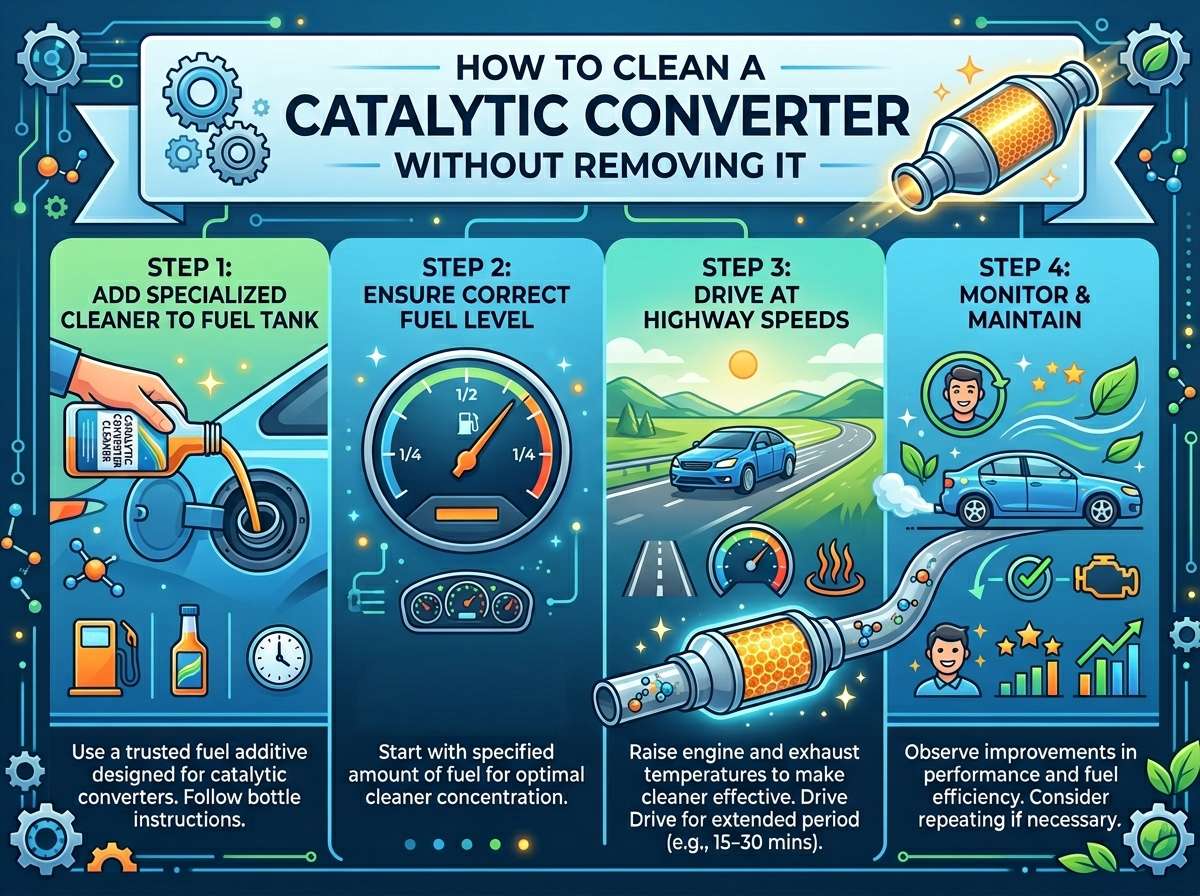
This is the easiest and most popular way to clean your catalytic converter without pulling it off your car. You simply add a special cleaner product to your fuel tank.
How Fuel Additives Work
These cleaners contain special detergents that travel through your fuel system and into the combustion chamber. As your engine burns fuel mixed with these cleaners, the detergent compounds flow through your exhaust system and coat the inside of your catalytic converter. The cleaners break down carbon deposits and help wash them out through the exhaust pipe.
The best part? You do absolutely nothing besides pour it in your fuel tank. No tools needed. No getting underneath your car. Just add it and drive.
Which Products Work Best
Several quality brands make catalytic converter cleaners that drivers trust. Redline fuel system cleaner, Chevron Techron concentrate, and BG 44K are all highly rated options. These products have proven track records and real customer reviews backing them up.
Look for cleaners specifically labeled for catalytic converter cleaning rather than general fuel system cleaners. The formulations designed for your converter work more effectively because they target the specific type of buildup inside your converter.
How to Use Fuel Additive Cleaners
The process is simple enough that anyone can do it. First, buy your cleaner from an auto parts store or online. Cost usually runs between twenty and forty dollars per bottle.
Fill your fuel tank almost full before you add the cleaner. The product needs to mix with a full tank of gas for best results. This ensures the cleaner gets thoroughly distributed through your fuel system.
Pour the entire bottle into your fuel tank. Don’t hold back or use half. The manufacturers design their products for a full tank of gas, so use the whole thing.
Now just drive your car normally. No special driving required. Some people like to take a highway drive to let the engine run at steady RPMs for an extended period. This helps the cleaner work its way through your exhaust system thoroughly. Spend thirty to forty minutes cruising on the highway if you can.
Continue driving for the next tank or two of fuel. The cleaner works gradually as you burn fuel, so patience helps. Don’t expect instant results, but after you’ve run through another full tank of gas, you should notice improvements in how your car runs.
Method Two: The Italian Tune-Up Approach
This method sounds fancy but it’s basically controlled hard driving that gets your engine hot and running at high RPMs. This naturally burns off carbon buildup inside your catalytic converter.
Why High RPMs and Heat Help
When your engine runs at high revolutions per minute and high temperatures, the combustion process becomes more complete. The hotter temperatures actually burn away carbon deposits faster than normal, gentle driving. The high exhaust temperature helps the converter do its job more efficiently and clears out blockages.
This method works because carbon buildup forms when your engine runs cool and you never push it hard. Constant stop-and-go city driving is the worst case scenario. Short trips, low RPMs, and cool running temperatures create the perfect environment for buildup.
How to Safely Do an Italian Tune-Up
First, make sure your engine is fully warmed up. Drive normally for ten to fifteen minutes until the engine reaches operating temperature. This prevents damage from sudden stress on a cold engine.
Find an empty stretch of highway or a safe track where you can legally drive faster without endangering anyone. A closed track is ideal, but a safe highway section works too. Make sure you follow all traffic laws and speed limits.
Gradually increase your RPMs to around forty-five hundred to fifty-five hundred, if your car can handle that safely. Don’t go crazy and redline your engine unless you know your vehicle can take it. Gradually accelerate to these RPMs and hold them for several minutes.
Your exhaust will get very hot. You might smell burned carbon, which is normal and expected. This smell means the carbon is literally burning away inside your converter.
Keep this up for five to ten minutes, then ease off gradually. Let your engine cool back to normal operating temperature before driving home. Don’t suddenly downshift or do anything aggressive. Smooth, controlled acceleration is what you want.
You can repeat this process a few times over several drives if needed. Space them out though. Don’t do multiple Italian tune-ups in the same day.
When to Skip This Method
If your car has an automatic transmission that doesn’t feel healthy, be careful with this approach. If your engine has mechanical issues, hard driving might make things worse. If you’re not confident in your vehicle’s condition, stick with the fuel additive method instead. Better safe than sorry.
Method Three: Seafoam Treatment
Seafoam is a different type of cleaner that some people swear by for catalytic converter cleaning. It works a bit differently than standard fuel additives, so it’s worth knowing about.
How Seafoam Works Differently
Seafoam can be added to your fuel tank like regular fuel additives, but it can also be introduced directly into your engine’s intake system through the carburetor or intake manifold. This dual capability makes it versatile for different situations.
When added to fuel, Seafoam works like other cleaners. When sprayed into the intake, it goes straight into the combustion chamber where it can work on carbon deposits more directly. This direct approach sometimes produces faster results than fuel tank additives.
Using Seafoam in Your Fuel Tank
This works like any other fuel additive. Add it to a full tank and drive normally. Seafoam costs about the same as other quality cleaners, running fifteen to thirty dollars per bottle.
Many people use Seafoam preventatively, adding it to their fuel every few months to stop buildup before it starts. This works as a maintenance approach to keep your catalytic converter clean and functioning properly.
Using Seafoam Through the Intake
This method takes more skill and confidence. You’ll need to locate your intake system and either spray Seafoam directly in or use a special intake cleaning tool. Some people have success with this, while others find it confusing and messy.
If you go this route, follow the bottle instructions exactly. Each car is different, and you don’t want to damage your intake system or engine. When in doubt, stick with the fuel tank method.
Method Four: Using a Carburetor Cleaner
This is a more DIY approach that some experienced car folks use. It’s more involved than just pouring something in your fuel tank, but it can work if you’re mechanically inclined.
How Carburetor Cleaner Helps
Carburetor cleaner is a powerful solvent that breaks down carbon and varnish. It’s more aggressive than fuel additives. Some people use it to clean their intake system, which indirectly helps keep the catalytic converter cleaner by improving combustion efficiency.
You spray this into your intake system while the engine runs. The cleaner dissolves carbon buildup in the intake valves and combustion chamber. Cleaner combustion means fewer deposits reach your catalytic converter in the first place.
Safety First with Carburetor Cleaner
This method requires caution. You’re working with flammable liquids and a running engine. If you’re not comfortable doing this, skip it. A fuel additive is safer and easier.
Make sure your engine is cool before you start. Have a fire extinguisher nearby just in case. Never leave your engine running unattended while using cleaner.
Find your carburetor or intake manifold. Locate where the air filter connects to the intake. With the engine off, remove the air filter and any covers blocking your access to the intake opening.
Start your engine and let it idle. Spray short bursts of carburetor cleaner into the intake opening. The engine will stumble and cough. That’s normal. Keep the engine running and repeat short sprays every few seconds.
Stop spraying after about thirty seconds to one minute. Let the engine run for another minute to burn off the cleaner. You might see smoke, and you’ll smell strong fumes. Open your garage door or work outside for ventilation.
Replace the air filter and covers once the engine settles down. Drive carefully and let the engine cool.
Method Five: Professional Catalytic Converter Cleaning Service
If you want someone else to handle it, many professional shops offer catalytic converter cleaning without removal. They use specialized equipment and professional-grade cleaners.
What Professionals Do Differently
Shops have commercial-grade cleaning systems that often connect to your fuel system or exhaust system. These machines force powerful cleaning solutions through your converter more aggressively than you can do yourself.
Some shops use ultrasonic cleaning, thermal shock treatments, or other advanced methods. Professional equipment can deliver results faster than DIY approaches.
Cost Expectations
Professional cleaning typically runs one hundred to three hundred dollars depending on your location and the shop. This is much cheaper than replacing a converter, which costs eight hundred dollars to two thousand dollars.
Finding a Good Shop
Ask friends and family for recommendations. Check online reviews on Google and Yelp. Call a few shops and ask specifically about their catalytic converter cleaning process. Make sure they clean without removal.
Combining Methods for Better Results
Many people find that combining approaches works better than relying on just one method. You might use a fuel additive while also doing a couple of Italian tune-ups. The synergistic effect sometimes produces better results than one method alone.
Try the fuel additive first since it’s easiest and cheapest. If that doesn’t fully solve your problem, add an Italian tune-up. Some people use Seafoam as a booster after a fuel additive hasn’t completely cleared the problem.
Don’t do everything at once though. Space them out and give each method time to work. Your converter will have a better chance to clear out when you’re not overwhelming it with multiple treatments simultaneously.
Preventative Maintenance Keeps Your Converter Happy
The best cure is prevention. Keeping your catalytic converter clean from the start saves you headaches later.
Use quality gasoline from reputable stations. Cheap gas often contains more detergent-depleting compounds. That sounds backwards, but some fuels lack the right additives. Shell, Chevron, and major brands tend to have better fuel quality.
Don’t ignore your engine maintenance. Keep your air filter clean, change your oil on schedule, and replace spark plugs as recommended. A well-maintained engine runs cleaner and produces fewer emissions that clog your converter.
Avoid short trips when possible. Longer drives let your engine fully warm up. A cold engine produces more emissions and carbon buildup. If you make lots of quick trips around town, try combining errands into one longer drive.
Get your emission system checked regularly. Many states require emission testing anyway. These tests catch converter problems early before they become serious.
Use a quality fuel system cleaner once or twice yearly as preventative maintenance. This stops buildup before it causes problems. Redline, BG, and Chevron all make good preventative products that cost less than fifty dollars.
When Professional Replacement Becomes Necessary
Sometimes cleaning won’t work and your converter needs replacement. Here’s when you should stop trying DIY cleaning and see a mechanic.
If you’ve tried cleaning methods and your check engine light comes back within a few drives, the converter might be permanently damaged. Physical damage inside requires replacement. You can’t clean your way out of that problem.
If your converter rattles constantly and none of the cleaning methods help, the internal honeycomb structure probably collapsed. This only gets fixed with replacement.
If your car suddenly loses all power and sounds awful, your converter might have completely failed. Don’t ignore this situation. Stop driving and get to a mechanic.
If your converter is extremely old and high mileage, and cleaning doesn’t help, replacement might be the right call. Most catalytic converters last one hundred fifty thousand to two hundred thousand miles. If yours is past that and failing, a new one is probably in your future.
Frequently Asked Questions About Catalytic Converter Cleaning
Q: How long does it take to see results from a fuel additive? A: Most people notice improvements after running through one full tank of gas. Sometimes it takes two tanks. Patience is important. Don’t expect instant changes.
Q: Is the Italian tune-up method safe for my transmission? A: It’s safe for manual transmissions. Automatic transmissions usually handle it fine too, but if your transmission already feels rough or hesitates, skip this method.
Q: Can I use multiple different cleaners at once? A: No. Mixing products can cause chemical reactions you don’t want. Stick with one product at a time and space out different methods by several days.
Q: Will cleaning my converter fix my low fuel economy? A: If your low fuel economy is caused by a clogged converter, yes. If other problems cause your poor mileage, cleaning the converter won’t fully fix it.
Q: How often should I clean my catalytic converter? A: If you use quality fuel and maintain your engine properly, you shouldn’t need to clean it often. Once yearly as preventative maintenance is plenty for most drivers.
Q: Can I damage my converter by trying to clean it? A: Fuel additives are safe. The Italian tune-up method is safe if done correctly. Carburetor cleaner and Seafoam intake methods carry more risk. If you’re not confident, stick with fuel additives.
Q: Will a clean converter pass an emission test? A: Yes. A clean converter will pass emissions testing. The test measures what comes out your exhaust, and a clean converter lets the test gases flow properly.
The Bottom Line on Cleaning Your Catalytic Converter
Your catalytic converter doesn’t need to drain your bank account. Cleaning it without removal is totally doable and saves you serious money compared to replacement.
Start with a quality fuel additive. It’s the easiest, safest, and cheapest option. Cost runs twenty to forty dollars and takes zero mechanical skill. Just pour it in your tank and drive.
If that doesn’t completely solve your problem, try an Italian tune-up or Seafoam treatment. These methods work for many people and cost almost nothing besides your time.
Combine approaches if needed, but give each method time to work before trying something else. Your converter needs time to clear out the buildup you’ve accumulated.
Once you’ve got your converter working properly again, maintain it well. Use quality fuel, keep up with engine maintenance, and add a cleaner product a couple times yearly. This preventative approach stops problems before they start.
Your car will run better, your fuel economy will improve, and your check engine light will stop haunting you. That’s worth a little effort on your part.
Stay on top of your catalytic converter health, and it’ll stay on top of cleaning your emissions. Your car, your wallet, and the environment all benefit from a well-functioning converter.

Peterson is an automotive enthusiast and auto parts reviewer with a passion for vehicle maintenance, upgrades, and performance. He enjoys researching and testing car parts, tools, and accessories to help drivers make informed buying decisions. Through AutoPartsTalk.com, Peterson shares honest reviews, practical maintenance tips, and expert guides to keep vehicles running safely and efficiently.