Chain Belt vs Timing Belt
You pop the hood. You hear a strange noise. Someone tells you it might be your timing belt or your timing chain. And now you’re standing there thinking — wait, are those the same thing?
They’re not. They do a similar job, but they work differently, wear differently, and cost very differently to fix.
This guide breaks it all down in plain English. No jargon. No confusing diagrams. Just clear, simple answers so you can walk into any auto shop and actually know what you’re talking about.
What Does a Timing Belt or Chain Actually Do?
Let’s start from the beginning.
Your car engine has two main parts that need to work together — the crankshaft and the camshaft. The crankshaft sits at the bottom of the engine and handles the pistons. The camshaft sits at the top and controls the valves.
For your engine to run, these two parts have to move in perfect sync. Not close to perfect. Exactly perfect.
If they go out of sync even slightly, the valves and pistons can crash into each other. That’s called “engine interference,” and it can destroy your engine in less than a second.
The timing belt or timing chain is what keeps them in sync. It connects the crankshaft to the camshaft so they spin at exactly the right time — hence the name “timing.”
So the next time someone mentions timing components, just remember: they’re the parts that keep your engine from destroying itself from the inside.
What Is a Timing Belt?
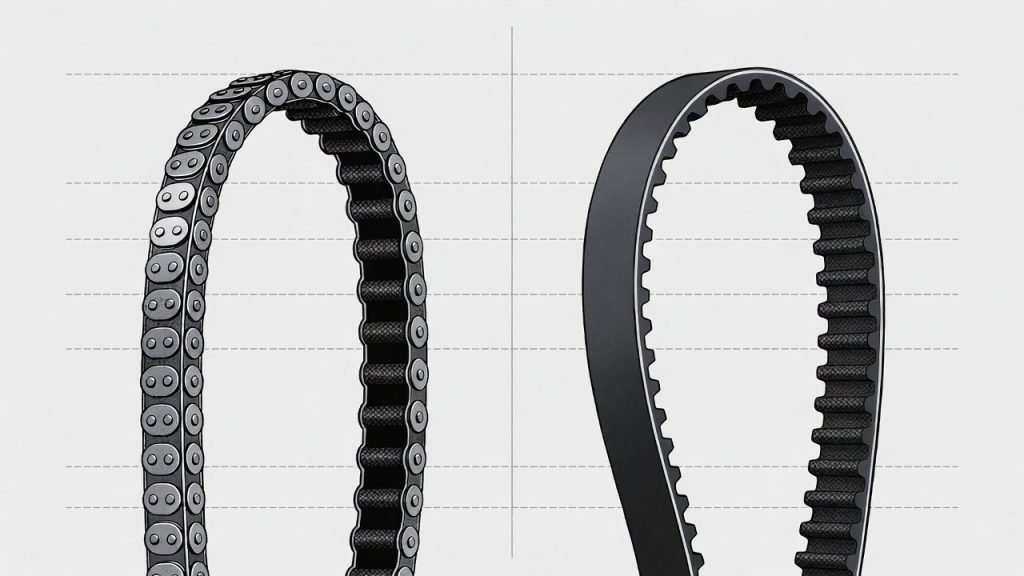
A timing belt is a rubber belt. It looks a lot like a regular belt you might find on a bike or a conveyor. It has teeth on the inside that grip the gears on the crankshaft and camshaft.
Because it’s made of rubber, it’s flexible, light, and runs very quietly. You won’t hear it at all when the engine is running normally.
But rubber wears out. It dries, cracks, and eventually snaps. That’s the big downside.
Timing belts need to be replaced on a schedule. Most manufacturers recommend replacement every 60,000 to 100,000 miles — but always check your owner’s manual for the exact number. If you miss that replacement window and the belt snaps while you’re driving, you’re looking at a potentially catastrophic engine failure.
Timing belts are common in older vehicles and many modern economy cars. Manufacturers used them because they’re cheaper to produce, lighter in weight, and quieter to run. That was a good trade-off when cars were designed to last a certain mileage and then be retired.
Quick facts about timing belts:
- Made of rubber with fiber reinforcement
- Much quieter than a timing chain
- Lighter weight — helps a tiny bit with fuel economy
- Needs scheduled replacement (usually every 60k–100k miles)
- Cheaper to buy, but requires regular maintenance
- When it breaks, serious engine damage can follow
What Is a Timing Chain?
A timing chain is made of metal links — a lot like a bicycle chain. It wraps around metal sprockets (gears) on the crankshaft and camshaft and keeps them in time, just like a belt does.
Because it’s metal, it’s a lot stronger and a lot more durable than rubber. A well-maintained timing chain can last the full life of the engine — sometimes over 200,000 miles.
Most modern vehicles use timing chains. Car manufacturers switched over because drivers started keeping their cars longer, and customers wanted engines that didn’t require as much routine service.
But timing chains aren’t perfect either. They can stretch over time. As they stretch, they can skip a tooth on the sprocket. That throws off the timing. You might notice a rattling noise from the engine, especially at startup. That’s often a stretched chain or a failing tensioner.
Timing chains also use an oil-bath system. They run inside the engine and get lubricated by the engine oil. That’s great for longevity — but it also means that skipping oil changes slowly kills the chain.
Quick facts about timing chains:
- Made of metal links
- Much more durable than a rubber belt
- Designed to last the life of the engine (with proper maintenance)
- Louder than a belt, especially if worn or stretched
- No scheduled replacement — but can fail if oil maintenance is neglected
- More expensive to repair when something goes wrong
Chain Belt vs Timing Belt: A Side-by-Side Look
Let’s put them head-to-head across the things that matter most to you as a car owner.
Durability
Timing chain wins here — by a lot.
Metal lasts longer than rubber. That’s just physics. A timing chain can outlast the rest of the engine when it’s properly cared for. A timing belt has a firm expiration date. You can’t ignore it.
If you’re buying a used car and longevity matters to you, a car with a timing chain gives you more peace of mind (as long as the previous owner changed the oil regularly).
Noise Level
Timing belt wins here.
Rubber runs quietly. Metal rattles and hums. A healthy timing chain is quiet enough that you won’t notice it during normal driving. But as it ages or if the tensioner starts to fail, you’ll start hearing a ticking or rattling sound — especially right when you start the car and the oil pressure hasn’t built up yet.
A timing belt runs smoothly and silently. This is one reason some high-end car manufacturers still use belts in certain engine configurations — smooth, quiet operation can matter in a luxury vehicle.
Maintenance Requirements
Timing chain wins here — for the lazy car owner.
If you forget to replace a timing belt, your engine might die on the highway. The belt doesn’t warn you. It just snaps.
A timing chain, on the other hand, doesn’t have a scheduled replacement interval. You just have to keep up with your oil changes. If you do that, the chain usually takes care of itself.
That said, “no scheduled replacement” doesn’t mean “maintenance-free.” Oil matters a lot for a timing chain. Dirty or low oil causes the chain to wear faster. Skipping oil changes is the number one way to kill a timing chain early.
Repair and Replacement Cost
Timing belt is cheaper — usually.
A timing belt replacement typically runs between $300 and $700 at a shop, depending on the car. Some vehicles are harder to access and cost more, but it’s generally a manageable service cost.
A timing chain repair is a bigger job. Since the chain is inside the engine (bathed in oil), getting to it requires more disassembly. Timing chain replacements can easily run $1,000 to $2,500 or more. If you also need to replace the tensioners, guides, and sprockets — which is common when a chain has stretched — costs go up fast.
Risk of Catastrophic Failure
Timing chain tends to give more warning.
When a timing belt fails, it often fails suddenly. One second it’s fine, the next it’s gone. In interference engines (which many modern engines are), that sudden snap can bend or break valves and pistons. The repair bill could reach $3,000–$5,000 or more.
Timing chains usually give warning signs before total failure. That ticking sound, that rattle on cold start, that slight engine hesitation — those are clues. If you catch it in time, you avoid the worst-case scenario.
Weight and Fuel Economy
Timing belt has a slight edge here.
A rubber belt is lighter than a metal chain. Less weight means a tiny improvement in fuel economy. We’re talking fractions of a percent here — you won’t feel it at the gas pump. But for engineers squeezing every drop of efficiency from an engine, it matters.
How Do You Know Which One Your Car Has?
Good question. Here are a few ways to find out.
1. Check your owner’s manual. If your manual lists a timing belt replacement interval (something like “replace every 90,000 miles”), you have a belt. If there’s no such interval listed, you likely have a chain.
2. Look up your vehicle online. Search your car’s make, model, and engine size along with “timing belt or chain.” You’ll find the answer in under a minute.
3. Ask your mechanic. Any shop can tell you instantly. It’s a simple question.
4. Listen to the engine. Not a reliable method on its own, but timing chains do tend to make a quiet ticking or whirring sound. Belts are nearly silent.
What Happens If You Ignore a Worn Timing Belt?
Here’s the honest truth — it can get very bad, very fast.
If your timing belt snaps mid-drive, a few things can happen:
- In a non-interference engine, the engine simply stops. It won’t restart. You’ll need a tow and a new belt. Annoying and expensive, but fixable.
- In an interference engine (the more common type in modern cars), the valves and pistons are now moving without coordination. They collide. Valves bend. Pistons crack. In extreme cases, the entire engine block is damaged.
A full engine rebuild or replacement can cost $3,000 to $8,000. All because a $400 belt wasn’t replaced on schedule.
Don’t skip this service. Seriously.
What Happens If You Ignore a Worn Timing Chain?
Ignoring a stretched or worn timing chain isn’t as immediately catastrophic — but it’s not smart either.
Here’s what typically happens:
- You start hearing a rattling noise from the engine.
- Over time, the chain skips a tooth on the gear.
- Engine timing goes off slightly. Performance drops. Fuel economy suffers.
- The check engine light comes on (usually a camshaft or crankshaft position sensor code).
- If you keep ignoring it, the chain can eventually snap — and you’re back to the same catastrophic failure scenario described above.
The difference is that a timing chain gives you time to react. The rattle is your warning. Take it seriously and get it looked at.
Timing Chain Tensioner — The Part Nobody Talks About
Here’s something most people overlook when talking about timing chains.
The chain doesn’t just sit there on its own. It has a tensioner — a spring-loaded or hydraulic device that keeps the right amount of pressure on the chain. It stops the chain from getting too loose.
And there are guides — plastic or metal rails that the chain slides along to keep it on track.
These parts wear out too. In fact, many timing chain failures are actually tensioner or guide failures, not the chain itself snapping.
When a tensioner weakens, the chain gets slack. Slack chain makes noise. Slack chain skips teeth. Skipped teeth wreck your engine timing.
So when someone tells you the timing chain needs to be replaced, ask about the tensioner and guides too. If the chain is worn enough to need replacement, those parts probably need to come out at the same time.
Doing it all at once saves you from opening up the engine twice.
Can a Timing Belt or Chain Be Reused After Removal?
Short answer: no.
If a belt or chain has been removed from an engine for any reason — even just for inspection — it should not go back in. The rubber in a belt can develop invisible cracks from the stress of removal. A chain can develop micro-stretch or wear that isn’t visible to the eye.
Always install a new belt or chain after any engine work that requires removing the old one.
This is standard practice. No reputable mechanic reuses these parts.
Signs That Something Is Wrong Right Now
Whether you have a belt or a chain, watch out for these warning signs:
For timing belts:
- Ticking or slapping noise from the engine
- Engine misfires or runs rough
- Difficulty starting
- Oil leaking from the front of the engine (can mean the belt cover seals are worn — not the belt itself, but a sign of age)
- Check engine light with codes related to camshaft timing
For timing chains:
- Rattling noise on startup that fades as the engine warms up
- Rattling that stays even after warmup (worse sign)
- Engine feels sluggish or less responsive
- Check engine light (especially codes P0016 or P0017, which relate to camshaft-to-crankshaft correlation)
- Rough idle
If you notice any of these, get it checked soon. Don’t wait for your next scheduled service.
Does the Type of Oil You Use Matter for a Timing Chain?
Yes — a lot more than most people realize.
Because a timing chain runs in the oil, the quality and freshness of your engine oil directly affects how long the chain lasts. Old oil gets thick and sludgy. Sludgy oil doesn’t flow fast enough to lubricate the chain properly, especially on cold starts.
Low-viscosity oils recommended by modern manufacturers (like 5W-20 or 0W-20) flow quickly and reach the chain faster on startup. Using the wrong viscosity or skipping oil changes slowly starves the chain of proper lubrication.
If your car has a timing chain, stick to the manufacturer’s recommended oil type and change interval. This is one of the most important things you can do to extend the life of your timing components.
The Bottom Line: Which Is Better?
There’s no simple winner here. They’re designed for different priorities.
Go with a car that has a timing chain if:
- You want fewer scheduled maintenance items
- You plan to keep the car for a long time
- You’re okay paying more if something eventually goes wrong
- You stay on top of regular oil changes
A car with a timing belt might work fine if:
- You follow the maintenance schedule without fail
- You prefer lower upfront repair costs
- You don’t plan to keep the car past a certain mileage
Most new cars come with timing chains because manufacturers want lower warranty claims and longer service intervals. But plenty of perfectly good vehicles still use belts, and they run great when maintained properly.
The real risk isn’t having one over the other. The real risk is ignoring your service schedule.
Final Thoughts
Here’s what it comes down to:
A timing belt is lighter, quieter, and cheaper to replace — but it has an expiration date you can’t ignore. Miss it and you could be looking at a destroyed engine.
A timing chain is stronger, lasts longer, and doesn’t need scheduled replacement — but it needs clean oil to survive, and when it does fail, the repair bill is bigger.
Both do the same critical job. Both can fail if you neglect them. Both can last a very long time if you take care of your car.
Now you know exactly what each one is, how they differ, and what to watch out for. The next time someone mentions a timing component issue, you won’t just nod along — you’ll actually know what they’re talking about.
And that knowledge could save you from a very expensive mistake down the road.
Always consult your owner’s manual or a qualified mechanic for your specific vehicle’s maintenance requirements.