How to Tell If a Shock Is Bad?
Your car’s shocks play a huge role in keeping you safe and comfortable on the road. They absorb bumps and keep your tires pressed firmly against the pavement. When shocks start to fail, your entire driving experience changes—and not for the better. The good news? You can learn to spot the warning signs before things get dangerous.
What Are Shocks and Why Do They Matter
Shocks are part of your vehicle’s suspension system. They work with springs to control how your car bounces after hitting a bump. Every time your wheel hits a pothole or goes over a dip, the spring compresses. Without shocks, your car would bounce up and down like a pogo stick. Shocks dampen that bouncing motion and bring everything back to normal.
Think of shocks as the shock absorbers in your suspension. They use fluid and a piston inside a tube to slow down spring movement. This happens thousands of times as you drive. Over time, the internal parts wear out. Seals break. Fluid leaks. The piston stops working right. When this happens, your shocks fail.
Bad shocks affect more than just comfort. They change how your car handles. Your brakes work differently. Your steering feels off. You might even lose control in emergency situations. That’s why catching bad shocks early matters so much.
Spotting a Bouncy Ride
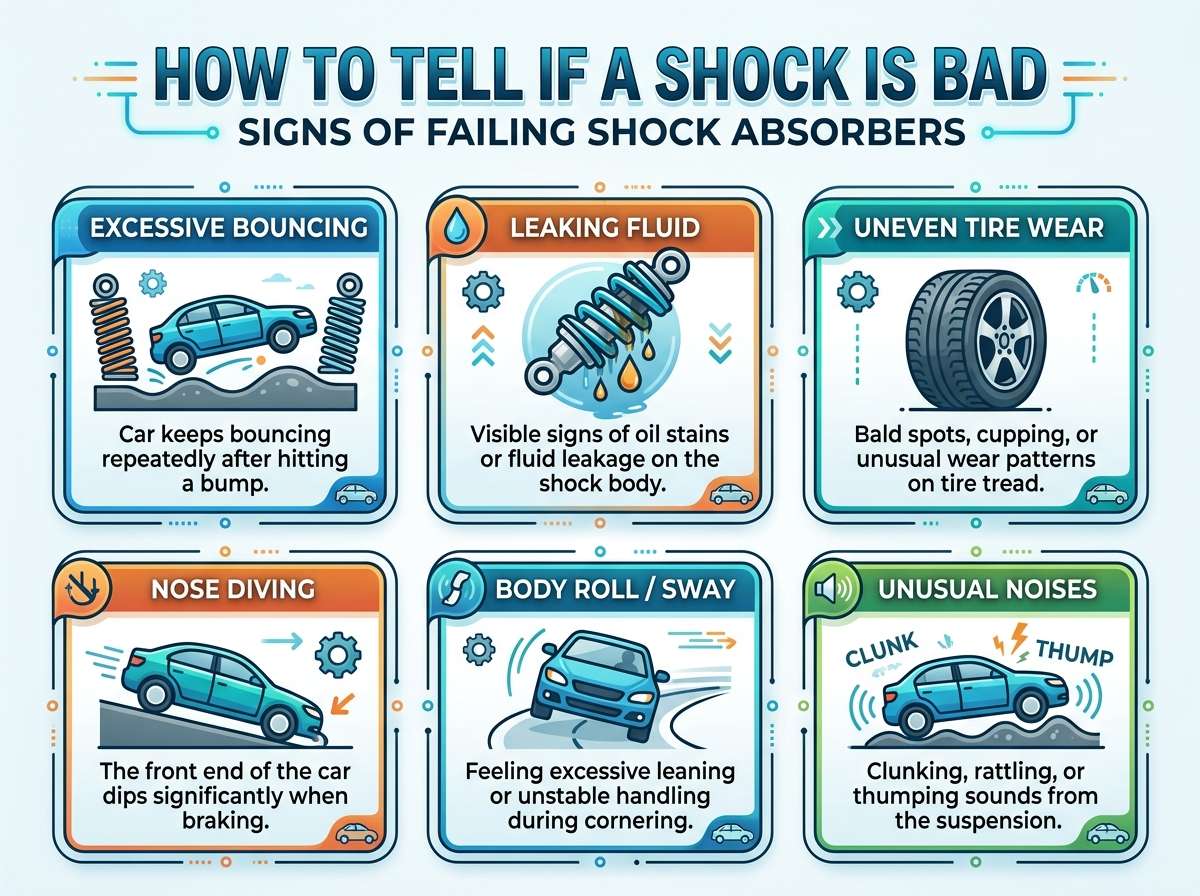
The most obvious sign of bad shocks is a ride that feels too bouncy. After you drive over a bump, your car should settle down quickly. With worn shocks, it keeps bouncing for several seconds. The rear end bounces more than the front. Your whole vehicle rocks back and forth.
You notice this bouncing most on bumpy roads. Even small dips cause big movements. Speed bumps feel extra harsh. Potholes send your car up in the air. The bouncing might also happen when you accelerate or brake hard.
Pay attention to how your car feels when you’re driving normally. Does it feel stable? Or does the front end dip when you hit the brakes? Do the back wheels bounce when you accelerate? These are all signs that your shocks are worn out. A car with good shocks feels planted and controlled.
Try this simple test. Find a safe, empty parking lot. Drive slowly over a speed bump. Feel how your car moves. Good shocks make the bounce quick and controlled. Bad shocks let you bounce longer and harder. You’ll feel the difference right away.
Your Tires Are Telling You Something
Worn shocks create uneven tire wear. When shocks can’t control the bouncing, your tires don’t stay flat against the road. They bounce too. This causes the tread to wear in strange patterns.
Look at your tires carefully. Check the tread across the whole tire. Good tires wear evenly. Bad shocks cause the tread to wear down the center or on the edges first. You might see bald spots surrounded by good tread. You might see scalloped edges where the tire has bounced hard against the road repeatedly.
Run your hand across the tire tread. Feel for high spots and low spots. Uneven wear means something is wrong with your suspension. Many times, that something is bad shocks.
Tire wear caused by bad shocks happens faster than normal wear. You might need new tires sooner than expected. Don’t ignore this warning sign. Fix your shocks before you need expensive new tires.
Fluid Leaks Show Real Damage
Shocks contain special oil-like fluid. This fluid helps them absorb bumps and control movement. When the seals inside wear out, this fluid leaks. You can see the evidence by looking under your car.
Get down low and look at each shock. They’re metal tubes mounted near each wheel. Check for wet spots or oily residue on the shock tube itself. Check the ground underneath where your car is parked. Is there a small puddle of reddish or golden fluid? That’s shock fluid leaking out.
A little dampness might not mean total failure yet. But it means your shock is starting to fail. Fluid leaks get worse over time. Eventually, your shocks won’t have enough fluid to work. When that happens, they fail completely.
Some people ignore small leaks and keep driving. Don’t do this. A leaking shock will fail. You’ll lose control of your vehicle. It’s not worth the risk. Get leaking shocks replaced soon.
Look at all four shocks regularly. Make it part of your car maintenance routine. You should inspect them every few months. The sooner you catch a leak, the sooner you can fix it.
Listen for Clunking and Rattling Sounds
Your car shouldn’t make noise when you drive over bumps. If you hear clunking, banging, or rattling sounds, your shocks might be bad. These noises come from worn-out shock parts.
Inside each shock is a piston. This piston moves up and down as it absorbs bumps. Over time, the piston wears down. It can come loose inside the shock tube. When this happens, you hear a clunking sound as the piston bangs against the sides of the tube.
Other parts can fail too. The mounting brackets and bushings that hold shocks in place wear out. Loose shocks rattle and move around. You hear rattling when you drive over bumps or turn corners.
Listen carefully while you drive. Turn down the radio. Roll down the windows. Does the clunking sound come from the front or the back? Can you tell which wheel? Try to pinpoint the noise. This helps you and your mechanic figure out which shock is bad.
Test the noise in a parking lot if possible. Drive slowly over bumps. Does the noise get louder? Does it happen only on one side of the car? These details help identify the problem.
Your Car Sits Lower Than Normal
Shocks work together with springs. The springs support your car’s weight and keep it at the right height. Bad shocks can’t work right with the springs. Sometimes a failed shock allows the spring to sag more than normal.
Look at your car from the side. Does one corner sit lower than the others? Does the front end droop? Does one side lean more when you go around a corner? These are signs of shock failure.
Compare your car to others the same make and model. Park next to a similar car in a parking lot. Does yours sit at the same height? Lower-than-normal suspension height means shocks aren’t doing their job.
This problem gets worse over time. A car with really bad shocks might sit noticeably lower on one corner. This creates an unsafe, unbalanced stance. Your weight distribution changes. Your tires wear unevenly. Your steering feels weird.
Steering and Handling Feel Wrong
Bad shocks change how your car handles. Your steering might feel vague or loose. The car doesn’t respond quickly to steering inputs. It feels like you’re driving a boat instead of a car.
When you turn the steering wheel, a good car turns right away. With bad shocks, there’s a delay. The car rolls too much on the corners. You feel the outside wheel lift up. Your inside tires might even leave the ground a little bit.
Swerving feels dangerous. If you need to make a quick lane change, your car takes too long to respond. The car leans hard and feels unstable. This is really dangerous at high speeds.
Braking also feels different. With good shocks, your car stops level. The nose dips a little bit, but not too much. With bad shocks, braking feels weird. The front end dives down hard. The back end seems to lift. Your car stops unevenly.
These handling changes make driving less safe. Your car is harder to control. You can’t predict how it will respond. That’s when bad shocks become a real danger.
Your Brakes Don’t Feel Right
Your shocks and brakes work together. When shocks fail, brakes behave differently. You might need to press the brake pedal harder to stop. The pedal might feel spongy or soft. Brakes might lock up too easily.
These brake problems happen because bad shocks let your car bounce. When your car is bouncing, the tires aren’t always flat on the road. They can’t grip as well. Your brakes can’t work as effectively.
Long brake distances are a danger sign. If you’re stopping much longer than usual, something is wrong. It might be your brakes themselves. But often it’s your shocks making the brakes less effective.
Don’t ignore brake problems. Have both your brakes and shocks checked by a mechanic. One problem might be hiding the other.
Vibrations in the Steering Wheel
Feel vibrations when you drive? Your hands shake on the steering wheel? Shocks might be the cause. Bad shocks let your tires bounce. This bouncing creates vibrations that travel up to the steering wheel.
These vibrations feel like the road is rough even on smooth pavement. They get worse at certain speeds. They might disappear when you go really fast or really slow. They get worse when you drive over bumps.
Vibrations can also mean tire problems. Check your tires first. Look for uneven wear or damage. If your tires are fine, the problem is likely your shocks.
Steering wheel vibrations aren’t just annoying. They’re a safety sign. Your car isn’t handling right. You need to get your shocks checked soon.
The Swerve Test
Here’s a test you can do to check your shocks. Find an empty parking lot with no other cars around. Make sure the pavement is flat and clear.
Drive slowly. Turn the steering wheel hard to one side, then quickly back to center. A good car returns to straight right away. The tires stay planted. The car doesn’t rock much.
With bad shocks, the car keeps rocking after you turn. The weight shifts from side to side. The car sways like it’s on a boat. This rocking lasts several seconds. It takes longer than it should for the car to settle.
Don’t do this test on public roads. Only do it in an empty parking lot where it’s safe. This test gives you a quick idea of how well your suspension works.
Comparing Front and Rear Shocks
Both front and rear shocks matter. They wear at different rates sometimes. Front shocks usually wear out first because they handle more bumps. But rear shocks can fail too.
Front shock problems often feel like the front of your car bounces more. The front dips hard when you brake. The front end feels loose. Front tires might make noise or vibrate.
Rear shock problems make the back of the car feel bouncy and unstable. The back sways when you turn. You might feel a side-to-side motion when driving. Rear tires might bounce unevenly.
Bad rear shocks can be extra dangerous because they affect your car’s stability. You might lose control when you turn or brake hard. Many accidents happen because people ignore rear shock problems.
Get both front and rear shocks checked if you think one is bad. Often when one fails, others aren’t far behind.
When to Replace Shocks
Some people try to keep driving with bad shocks. They think they can wait until they have more money. This is a mistake. Bad shocks make driving unsafe. They cause damage to other parts of your car.
Worn shocks put extra strain on your springs. Springs fail sooner than normal. Your tires wear out faster. Your brakes work less effectively. These problems all cost money to fix. Ignoring bad shocks ends up being more expensive.
Shocks also affect your whole suspension system. Springs, bushings, and ball joints all work harder when shocks fail. One bad shock can damage these other parts. Fixing everything later costs way more than replacing shocks now.
Most mechanics suggest replacing shocks every 50,000 miles. Some last longer. Some wear out faster. It depends on your driving and road conditions. Rough roads and lots of bumps wear shocks faster. Highway driving wears them slower.
Don’t wait for shocks to fully fail. Replace them when you notice the first warning signs. Your safety depends on it.
DIY Inspection or Professional Help
You can do some shock inspections yourself. Check for leaks. Look at tire wear. Feel how your car drives. These simple checks tell you a lot.
But for a full inspection, you should see a professional mechanic. Mechanics have lifts and tools. They can see things you can’t. They can feel problems in the suspension that you might miss. They can test your shocks properly.
A mechanic can also check other suspension parts while they’re looking at shocks. Springs, bushings, and ball joints might need work too. A full inspection costs less than guessing and then having multiple problems fixed separately.
Many mechanics will inspect your shocks for free or for a small fee. It’s worth getting a professional opinion. Then you know exactly what needs fixing.
How Much Do New Shocks Cost
Shock prices vary a lot. Cheap shocks might cost $200 to $400 per pair. Mid-range shocks might cost $400 to $800 per pair. High-quality shocks can cost more than $1,000 per pair.
Labor costs also vary. A mechanic might charge $200 to $500 to replace a pair of shocks. Some shops charge more. Some charge less.
Total cost for replacing all four shocks usually runs $800 to $2,000. This sounds like a lot. But compare it to accidents, damaged tires, and other problems caused by bad shocks. Prevention is cheaper than the damage.
You can save money by replacing shocks yourself if you’re skilled with car work. This requires proper tools and knowledge. Most people should have a professional do this work. The risk of doing it wrong isn’t worth the money saved.
Signs That Shocks Are About to Fail Completely
Some warning signs mean shocks are about to fail completely. Watch for these urgent indicators.
If your shock is leaking and the leak is getting bigger, failure is coming soon. If your car is sitting noticeably lower on one corner, get it fixed immediately. If you hear constant clunking or banging that gets louder, don’t wait.
Vibrations that make steering dangerous are another urgent sign. If your steering wheel shakes so much that you can’t control the car safely, you need repairs now. Don’t drive far to the mechanic.
Loss of control in rain or wet conditions is serious. If your car slides or drifts when braking in wet weather, your shocks might be the problem. This is very dangerous.
Any of these signs means you should stop driving and get your car to a mechanic as soon as possible. Don’t keep driving long distances. You’re putting yourself and others at risk.
Preventing Premature Shock Failure
You can’t completely prevent shock failure. It’s just part of wearing out. But you can make shocks last longer.
Drive smoothly. Avoid hitting potholes and bumps fast. Slow down on rough roads. Easy driving means less stress on shocks.
Keep your tires properly inflated. Underinflated tires bounce more and put extra stress on shocks. Check tire pressure monthly.
Keep your suspension aligned. Get an alignment check every year or if you hit something hard. Proper alignment reduces stress on shocks and suspension parts.
Avoid carrying extra heavy loads regularly. Heavy weight stresses shocks more. If you must carry heavy stuff, distribute the weight evenly.
Regular maintenance helps too. Inspect your suspension regularly. Catch problems early. Small fixes now prevent big problems later.
Common Myths About Bad Shocks
Some people believe myths about shocks. Let’s clear up confusion.
Myth: Bad shocks are fine for just highway driving. Truth: Bad shocks are unsafe at any speed. They affect control and braking.
Myth: You don’t need to replace all four shocks at once. Truth: Replacing all four ensures even handling. Replacing just one or two causes uneven performance.
Myth: Cheap shocks are fine if they’re less than new ones. Truth: Cheap shocks wear out faster and affect safety more. Quality matters.
Myth: You’ll always feel vibrations if shocks are bad. Truth: Some shock problems are subtle. You might not feel them until something is really wrong.
Myth: Only old cars have shock problems. Truth: New cars can have shock failures too. Bad roads and rough driving age shocks faster.
Final Thoughts on Bad Shocks
Bad shocks create a safety risk that’s easy to spot if you know what to look for. Bouncy rides, fluid leaks, strange noises, and poor handling are all red flags. Pay attention to how your car feels and drives.
Getting your shocks checked regularly keeps you safe. Replace them before they fail completely. Your safety and comfort depend on having good shocks.
Don’t put off shock repairs. The longer you drive with bad shocks, the more damage you cause. The more you spend fixing other problems. Taking action now saves money and keeps you safe on the road.
Your car depends on you to notice problems and fix them. Shocks are too important to ignore. If you think your shocks are bad, get them checked by a professional mechanic right away. Your next safe drive might depend on it.

Peterson is an automotive enthusiast and auto parts reviewer with a passion for vehicle maintenance, upgrades, and performance. He enjoys researching and testing car parts, tools, and accessories to help drivers make informed buying decisions. Through AutoPartsTalk.com, Peterson shares honest reviews, practical maintenance tips, and expert guides to keep vehicles running safely and efficiently.