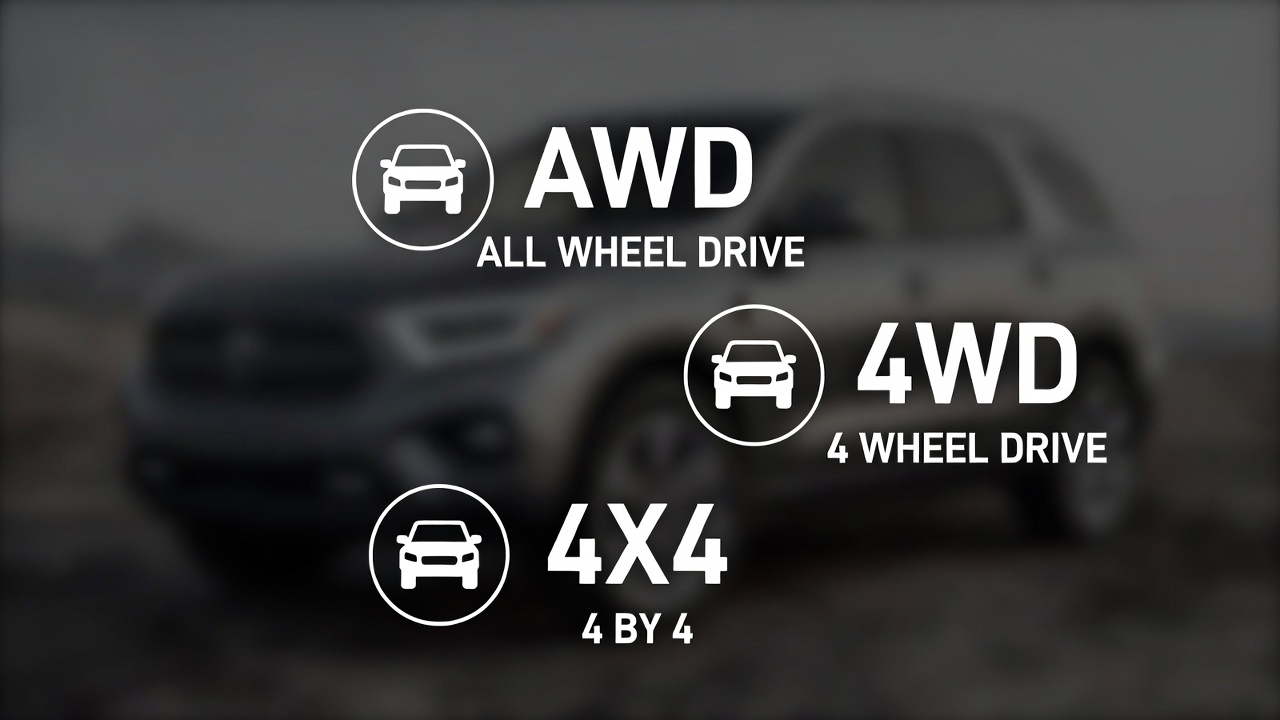
AWD vs 4WD vs 4×4
So you’re shopping for a new car, and suddenly everyone’s throwing around terms like AWD, 4WD, and 4×4. They sound like alphabet soup, but they actually mean very different things. Let me break it down for you in a way that makes sense.
The Basics: What Do These Terms Actually Mean?
Let’s start simple. Your car has four wheels, right? Each wheel can be powered in different ways. The system that decides which wheels get power and how much power they get is what we’re talking about here.
Think of power like water flowing through pipes. Sometimes you want all the pipes working. Sometimes you want just a couple. Sometimes you want one pipe carrying most of the load while others help out when needed. That’s basically what these systems do with your car’s engine power.
What Is AWD?
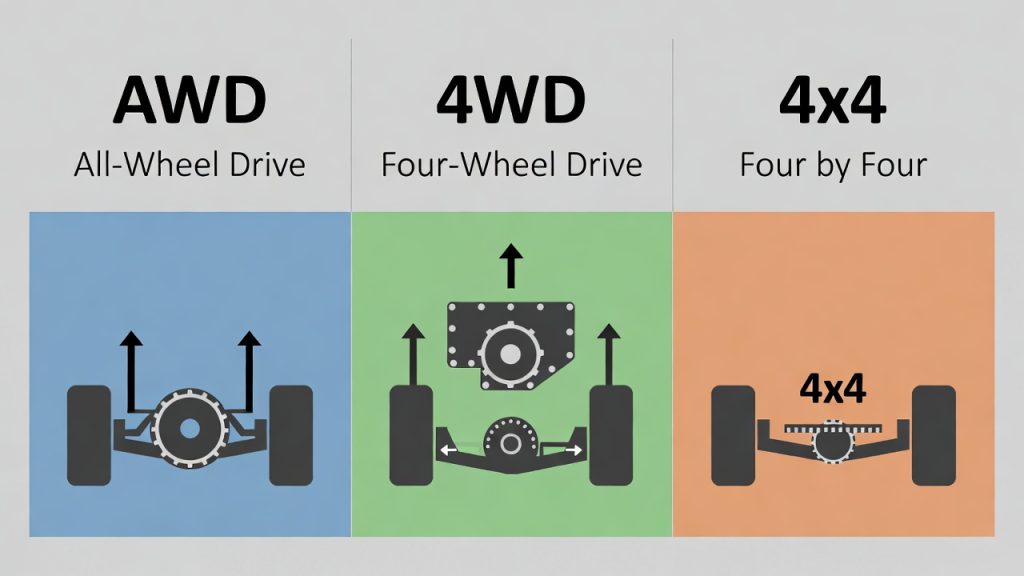
AWD stands for All-Wheel Drive. This system is designed to send power to all four wheels at the same time. But here’s the thing: it doesn’t send equal power to each wheel. That would be a nightmare.
Instead, AWD systems are smart. They use computers to figure out which wheels need more power right now. If you’re turning a corner, the wheels on the outside of the turn might need more power than the ones on the inside. If you hit a patch of ice, the system can adjust power instantly.
How AWD Works
An AWD vehicle has a central computer that talks to the engine and the wheels. It’s checking all the time:
- How much traction does each wheel have?
- Are we slipping anywhere?
- Are we going around a corner?
- What’s the road surface telling us?
The system then adjusts power delivery constantly. All four wheels are always in the game, but they’re not always getting the same amount of power. This is what makes AWD different from 4×4 systems, which work in a very different way.
AWD: The Good Stuff
AWD is fantastic for most drivers. Here’s why:
Better traction in bad weather. When it rains or when there’s light snow, AWD vehicles grip the road better. Two wheels doing the work is good. Four wheels doing the work is better.
Easier to drive. You don’t have to do anything special. You don’t flip switches or change modes. You just drive. The system handles everything automatically.
Good for city driving. Most of us spend most of our time in cities or towns. AWD helps you accelerate better, turn sharper, and stop quicker on normal roads.
Lighter and cheaper than 4WD. An AWD system weighs less. It costs less to build. It costs less to put in your car. That means more money in your pocket.
Better fuel economy. Since AWD is lighter and simpler than 4WD, it burns less gas. Not tons less, but you will notice it.
AWD: The Not-So-Good Stuff
AWD isn’t perfect. Here’s what it can’t do:
Can’t handle serious off-road driving. If you’re planning to rock crawl or drive through deep sand or mud, AWD will disappoint you. It’s built for roads, not for extreme terrain.
Limited ground clearance. Most AWD cars sit pretty low to the ground. That means a little bump can cause problems.
Not ideal for towing heavy loads. If you’re planning to pull a horse trailer or a big boat, AWD vehicles struggle with the weight distribution.
Can’t lock the wheels. With some AWD systems, you can’t really engage a “lock” that keeps wheels moving together. This is a big deal for serious off-roading.
What Is 4WD?
4WD stands for Four-Wheel Drive. But here’s where things get confusing. 4×4 and 4WD are often used to mean the same thing, but technically they’re different. Let me explain.
4WD usually means a system that’s designed to handle serious terrain. You actively engage it. You flip a switch or push a button, and suddenly all four wheels get power. It’s not automatic like AWD. You control it.
How 4WD Works
A 4WD system has a transfer case. Think of it as a switcher. When you’re on the highway, you use 2WD (just the rear wheels, usually). When you need extra power or traction, you shift into 4WD high. When things get really bad, you shift into 4WD low.
The transfer case lets you choose. AWD doesn’t give you that choice. The computer makes the choice for you.
In true 4WD:
- 2WD mode: Only the rear wheels get power. This is for normal driving.
- 4WD high: All four wheels get power. The gear ratio is 1:1. This is for slippery roads or light off-roading.
- 4WD low: All four wheels get power, but with much lower gearing. This gives you serious power. This is for climbing mountains, navigating rocky terrain, or pulling yourself out of mud.
4WD: The Good Stuff
4WD is the serious choice. Here’s what it does well:
True off-road capability. 4WD systems are built for terrain, not just roads. Rocks, mud, sand, steep hills—4WD can handle it.
Locking differentials. Many 4WD vehicles let you lock the wheels. This means both wheels on an axle move at exactly the same speed. This is essential for real off-roading because it prevents one wheel from spinning uselessly while the other loses traction.
Low range gearing. This gives you insane amounts of torque. You can climb a hill that would stop any other vehicle. You can pull through mud like it’s nothing.
Great towing capability. 4WD vehicles are usually built tough. They can tow heavy loads without breaking a sweat.
True redundancy. If you damage one system, you still have another way to move. You can lock differentials and keep going.
4WD: The Not-So-Good Stuff
4WD isn’t the right choice for everyone:
Costs more. Building a real 4WD system is expensive. You’re paying for heavy-duty components, a transfer case, locking differentials, and more. This drives up the price.
Worse fuel economy. A 4WD vehicle weighs way more. The engine works harder. You’ll see this at the pump.
Less efficient on normal roads. All that extra weight and drag? It hurts performance on asphalt. 4WD systems are built for terrain, not speed.
Harder to drive in some situations. In snow, 4WD can make things tricky. You need to know when to use high range versus low range. You need to understand locking differentials. This isn’t the system for beginners.
Overkill for most drivers. Ninety percent of drivers will never use 4WD’s full capability. If you’re mostly driving in cities, you’re wasting money and fuel.
What Is 4×4?
This is where the confusion gets real. 4×4 is technically a term that means four wheels powered by a four-cylinder engine. But colloquially, people use 4×4 and 4WD to mean the same thing.
However, in strict automotive terms, 4×4 refers to a vehicle configuration. When something is labeled 4×4, it means four-wheel drive. It’s just written in a different format. 4×4 = 4WD.
But wait—some people use 4×4 to describe vehicles with aggressive capabilities. Some use it for any truck with all-wheel power. This is where the confusion comes from.
The 4×4 Landscape
In the real world, 4×4 usually describes:
- Traditional trucks with transfer cases
- SUVs with serious off-road geometry
- Vehicles with locking differentials
- Vehicles with low range gearing
So when you’re shopping and see “4×4,” think “this is probably built tough for terrain,” not just “this is powered by four wheels.”
AWD vs 4WD: Head-to-Head Comparison
Let’s compare these systems directly across several important factors.
Traction and Grip
AWD wins on normal roads. The constant power distribution and computer control mean better traction on highways, wet streets, and light snow.
4WD wins off-road. The ability to lock differentials and use low range gearing means unstoppable traction on terrain.
Verdict: It depends where you drive. Road? AWD. Dirt? 4WD.
Cost
AWD is cheaper. You’ll spend less money buying an AWD vehicle. You’ll also spend less on maintenance.
4WD costs more. More components mean higher cost and higher maintenance bills.
Verdict: AWD by a mile. 4WD vehicles are pricier.
Fuel Economy
AWD is more efficient. Less weight, less complexity, less drag.
4WD is a fuel hog. You’ll definitely notice the difference at the pump.
Verdict: AWD wins here too.
Ease of Use
AWD is automatic. You do nothing special. The system handles it.
4WD requires engagement. You need to switch modes, understand high and low ranges, and know when to use locking differentials.
Verdict: AWD is simpler.
Off-Road Capability
AWD is limited. It can handle light trails and snow, but serious terrain? No way.
4WD is built for it. This is what it was designed to do.
Verdict: 4WD dominates here.
Bad Weather Performance
AWD is excellent. Rain and light snow are no problem.
4WD is good but can be tricky. It’s overkill for most weather, and using it wrong can cause problems.
Verdict: AWD for most drivers. 4WD for extreme conditions.
Daily Driving Experience
AWD feels normal. You drive like you always did. Nothing changes.
4WD can feel clunky. The vehicle might be heavier. Mode switching can feel awkward in cities.
Verdict: AWD is more natural for daily driving.
Hauling and Towing
AWD is okay for light towing. You can pull a small trailer.
4WD is built for heavy loads. Hauling is what these vehicles do best.
Verdict: 4WD is the choice here.
So Which One Should You Get?
Okay, let’s stop dancing around this. Which system is right for you?
Get AWD If:
You live in a place with occasional rain or light snow. You drive mostly on highways and city streets. You care about fuel economy. You want a lower purchase price. You like automatic, no-fuss driving. You don’t plan any serious off-roading. You want a car or sedan. You’re a beginner driver.
Most people should get AWD. Seriously. If this list describes you, AWD is the right choice.
Get 4WD If:
You live somewhere with heavy snow and ice. You drive on rough roads regularly. You plan off-road adventures. You need to tow heavy loads. You have a rural property. You want maximum traction in extreme conditions. You don’t mind paying more. You like having control over your vehicle’s power distribution.
If you’re thinking “yeah, that’s me,” then 4WD makes sense. But be honest with yourself. A lot of people think they need 4WD but don’t really use it.
Get 4×4 If:
You want a vehicle built to handle both roads and terrain. You live in a place with extreme weather. You might do some light off-roading. You want the capability even if you don’t use it often. You like trucks and traditional SUVs.
4×4 is great if you want flexibility. You get road manners from 4WD vehicles but serious capability underneath.
Real-World Examples
Let’s look at some actual vehicles and what they offer.
Typical AWD car: Sedan with all-wheel power. Good for snow-prone cities. Think suburbs and highways. Great for someone living in the Northeast or Pacific Northwest.
Typical 4WD truck: Full-size truck with transfer case, locking differentials, and low range. Built for construction sites, farms, and serious trails. Designed for someone who genuinely needs capability.
Typical 4×4 SUV: Crossover with all-wheel power but stronger than basic AWD. Built for people who want capability without the truck size. Great for families who might hit a trail occasionally.
Each fills a different need. None is better than the others. They’re just different tools.
Maintenance and Reliability
AWD systems are simpler. Fewer moving parts mean fewer things to break. You’ll do basic maintenance like any other car.
4WD systems are more complex. Transfer cases need fluid. Differentials need attention. You’ll spend more time and money on maintenance.
Both are reliable when properly maintained. But maintain a 4WD system, or you’ll have problems.
The Resale Value Question
Here’s something many people forget about. What’s your vehicle worth later?
AWD vehicles hold value well. They’re common, people want them, and they appeal to a wide market.
4WD vehicles hold value excellently. Especially trucks. Demand is high, and people love them. You might even get more than you paid.
So don’t worry about this too much. Both systems hold value. 4WD might actually hold it better.
Snow and Ice: The Ultimate Test
Everyone asks about winter performance. Let’s settle this.
AWD is genuinely good in snow. The automatic power distribution keeps wheels spinning. You get traction. You go places.
4WD is genuinely good in snow too. With proper tires, 4WD excels. Lock a differential, engage low range, and you’re unstoppable.
The real winner: Good tires. Seriously. The difference between good winter tires and all-season tires is bigger than the difference between AWD and 4WD. Invest in tires.
Common Myths About These Systems
Myth 1: 4WD is better than AWD.
Reality: They’re different. 4WD is better for terrain. AWD is better for roads. There’s no universal “better.”
Myth 2: AWD means you don’t need winter tires.
Reality: Wrong. Winter tires matter more than your drivetrain. Get good tires.
Myth 3: 4WD means you can drive anywhere in any condition.
Reality: Even 4WD has limits. Deep snow, river crossings, extreme terrain—these beat everything. Respect your vehicle’s limits.
Myth 4: You should always run 4WD engaged.
Reality: Bad idea. Leave 4WD in 2WD mode when you don’t need it. You’ll save fuel and reduce wear.
Myth 5: AWD is the same as 4WD.
Reality: Nope. They work completely differently.
All-Terrain Performance: Deep Dive
Let’s talk about how these systems handle real-world terrain. This is where the differences really show up.
Sand and Desert Driving
On sand, 4WD dominates. The ability to lock differentials is essential. You can keep wheels from spinning uselessly while you power through. AWD? It’ll struggle. The wheels will fight each other, and you’ll sink.
4×4 vehicles with proper sand driving knowledge and equipment can cross vast desert regions. They do it every day. AWD vehicles? They’re not built for this.
Mud and Swampy Ground
Mud is 4WD territory. The power and control it gives you are essential. You need to keep forward momentum. You need to power through without getting stuck. 4WD lets you do that.
AWD can handle light mud on roads, but deep mud? You’re stopped. The computer-controlled system works against you because it limits power to wheels that are slipping.
Rock Crawling
This is pure 4WD work. Rock crawling needs low range gearing and locking differentials. AWD can’t do this at all. It’s not even in the conversation.
4×4 vehicles built for this purpose can climb rock faces that seem impossible. The power, control, and flexibility they offer is beyond anything AWD can match.
Snow and Ice
This is interesting because both systems work here. AWD is great for general snow driving. The computer handles everything. You just go.
4WD is overkill in most snow situations. But when things get extreme—deep powder, icy slopes, mountainous terrain—4WD shines. You can lock differentials for maximum traction. You can shift to low range for better control.
The truth: invest in winter tires first. After that, AWD is plenty for most snow driving.
Water Crossings
Some 4×4 vehicles can ford through water. AWD vehicles can’t. Even shallow water can damage an AWD system’s electronic components. 4WD vehicles with snorkels and waterproofing can handle it.
This is a big difference if you’re adventuring in extreme conditions.
The Different Types of AWD
Here’s something people don’t realize: AWD comes in different flavors.
Standard AWD: The computer controls power all the time. It’s always thinking, always adjusting. This is most AWD cars.
AWD with torque vectoring: Some systems send power differently to the left and right wheels. This helps cornering. Fancier, more expensive, but really smooth.
AWD with adjustable modes: Some allow you to choose between modes like “sport” or “snow.” You get a bit more control than standard AWD.
These differences matter, but not as much as the difference between AWD and 4WD. It’s still the same basic system.
The Different Types of 4WD
4WD also has variations.
Part-time 4WD: This is traditional. You switch between 2WD and 4WD. When you’re in 2WD, only the rear wheels work. This is fuel-efficient. It’s best for people who only use 4WD occasionally.
Full-time 4WD: All four wheels always get power. The center differential splits power between front and rear. This works great on roads and trails. It’s more expensive and uses more fuel, but it’s smoother.
Locking differentials: Some 4WD vehicles let you lock the center differential (and sometimes the front and rear too). This is for serious off-roading. When locked, wheels on that axle move together at the same speed.
Low range: This is the multiplier that gives you serious power for climbing and pulling.
These variations matter a lot for actual use. A part-time 4WD with locking differentials is built different than a full-time 4WD without locks.
What About SUVs and Crossovers?
This is confusing territory. Some SUVs are built on truck platforms with true 4WD. Some are built on car platforms with AWD. Some are somewhere in between.
A truck-based SUV with 4WD is basically a truck. It offers real capability.
A car-based crossover with AWD is basically a car. It’s for roads, not terrain.
Some in-between SUVs mix both. They’re good at roads and decent at trails, but not excellent at either.
Know what you’re buying. Look at the platform, the drive system, the ground clearance, and the components. A fancy name doesn’t mean real capability.
The Environmental Angle
Here’s something to think about: which system is better for the environment?
AWD is lighter and uses less fuel. It burns less gas. That means fewer emissions. From an environmental standpoint, AWD is better.
4WD uses more fuel and burns more gas. If you’re not actually using the capability, you’re wasting fuel for no reason.
If you’re a city driver with AWD, you’re making a good environmental choice. If you’re a city driver with 4WD and never use it, you’re burning fuel for nothing.
Real Talk About Off-Roading
People fantasize about off-roading. “I’ll totally do trails,” they say. Then they buy an expensive 4WD vehicle and park it in a garage. Most of that capability never gets used.
Be honest. How often will you actually off-road? Once a year? Never? If it’s rare, maybe you don’t need 4WD.
But if you live on a rural property, drive on unimproved roads regularly, or genuinely plan adventures, then 4WD makes sense. You’re using it.
The worst thing you can do is buy 4WD you don’t need, then feel guilty about the fuel economy and rarely use the capability. Buy what you’ll actually use.
Technology and the Future
Newer AWD systems are getting smarter. They use torque vectoring, predictive power management, and artificial intelligence. They’re getting more capable while staying efficient.
Newer 4WD systems are getting smarter too. Electronic locking differentials, adaptive suspension, and better transfer cases are making them easier to use.
Technology is making both systems better at what they do. But the fundamental difference remains: AWD is for roads, 4WD is for terrain.
Making Your Final Decision
Here’s what you need to do:
First, think about where you actually drive. Not where you want to drive. Where you actually drive every day.
Second, think about the weather. Does it snow where you live? How much? Is it regular heavy snow or occasional light snow?
Third, think about your adventures. Are you a trails person? Do you camp off-road? Do you have a rural property? Or do you mostly stay on paved roads?
Fourth, think about your budget. How much can you spend? How much are you willing to spend on fuel and maintenance?
Fifth, test drive both. Feel how they handle. Listen to how the systems work. Get a sense of what you’re getting.
Then make your choice based on your actual life, not your fantasy life.
Conclusion: It All Makes Sense Now
AWD and 4WD and 4×4 are just different ways of getting power to wheels. They work differently. They excel in different situations. They cost different amounts. They use different amounts of fuel.
AWD is for most people. It’s smart, efficient, automatic, and works great on roads.
4WD is for specific people. It’s powerful, controllable, capable, and works great on terrain.
4×4 is a designation that usually means true capability, but it’s just a name.
Neither is universally better. They’re tools. Pick the right tool for your actual job, and you’ll be happy. Pick the wrong tool because you think you might need it someday, and you’ll regret it.
Drive honest. Drive safe. And now you know the difference.