How Does a Torque Curve Change When You Increase Boost?
If you have spent any time around turbo cars or supercharged engines, you have probably heard people talk about “the torque curve.” It sounds technical, but the idea behind it is simple. It just shows how much twisting force, or torque, your engine makes at each point in the RPM range. Once you add boost into the mix, that curve does not stay the same. It shifts, it grows, and it changes shape in ways that can make your car feel like a totally different machine.
In this guide, we will break down exactly what happens to a torque curve when boost goes up, why it happens, and what it means for the way your car actually drives. No confusing jargon, no wall of math. Just plain talk that a beginner can follow from start to finish.
What Is a Torque Curve, Really?
Before we jump into boost, let’s get the basics straight. Torque is the rotational force your engine produces. Think of it as the “push” that gets your car moving and keeps it accelerating. Horsepower gets all the attention in ads, but torque is what you actually feel in the seat of your pants.
A torque curve is just a graph. The bottom line, called the x-axis, shows engine speed in RPM (revolutions per minute). The side line, called the y-axis, shows torque output, usually in pound-feet or newton-meters. When you plot torque at every RPM point, you get a curve. Some curves are flat and wide. Others spike early and drop off fast. Some build slowly and peak near redline.
Every engine has its own natural shape based on things like:
- Displacement (how big the engine is)
- Cam timing
- Intake and exhaust design
- Compression ratio
- How it breathes, on its own or with help from forced induction
That last point is where boost comes into play.
What Does “Boost” Actually Mean?
Boost is extra air pressure pushed into the engine by a turbocharger or supercharger. A normal, naturally aspirated engine only pulls in air using the vacuum created by the pistons moving down. That limits how much air, and therefore fuel, can get burned in each cycle.
A turbo or supercharger changes that. It packs more air molecules into the same cylinder space. More air means the engine can burn more fuel per cycle, and burning more fuel means making more power. Boost pressure is usually measured in PSI (pounds per square inch) or BAR, and it tells you how much above normal atmospheric pressure the intake system is running.
So when someone says “I bumped my boost from 10 PSI to 15 PSI,” they mean the engine is now forcing significantly denser air into the cylinders than it did before.
The Short Answer: What Happens to the Torque Curve
Here is the quick version before we go deeper. When you raise boost:
- Peak torque goes up
- Torque arrives earlier in the RPM range
- The curve gets fatter and flatter across a wider band
- The area under the curve, meaning usable power across the rev range, grows a lot
That last point matters more than most people realize. A taller peak number looks good on paper, but a wider, fatter curve is what actually makes a car feel strong everywhere, not just at one specific RPM.
Now let’s slow down and go through each of these changes one at a time.
1. Peak Torque Increases
This one is fairly obvious, but it is worth explaining why it happens. More boost means more air packed into the cylinder. More air lets you add more fuel while keeping the air-fuel ratio safe. Burning more fuel-air mixture in each combustion event creates a bigger explosion, and a bigger explosion pushes the piston down harder.
That harder push is torque. So as boost climbs, the cylinder pressure climbs with it, and peak torque numbers climb right along with cylinder pressure.
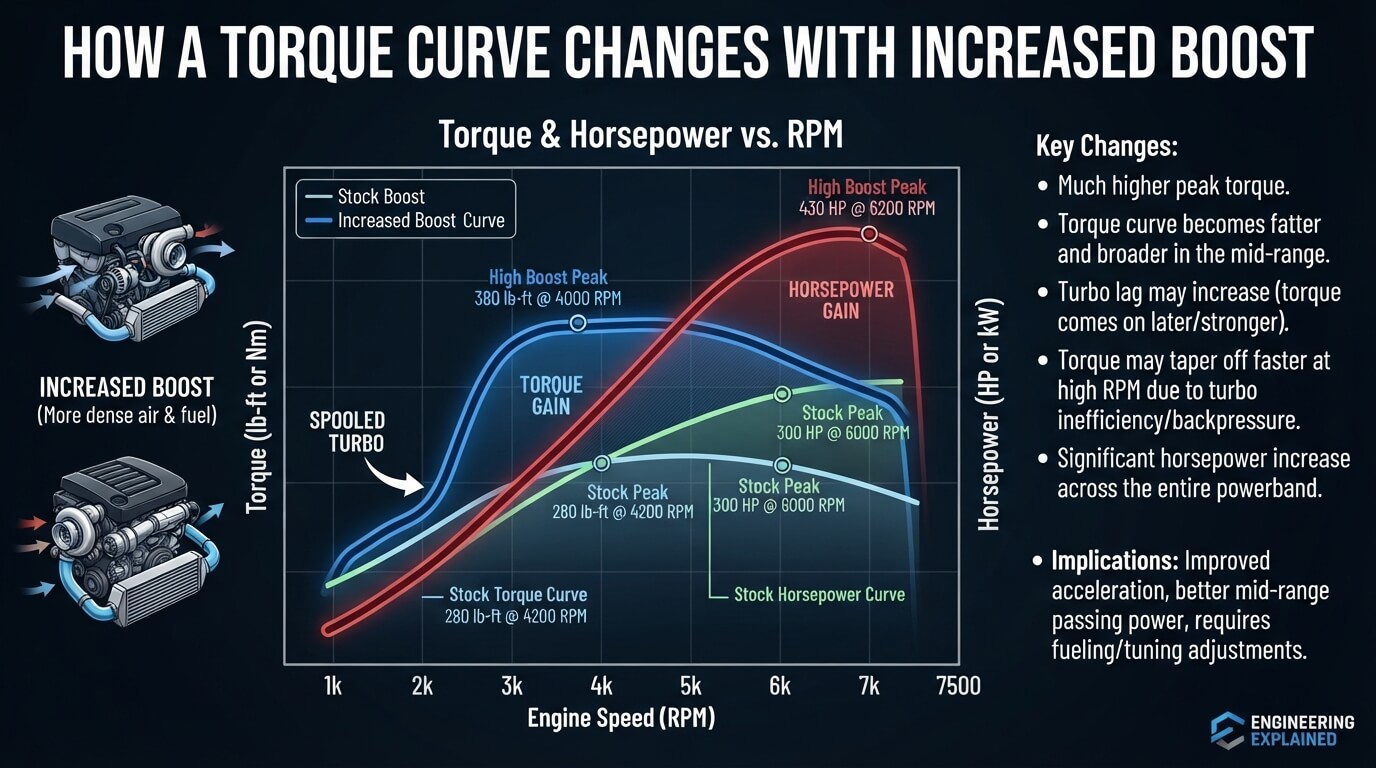
For example, an engine making 300 lb-ft at 8 PSI might jump to 380 lb-ft at 14 PSI, all without changing anything else mechanically. The block, heads, and cams stay the same. Only the air charge density changed, and that alone drives a big jump in output.
2. Torque Shows Up Earlier
This part surprises a lot of beginners. It seems like more boost should just make the top-end pull harder, but in reality, one of the biggest changes happens down low, in the mid-range.
Here is why. A turbocharger relies on exhaust gas flow to spin its turbine. At low RPM, there is not much exhaust flow yet, so the turbo has not “spooled up” to full boost. This delay is often called turbo lag.
When you raise the boost target, tuners often also adjust the wastegate, turbine size, or spring pressure so the system reaches that higher boost target sooner in the rev range. Even without any hardware changes, a higher boost setting frequently means the engine crosses into strong power earlier because there is now a bigger pressure difference for the turbo to chase, so it builds up faster once the throttle opens.
The result: the steep, rising part of the torque curve, which is the part right before peak torque, shifts to the left on the graph. In plain language, the strong pull starts sooner after you hit the gas.
3. The Curve Gets Wider and Flatter
A naturally aspirated engine usually has a torque curve shaped like a hill. It climbs, peaks somewhere in the middle of the rev range, then falls off toward redline. That shape is dictated mostly by how well the cylinder head, intake, and exhaust can move air at different engine speeds.
Forced induction changes that shape dramatically. Because the turbo or supercharger is actively forcing air in rather than depending purely on natural airflow, it can maintain strong cylinder filling across a much wider RPM window. Instead of a hill shape, you often get something closer to a plateau, a flat stretch where torque stays close to its peak value for a long stretch of RPM before finally tapering off near the redline.
Raise boost further, and that plateau usually gets both higher and wider, assuming your fueling, ignition timing, and intercooling can keep up. This is why turbocharged cars often feel like they have a much broader “sweet spot” than naturally aspirated engines. You do not have to keep the engine spinning at one specific RPM to feel strong acceleration. That flat torque plateau is available across a big chunk of the rev range.
4. More Area Under the Curve
Engineers sometimes talk about the “area under the curve” when discussing engine output. This just means the total torque produced across the entire usable RPM range, not just the single highest number.
A car with a torque curve that spikes to a high peak for a split second but drops off quickly on both sides has a small area under the curve. A car with a slightly lower peak but a long, wide plateau can actually have a bigger area under the curve, and that translates to stronger real-world acceleration, because your engine spends more time making strong torque rather than just passing through it briefly.
Raising boost tends to grow this area in two ways at once: by raising the peak, and by widening the plateau around that peak. That combination is why boosted cars often feel dramatically stronger in daily driving, not only on a dyno printout.
Why Boost Does Not Just Multiply Everything Evenly
It would be nice if doubling boost simply doubled torque everywhere, but real engines do not behave that cleanly. A few limiting factors shape how the curve actually changes:
Air-Fuel Ratio Limits
More boost means more oxygen, and more oxygen needs more fuel to keep combustion safe. If your fuel injectors, fuel pump, or fuel pressure system cannot keep up, the air-fuel ratio goes lean at high boost. A lean mixture at high cylinder pressure is a recipe for detonation, which is damaging and also actually costs torque rather than adding it. So fueling capacity often becomes the ceiling on how far boost gains can go before you hit diminishing returns or outright danger.
Ignition Timing and Knock
Higher cylinder pressure from boost also raises the risk of knock, sometimes called detonation. Modern ECUs pull ignition timing back automatically when knock sensors detect trouble. Pulled timing means less torque produced from that same combustion event, even with more air and fuel present. This is why simply cranking up boost on a stock tune without proper calibration often gives disappointing or even negative results. The engine protects itself by retarding timing, and that eats into the very gains you were chasing.
Intercooler Efficiency
Compressing air heats it up. Hot, compressed air is less dense than cool, compressed air, so an intercooler’s job is to cool that charge air down before it reaches the cylinders. As boost rises, the compressor works harder and heat soak becomes a bigger factor. If the intercooler cannot keep pace, incoming air temps climb, density drops, and the torque gains from boost start to shrink or even reverse at very high boost levels. This is a big reason race cars run large, well-ducted intercoolers instead of tiny stock units.
Mechanical and Turbo Limits
There is also a physical ceiling. Turbochargers have a compressor map with an efficiency zone. Push boost past that efficient zone, and the compressor starts making more heat than usable pressure, which hurts the torque curve instead of helping it. Bottom end strength, head gaskets, connecting rods, and clutch or transmission capacity all set real limits too. At some point, more boost stops being a free lunch and starts becoming a reliability risk.
What a Real Dyno Comparison Looks Like
If you pull up a dyno chart comparing a car at low boost versus the same car at higher boost, here is generally what you would see:
- The higher boost line sits above the lower boost line across almost the entire RPM range, not just at the peak
- The higher boost line often reaches its climb earlier, meaning torque ramps up sooner after idle
- The gap between the two lines tends to be biggest in the mid-range, where turbo lag used to hold torque back
- Near redline, the gap sometimes narrows again, because exhaust backpressure, valve timing limits, and turbo efficiency start capping gains at very high RPM regardless of boost level
This pattern is extremely common across turbocharged four-cylinders, six-cylinders, and V8s alike. The details shift based on turbo size, engine displacement, and tuning, but the general shape of “higher, earlier, and wider” tends to hold true.
Boost and Horsepower: A Quick Side Note
Since torque and horsepower are related through RPM, it is worth mentioning how horsepower reacts too. Horsepower is calculated from torque multiplied by RPM, divided by a constant. Because boost raises torque especially in the low and mid RPM range, horsepower often rises across nearly the whole curve too, not just at the very top. This is different from something like a high-revving naturally aspirated engine, which usually gains horsepower mainly by extending the RPM range rather than by boosting torque itself.
So in a boosted car, you often get both a torque curve and a horsepower curve that grow together, shifted earlier and packed with more area underneath, rather than one growing at the expense of the other.
Supercharger vs Turbocharger: Does the Curve Change Differently?
It is worth touching on this because the two systems behave a bit differently.
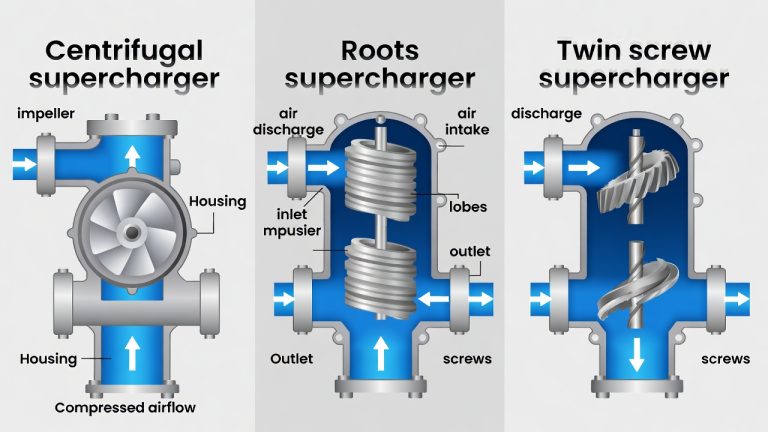
A supercharger is driven directly by a belt connected to the crankshaft, so it builds boost in a fairly linear way tied directly to engine RPM. This means superchargers often produce a smoother, more predictable torque curve with less of that early-RPM lag that turbos can suffer from. The tradeoff is that they usually pull some engine power just to spin the supercharger itself, and boost keeps climbing as RPM climbs, sometimes making top-end boost harder to control without a bypass valve.
A turbocharger uses exhaust energy that would otherwise be wasted, which makes it more efficient overall, but that same design is exactly why lag exists at low RPM. As you raise boost targets on a turbo setup, the curve shape often improves more dramatically in the low and mid-range specifically, because that is where the turbo previously struggled to keep up.
Both systems still follow the same core rule though: more boost, done properly, raises torque and widens the strong part of the curve.
Practical Takeaways for Anyone Tuning or Modifying
If you are actually planning to raise boost on your own car, keep these points in mind:
- Fuel system capacity needs to scale with air, or you risk a lean, knock-prone condition instead of real gains
- Ignition timing needs proper calibration for the new boost level, since factory maps are not built for higher pressure
- Intercooling becomes more important as boost climbs, since heat soak eats into your density gains
- Mechanical limits are real, so check what your internals, clutch, and drivetrain can safely handle before pushing much further
- Small, well-planned boost increases paired with proper tuning usually beat large, careless jumps that overwhelm fueling and cooling systems
A properly tuned boost increase does far more than just raise a peak number on a spec sheet. It reshapes the entire torque curve into something broader, earlier, and far more usable in real driving conditions, from merging onto a highway to launching off a line.
Wrapping It Up
So, to sum up the whole picture: raising boost pushes peak torque higher, pulls that torque earlier into the rev range, and widens the strong middle section of the curve into a flatter plateau instead of a narrow spike. The total usable power across the whole RPM band grows, often by a lot, as long as fueling, ignition timing, and cooling keep pace with the added air.
It is not simply a case of “more boost equals more power” in a straight line. Real gains depend on how well the rest of the engine’s supporting systems can handle that extra air charge. Get those pieces right, and the torque curve transforms from a narrow hill into a broad, strong plateau that makes the car feel powerful across almost the entire rev range, not just at one lucky spot on the tach.
That is really the heart of why boosted engines feel so different from naturally aspirated ones. It is not only about a bigger number at the top. It is about reshaping the whole curve into something stronger, earlier, and wider from idle all the way to redline.
A Few Common Questions Beginners Ask
Does raising boost always make the car feel faster in every gear?
In most cases, yes, but the feeling is strongest in the mid-range gears where you spend the most time on the street. First gear can sometimes feel similar since traction, not torque, becomes the limiting factor. Higher gears at highway speed tend to show the biggest difference, since a fatter torque curve means stronger passing power without needing to drop down two gears just to get a response.
Can too much boost ever hurt low-end response?
Yes, in a few specific cases. If a turbo is sized too large for the engine, chasing very high boost numbers can actually make lag worse, since a bigger turbine takes longer to spool. In that scenario, low-end torque can feel weaker even though peak numbers on paper look impressive. This is why turbo sizing matters just as much as the boost number itself when it comes to how the curve actually behaves in the real world.
Do all engines respond to boost the same way?
Not exactly. Smaller displacement engines often show a bigger percentage jump in torque from added boost, since they rely more heavily on forced induction to make up for their smaller natural airflow. Larger displacement engines already flow a lot of air on their own, so the relative gain from the same boost increase can look smaller in percentage terms, even if the raw torque numbers are still impressive.
Is it safe to just add boost with a simple piggyback tuner?
A piggyback device can adjust boost, but without also adjusting fueling and ignition timing to match, you risk exactly the lean, knock-heavy scenario mentioned earlier. A proper tune accounts for the whole system together, not boost pressure alone, which is why most experienced tuners treat boost, fuel, and timing as one connected package rather than three separate knobs.
Final Thought
Boost is one of the most powerful tools for reshaping an engine’s character, but it rewards a careful, complete approach rather than a single aggressive change. Treat the fuel system, ignition timing, cooling, and mechanical strength as parts of one connected puzzle, and the torque curve will reward you with a broad, strong, and reliable pull across the rev range rather than a short-lived spike that risks the health of the engine.