Drilled vs Slotted Rotors
When you pump your brakes and your car slows down, you might not think much about what’s happening under the hood. But those brake rotors spinning on your wheels are doing some serious work. If you’re shopping for new brake components or just curious about what makes some rotors different from others, you’ve come to the right place.
Today we’re going to break down the differences between drilled rotors and slotted rotors. Both are popular upgrade options for car owners who want better braking performance. But which one is right for you? Let’s find out.
What Are Brake Rotors Anyway?
First, let’s cover the basics. Your brake rotors are round metal discs that spin along with your wheels. When you hit the brakes, your brake pads press against these rotors. This friction is what slows your vehicle down and brings it to a complete stop.
Most factory brake rotors are smooth and flat. They work just fine for everyday driving. But if you want better performance, drilled and slotted rotors offer some real advantages.
The basic rotor design has been around for a long time. It’s simple and effective. The brake pad material rubs against the rotor surface. Heat builds up from this friction. Your brakes slow your car down. It’s a reliable system that works well.
But there’s a catch. Heat is the enemy of good braking. When your rotors get too hot, they can lose their stopping power. This is called brake fade. Both drilled and slotted rotors try to solve this problem in their own ways.
Understanding Drilled Rotors
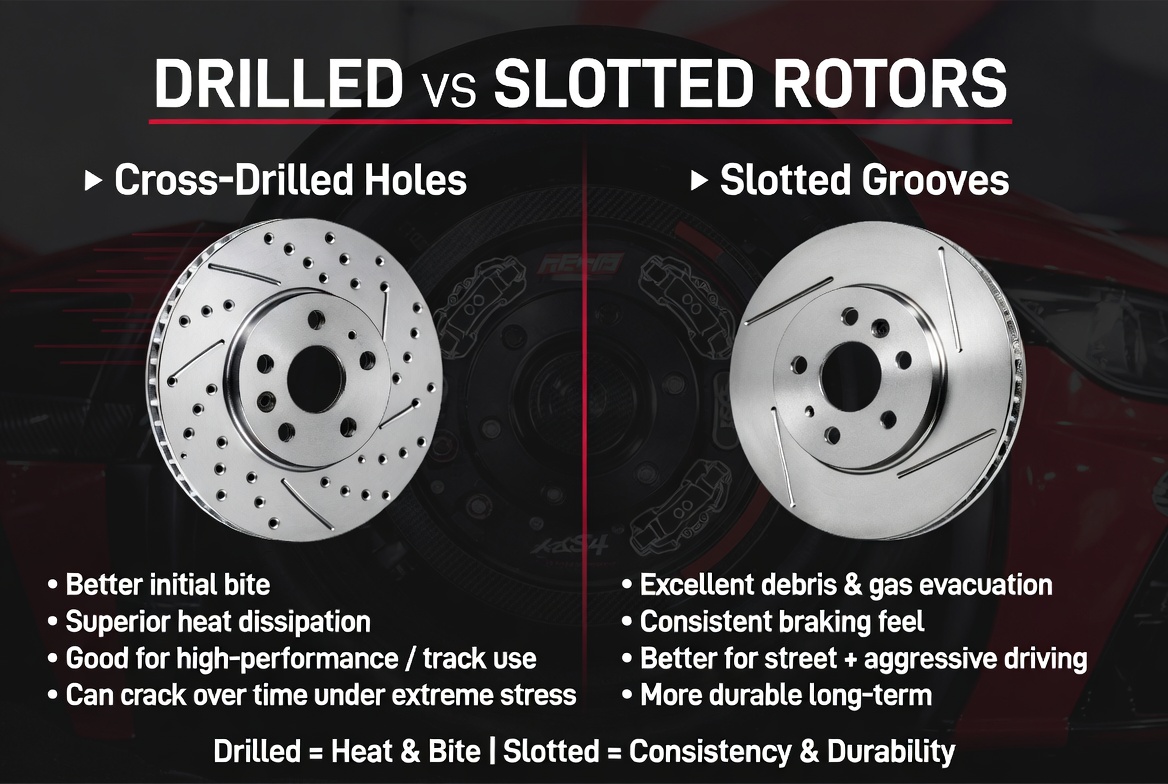
Drilled rotors have holes drilled right through them. These holes go straight through the rotor from the front face to the back. That’s where they get their name.
The idea behind drilled rotors is pretty smart. Those holes help cool the rotor down faster. Heat can escape through the holes. Air flows through them too. Better cooling means your brakes can handle more heat without fading.
Drilled rotors look really cool. That’s part of their appeal. The holes give them a sporty appearance. Many car enthusiasts love how they look on a wheel. If you care about the visual side of your brakes, drilled rotors deliver.
The holes also help get rid of gases and moisture. When your brake pads heat up, they can release gases. These gases can reduce the friction between the pad and rotor. Drilled holes let those gases escape. Moisture that builds up on the rotor surface can also be pushed out through the holes.
The Downsides of Drilled Rotors
Now let’s talk about the negatives. Drilled rotors aren’t perfect.
Those holes weaken the rotor structure. A rotor with holes isn’t as strong as a solid rotor. This matters when you’re braking hard or towing heavy loads. The rotor can crack more easily. A crack in your rotor means you need to replace it. That gets expensive fast.
Drilling holes changes how the heat spreads across the rotor. The material around each hole gets stressed differently. This uneven stress can cause cracks to form over time.
The holes can also reduce the amount of surface area available for the brake pad to grip. Less surface area means less friction. Your braking power might actually be reduced compared to a solid rotor.
Rain is another concern. Water can get into those holes and sit there. When you drive, the rotor heats up. The water can cause rust spots to form. Rust weakens the rotor and looks bad.
Some drivers report that their drilled rotors wear out faster than stock rotors. The pads might wear unevenly around the holes. This means you’ll be buying new pads more often.
Let’s Talk About Slotted Rotors
Slotted rotors take a different approach. Instead of holes all the way through, they have slots. These slots are like grooves carved into the rotor surface.
The slots usually run in curved or straight lines across the rotor face. They don’t go all the way through. They’re cut into the braking surface where the pad makes contact.
Slotted rotors work by moving heat away from the braking surface. Those slots help channel heat away from the contact area. They also help remove gases and moisture just like the holes in drilled rotors do.
The slots give the rotor a directional design. The patterns are usually designed to work with the rotation of the rotor. As the rotor spins, the slots push hot gases and water outward. This keeps the braking surface cleaner and cooler.
Slotted rotors are tougher than drilled ones. The rotor doesn’t have holes going through it, so it stays stronger overall. This means they can handle more stress without cracking.
The Downsides of Slotted Rotors
Slotted rotors have their own set of problems.
The main issue is noise. Slotted rotors can make a squealing sound when you brake. Some people don’t mind it. Others find it annoying. The squealing comes from the pad and rotor interaction with the slots.
The slots can wear out your brake pads faster. The sharp edges of the slots can scrub against the pad surface. This increases wear on the pads. You’ll spend more money on brake pads if you go with slotted rotors.
Heat transfer isn’t quite as efficient as with drilled rotors. The slots help, but they’re not as good at cooling as actual holes are. If you do a lot of heavy braking, drilled might cool better.
Slotted rotors cost more than basic rotors. They also cost a bit more than drilled rotors in many cases. The manufacturing process is more complex.
Some drivers report less braking power with slotted rotors compared to stock options. The pad-to-rotor contact might not be quite as good in certain situations.
Direct Comparison: Drilled vs Slotted
Let’s line these two up side by side.
Cooling Performance Drilled rotors cool faster because air flows right through the holes. Slotted rotors cool well but not quite as effectively. If cooling is your top priority, drilled rotors win this round. However, slotted rotors still handle cooling duties very well for street driving.
Durability Slotted rotors are more durable overall. They don’t have structural weakness from holes. Drilled rotors can crack more easily under stress. If you want your rotors to last longer, slotted is the way to go.
Appearance Both look better than stock rotors. Drilled rotors have a more aggressive look. Slotted rotors have a sleeker, more refined appearance. This comes down to personal taste.
Noise Level Slotted rotors are noisier. They can squeal under braking. Drilled rotors are generally quieter. If you don’t want brake noise, drilled is better.
Cost Drilled rotors are typically cheaper than slotted. But the price difference isn’t huge. Both cost more than standard rotors.
Brake Pad Wear Slotted rotors wear pads faster. Drilled rotors are easier on pads. If you want to stretch your brake pad life, drilled is the better option.
Moisture Handling Both handle water well. Drilled rotors move moisture away quickly through the holes. Slotted rotors channel water outward through the slots. They’re roughly equal on this front.
Best Use Cases Drilled rotors work great for street driving with occasional hard braking. Slotted rotors excel in heavy braking situations and racing environments.
What About Combined Rotors?
Here’s something interesting. You can get rotors that are both drilled and slotted. These combo rotors try to get the best of both worlds.
Drilled and slotted rotors together offer great cooling from the holes and good structural integrity from the slots. The slots help channel gases and moisture. The holes aid with cooling.
The downside is they cost even more. They also combine some of the weaknesses from both styles. The drilling still weakens the rotor somewhat. The slots still cause some pad wear.
These combo rotors are a solid middle ground. If you can’t decide between the two, a combined rotor might work for you. Just be prepared to pay extra.
Stock Rotors: Don’t Sleep On Them
Before you rush out to buy fancy rotors, remember that stock rotors work fine for most people. Factory brake systems are engineered to work well together.
Stock rotors are smooth and simple. They don’t look as cool as drilled or slotted options. But they’re reliable and last a long time. If you’re not doing extreme driving, stock rotors might be all you need.
Many drivers upgrade their rotors because they want the look, not because they truly need the performance. That’s okay. Just know that it’s a cosmetic upgrade more than a functional one for everyday driving.
If you track your car or do a lot of mountain driving, then the upgrade makes sense. Your rotors will handle more heat and stress. An upgrade becomes a practical choice, not just a style thing.
Heat and Brake Fade: The Real Story
We’ve mentioned brake fade a few times. Let’s dig into this more.
Brake fade happens when your brakes get too hot. The friction material on your brake pads breaks down. The rotor surface changes. Your braking power drops. This is dangerous.
In normal street driving, brake fade rarely happens. You’re not braking hard enough or long enough to cause the rotors to overheat.
Track driving is different. Racing involves repeated hard braking. Your rotors can get extremely hot. This is where drilled rotors shine. They cool faster and prevent brake fade more effectively.
Mountain driving is another scenario where heat builds up. Long downhill stretches require constant braking. Your rotors work continuously. They heat up. A better cooling system helps.
Towing heavy loads creates heat too. If you pull a trailer, your brakes work harder. Upgrading to drilled or slotted rotors can help maintain braking power.
For simple street driving, stock rotors won’t fade. You just don’t brake hard or long enough to cause the problem. But if you want to be extra safe during emergencies, an upgrade gives you peace of mind.
The Brake Pad Connection
Here’s something many people forget. Your brake pads matter just as much as your rotors.
If you upgrade your rotors, you should think about your brake pads too. High-performance pads work better with upgraded rotors.
Stock pads are designed for stock rotors. They work together as a system. When you change one part of the equation, the other part becomes less optimal.
For drilled rotors, you might want to pair them with performance pads. These pads handle heat better. They offer better stopping power.
Slotted rotors benefit from pads designed to work with slots. Some pads are made specifically for slotted applications.
You can mix and match, but a complete brake upgrade system always works better. The rotors and pads have been tested together. They know how to work as a team.
Budget matters here. A full brake system upgrade costs more than just new rotors. But it gives you a system that works well together. Performance improves across the board.
Maintenance Tips for Any Rotor Type
No matter which rotor you choose, proper maintenance keeps them healthy.
Check your rotors regularly. Look for cracks, especially on drilled rotors. Run your finger over the surface. Feel for deep ridges or gouges.
Keep your rotors clean. Dust and debris can build up. A simple wash with water helps. For stubborn buildup, use a soft brush.
Listen for noises. A squealing or grinding sound means something is wrong. Grinding usually means your pad material is gone. Get new pads immediately.
Feel your pedal. A soft or spongy pedal might mean air in your brake lines. A pulsing pedal might mean your rotor is warped. Both need attention.
Replace pads when they get thin. Don’t wait until they’re completely worn out. Worn pads can damage your rotors. New pads cost less than replacing rotors.
Avoid dragging your brakes. Holding steady pressure on the brakes causes excessive heat. Release the pedal fully between braking. Let your rotors cool down.
Making Your Choice
So which should you pick? Drilled or slotted?
Think about your driving style first. If you drive normally around town and on highways, either works fine. Stock might even be better.
If you track your car or drive in mountains often, drilled rotors give you better cooling. They’re the performance choice.
If you want durability and don’t mind a little noise, slotted rotors are solid. They last longer and handle stress well.
Think about looks too. This matters more than some people admit. If you care how your brakes look through your wheels, choose the style you prefer.
Consider your budget. Drilled rotors cost a bit less. Slotted rotors cost a bit more. The difference isn’t huge.
Think about maintenance. Drilled rotors need attention to rust and cracking. Slotted rotors need patience with noise and pad wear.
Really, you can’t go wrong with either choice. Both are better than stock rotors for performance. Both look good on a wheel. Both improve your braking in specific ways.
The Brands That Matter
When you’re shopping, you’ll see different brands. Not all rotors are created equal.
Buy from reputable brake manufacturers. These companies test their products thoroughly. They stand behind what they sell.
Cheap rotors might save you money upfront. But they won’t last as long. They might not cool as well. They could be less safe.
Spend a little more and get a quality product. Your brakes are important. They keep you and your passengers safe. Don’t cheap out on safety.
Read reviews before buying. See what other drivers say about specific rotor models. Their experiences can guide you.
Installation matters too. If you don’t have the skills, take your car to a professional. Brakes are critical. You need them done right.
Real-World Scenarios
Let me give you some examples.
Daily Commuter You drive to work and back. Maybe 30 minutes each way. Light traffic, mostly highway. Stock rotors are fine. You don’t need to upgrade. Save your money.
Weekend Mountain Driver You like to take scenic drives through hills. Long descents mean constant braking. Drilled rotors help here. They cool better during extended braking. Your commute doesn’t demand this, but your weekend drives benefit.
Track Day Enthusiast You take your car to the track once a month. You brake hard and often. Heat is a constant issue. Drilled rotors are your best friend. They handle the punishment. Combined drilled and slotted rotors are even better.
Truck Owner Who Tows You pull a trailer regularly. Extra weight means extra braking stress. Drilled rotors help manage the heat. Your safety improves. The upgrade is worth it.
City Driver With Short Trips You park and drive short distances. Lots of stop-and-go traffic. Your rotors never get very hot. Stock rotors are perfect. No reason to upgrade.
Myths and Misconceptions
Let’s bust some common myths about brake rotors.
Myth: Drilled rotors stop faster False. The rotor type doesn’t change your stopping distance much. Your brake pad type matters more. Braking force depends on pad material and rotor surface contact.
Myth: Slotted rotors are for racing only False. Slotted rotors work fine on the street. They’re durable and reliable. Many street cars use them successfully.
Myth: More holes equals better cooling False. At some point, too many holes hurt more than they help. Structural integrity drops. Rotors become less effective. Manufacturers find a sweet spot with hole placement.
Myth: You need premium rotors for basic driving False. Stock rotors work perfectly well for normal driving. They’re engineered for this exact purpose. Upgrades are nice but not necessary.
Myth: All drilled rotors are the same False. Quality varies between manufacturers. Some drilled rotors are built better than others. Brand and design matter.
The Environmental Side
Here’s something to think about. Manufacturing rotors uses energy and resources.
Stock rotors are designed to last your car’s entire life. Upgrading to performance rotors means replacing them sooner. More frequent replacement means more manufacturing.
However, modern rotors are recyclable. The metal gets melted down and used again. There’s some environmental benefit there.
If you do a lot of heavy braking, upgraded rotors might last longer overall. Better cooling prevents damage. This means fewer replacements over time.
It’s a small factor, but worth keeping in mind. Use what you actually need. Don’t upgrade just for the sake of upgrading.
Final Thoughts
Drilled rotors offer better cooling and a sporty look. They’re lighter on brake pads. But they can crack and need attention to rust.
Slotted rotors are more durable and handle stress well. They look professional and refined. But they make noise and wear pads faster.
Neither is objectively better. Each has strengths and weaknesses. Your choice depends on your specific needs and preferences.
For most drivers, either option improves upon stock rotors. You get better looks and slightly better performance. The investment is reasonable.
Just remember that brakes are crucial. Don’t let performance become a distraction from safety. Proper maintenance matters more than fancy rotors. Keep your braking system in good shape, and you’ll be fine.
If you drive normally, stock rotors might be your best choice. Save the upgrade for when you really need it. But if you want to invest in your car and enjoy better braking performance, both drilled and slotted rotors deliver.
Your brakes keep you safe every single day. Give them the attention they deserve. Whether you choose drilled, slotted, or stock, make sure they’re working well. That’s what really matters.