How to Know If Your Alternator Is Bad?
Your car’s alternator is one of those parts you don’t think about until something goes wrong. It’s sitting under your hood, quietly doing its job, keeping your battery charged while your engine runs. But when it fails, your whole car stops working right. The good news? You can spot a bad alternator before it leaves you stranded.
What Is an Alternator and Why Does It Matter?
Let’s start simple. Your alternator is basically an electrical generator for your car. Think of it as a tiny power plant mounted on your engine. While your engine runs, the alternator spins and makes electricity. This electricity does two things. It powers all your car’s electrical systems right now. It also charges your battery so it has enough juice to start the engine next time.
Your battery alone can’t keep everything running. If the alternator wasn’t there, your battery would drain to zero in just a few minutes. The alternator keeps the power flowing constantly. Without it, your car is just a big metal box that won’t go anywhere.
This is why a bad alternator is serious. It’s not like a broken cup holder. A failing alternator will kill your battery, and a dead battery means your car won’t start. It means your headlights won’t work. It means you’re stuck.
The Most Common Signs Your Alternator Is Failing
Your Dashboard Light Comes On
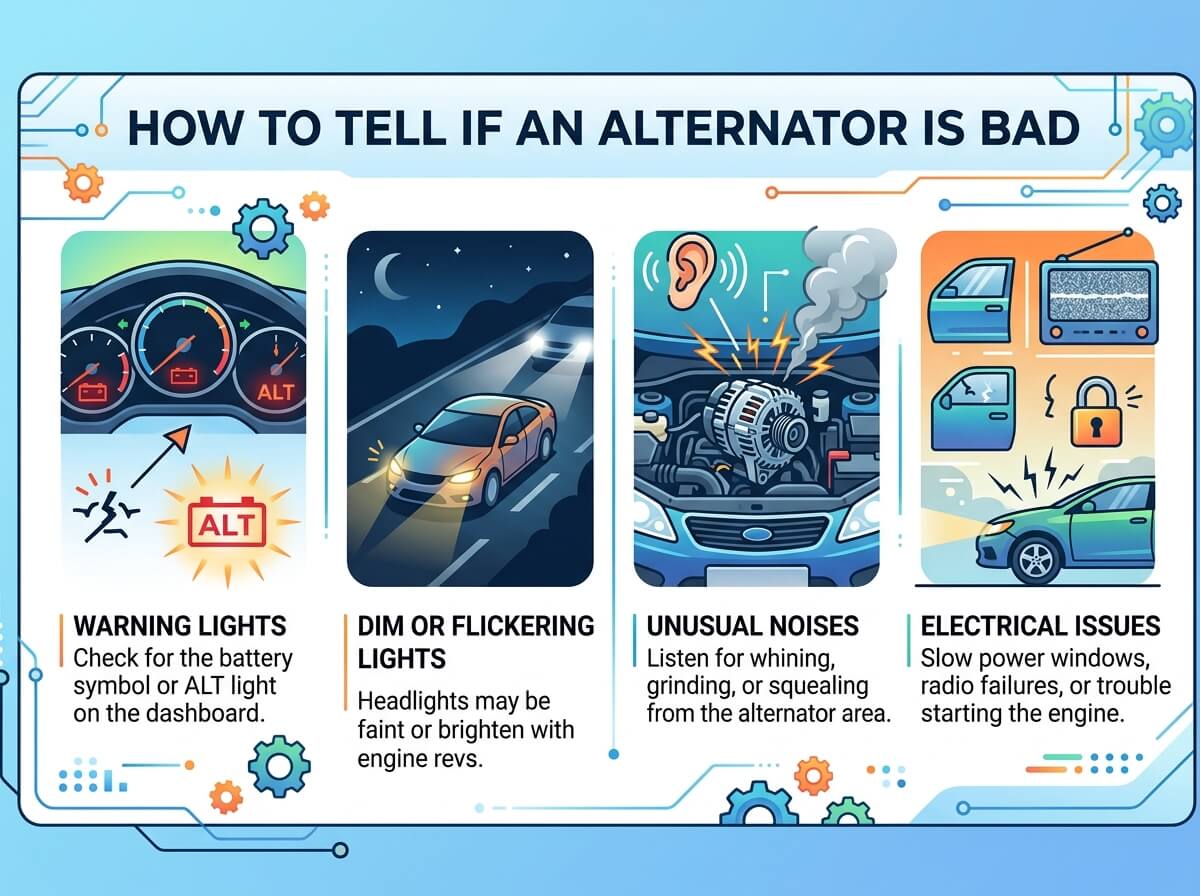
The easiest sign is the dashboard warning light. Most cars have a little light on the dashboard that looks like a battery or shows the letters “ALT”. When this light turns on, your car is telling you something is wrong with your charging system.
Don’t ignore this light. It’s not a suggestion. It’s your car talking directly to you. This light means the voltage running through your electrical system has dropped below what it should be. The most common reason? Your alternator isn’t doing its job anymore.
Sometimes this light flickers. Sometimes it stays on steady. Either way, get it checked. A flickering light might mean a loose belt or a loose connection. A steady light might mean your alternator is dying.
Your Headlights Look Dim
Have you noticed your headlights aren’t as bright as they used to be? You turn them on, and they barely light up the road ahead. That’s a red flag. Headlights need steady power to work right. When your alternator starts to fail, it can’t keep up with the power demand.
Here’s how to check this. Start your car. Make sure the engine is running. Now turn on your headlights and look at how bright they are. Now turn off the engine and check them again. If the headlights are noticeably brighter with the engine off, your alternator is probably dying. When the engine runs, the alternator should make them brighter, not dimmer.
Pay attention to the brightness over time. Dim headlights can be a small problem at first. But they get worse. Soon they’re barely working. Then your battery dies, and you’re left in the dark.
Your Battery Keeps Dying
You had your battery tested, and it’s fine. You haven’t left anything on overnight. Your lights aren’t staying on. So why does your battery keep going dead?
A bad alternator is the answer. Even while you’re driving, the alternator might not be charging the battery. The battery powers the start, and the alternator is supposed to take over and keep that battery topped up. If the alternator fails, it never takes over. The battery drains and drains until there’s nothing left.
You might notice this pattern. You charge the battery, and it works fine for a few hours. Then it goes dead again. That cycle keeps repeating. That’s not a battery problem. That’s your alternator not charging it back up.
Strange Smells Coming from Under Your Hood
Your alternator works by spinning and creating electricity. It gets hot when it works. If something is going wrong inside, the heat can cause the insulation on the wires to burn. You might smell something like burning rubber or burning plastic when you pop your hood.
Don’t ignore weird smells. Burning smells mean something electrical is overheating. The alternator creates a lot of heat anyway. Add a mechanical problem to that, and you’ve got a fire risk. If you smell burning, pull over safe and turn off the engine. Don’t keep driving.
Your Electrical Devices Act Strange
Your car has a lot of electrical stuff going on. The radio, the windows, the interior lights, the air conditioner, the seat heaters. When your alternator starts to fail, these things start acting weird.
The radio might cut out while you drive. Your interior lights might flicker. Your seat heaters might cut on and off. Your air conditioning might stop working for a while and then start again. These devices are all fighting for power that your alternator isn’t supplying properly.
Pay attention to patterns. Do certain things stop working at the same time? Do they work fine when you first start the car but quit after a few minutes of driving? That points to alternator problems.
Your Engine Sounds Different
Sometimes a bad alternator affects the engine itself. The serpentine belt is the rubber belt that spins your alternator and other engine parts. If the alternator is failing, the belt might be slipping on it. A slipping belt makes a squealing noise, usually a high-pitched sound you can hear from inside the car.
This squealing is different from a normal engine sound. It’s annoying and hard to miss. It might be worse when you first start the car or when you turn the steering wheel hard. The squealing sound doesn’t always mean your alternator is bad. Sometimes it just means the belt is old and needs replacing. But it’s worth getting checked out.
A worn-out alternator bearing can also make a grinding sound. This is an internal sound, quieter than the squealing, but noticeable if you listen carefully. You might hear it when the car is idling.
Clicking Noise When You Turn the Key
You turn the key to start the car, and all you hear is a clicking sound. Click. Click. Click. The engine doesn’t turn over. This is often blamed on the battery, and sometimes it is. But a bad alternator can cause this too.
Here’s why. Even if your battery is good, it needs to be charged. If your alternator hasn’t been charging it, the battery is weak. When you go to start the car, there isn’t enough power to turn over the engine. You hear clicking instead.
The battery might have enough power to run other things, like the dash lights or the radio. But starting the engine takes a lot more power than running the lights. That’s why the lights work but the car won’t start.
You Smell Something Like Rotten Eggs
This is a weird one, but it happens. Inside your alternator is something called a diode. It’s a tiny electrical part. When a diode fails, it can cause a chemical reaction that smells like rotten eggs or sulfur. This smell comes from under your hood.
You won’t mistake this smell for anything else. It’s strong and foul. If you smell it, turn off the car and let it cool down. This smell means something inside the alternator is breaking down.
How to Test Your Alternator
You can do some basic tests yourself. You don’t need to be a mechanic. These tests take just a few minutes.
The Headlight Test
This is the easiest test. Start your car and turn on the headlights. Make sure the engine is running. Watch the brightness of the headlights. They should stay steady and bright. Now rev the engine a little. Push the gas pedal so the engine spins faster. The headlights should get even brighter.
If the headlights get brighter when you rev the engine, your alternator is probably working. If they stay the same brightness or get dimmer, your alternator is failing.
The Multimeter Test
A multimeter is a tool that measures electricity. You can buy one at any auto parts store for about ten dollars. It’s not hard to use. This test is simple.
Turn off your car. Set the multimeter to read voltage. Touch the red probe to the positive terminal on your battery. Touch the black probe to the negative terminal. Read the number. A healthy battery should read around 12 volts when the engine is off.
Now start the car. Read the voltage again. It should go up to between 13.5 and 14.5 volts. If the voltage stays around 12 volts or goes down, your alternator isn’t charging.
The Battery Test
You can take your battery to any auto parts store and most of them will test it for free. They’ll tell you if the battery is good or dying. If the battery tests good but your car still has power problems, that’s a sign your alternator is bad.
Why Your Alternator Fails
Alternators don’t last forever. They wear out. The average alternator lasts between five and seven years. Some last longer. Some fail sooner. A few things make an alternator fail faster.
A worn-out serpentine belt puts extra strain on the alternator. The belt is supposed to spin the alternator smoothly. A worn belt creates friction and heat. That heat damages the internal parts of the alternator.
Water damage is another killer. If water gets inside the alternator, it causes corrosion. Corrosion eats away at the metal parts inside. The alternator stops working.
Electrical surges can fry an alternator too. If you jump-start your car wrong or if lightning strikes nearby, the surge of electricity can damage the delicate parts inside.
Bad connections on the battery or the alternator itself can make it seem like the alternator is bad when it’s really just a loose wire. That’s why checking for loose connections is always worth doing.
What Happens If You Drive with a Bad Alternator
You might think you can just keep driving until you save up to fix it. That’s risky. A bad alternator gets worse over time. It doesn’t stabilize at a low power output. It slowly gets worse and worse.
Eventually, your battery will die completely. You’ll be driving down the road, and your car will just quit. The engine will shut off. Your power steering will stop working. Your brakes will still work, but they’ll be harder to use. You’ll coast to a stop, hopefully in a safe place.
This is dangerous. Getting stranded on a busy highway is not safe. Getting stranded at night with no lights is not safe.
Driving with a bad alternator also uses up your battery. A dead battery costs money to replace. A bad alternator costs money to replace. If you drive long enough with a bad alternator, you’ll end up paying for both.
The Difference Between a Bad Alternator and a Bad Battery
People get confused about this all the time. Is it the battery or the alternator? They work together, so it’s easy to mix them up.
Here’s the simple difference. The battery starts the car. The alternator keeps it running. If your battery is bad, the car won’t start but everything electrical works while the engine is running. If your alternator is bad, the car might start but the electrical systems get weaker while you drive.
A dead battery means nothing happens when you turn the key. A bad alternator means the battery warning light comes on, or the lights get dim while driving, or the electrical systems act weird.
Another way to tell. Turn on the headlights with the engine off. Count how many minutes until they go completely dark. If they last a good while, your battery is probably okay. If they die in just a few minutes, your battery is bad. But if your headlights were working fine yesterday and today they’re suddenly dim even while driving, your alternator is probably the problem.
The Cost of Replacing an Alternator
Replacement costs depend on your car. A new alternator can cost anywhere from 200 dollars to 600 dollars or more. Labor costs are usually between 150 and 300 dollars. So all in, you’re probably looking at 400 to 900 dollars.
A remanufactured alternator is cheaper. These are used alternators that have been rebuilt and tested. They usually cost 100 to 300 dollars. Some people buy remanufactured parts to save money. They usually come with a warranty.
Don’t put off the repair. A bad alternator only gets worse. The longer you wait, the bigger the risk you take. And if your battery dies because of a bad alternator, you’re paying for both repairs instead of just one.
Can You Fix an Alternator Yourself?
If you’re handy, you might be able to replace an alternator yourself. It’s not the hardest repair, but it’s not super easy either. The alternator is bolted to the engine. You have to disconnect the battery, remove the serpentine belt, unplug the electrical connectors, and pull the alternator out. Then you put a new one in and reverse all those steps.
The job takes between two and four hours depending on your car. If you’re not comfortable working on cars, take it to a mechanic. Messing with electrical systems wrong can cause more problems.
Even if you do the work yourself, you still have to buy the alternator. So you’re not saving that part of the cost. You’re only saving the labor cost.
How to Prevent Alternator Problems
The best way to deal with a bad alternator is to stop it from going bad in the first place.
Keep your serpentine belt in good shape. Have it checked during regular maintenance. A worn belt causes problems for the alternator. Replace it if it’s cracked or frayed.
Keep water out of your engine bay. Don’t wash the engine bay with a high-pressure hose. That water can get into the alternator and cause corrosion. If your car has been driven through deep water, get it checked by a mechanic.
Keep your battery terminals clean and tight. Corroded or loose connections make the alternator work harder. Wipe off any white, blue, or green powder on the battery terminals. Make sure the wires are tight.
Don’t overload the electrical system. Upgrading to super bright lights or running extra electronics puts stress on your alternator. The alternator is built for your car’s normal electrical load. Going way over that can damage it.
Have your alternator tested as part of regular maintenance. Most mechanics will do this for free or very cheap. Catching problems early means you can fix them before you get stranded.
What to Do If Your Alternator Dies While You’re Driving
It happens. Your alternator dies while you’re on the road. What do you do?
First, stay calm. Your car won’t just stop immediately. You have some time. Your battery will power your electrical systems for a while.
Turn off everything you don’t need. Turn off the air conditioning. Turn off the radio. Turn off the seat heaters. Anything that uses power should go off. This makes your battery last longer.
Try to drive to a safe place. A repair shop, a friend’s house, a well-lit parking lot. Somewhere you can pull over. Don’t try to drive across the country. The further you go, the lower your battery gets.
Turn on your hazard lights. This tells other drivers you’re having trouble. Hazard lights use very little power.
If you can’t make it to a shop, call for help. Call a tow truck or a friend. Don’t run the engine off while you’re trying to get to safety. The alternator might work sometimes even when it’s bad. Keep the engine running.
When to Replace Versus When to Repair
Sometimes your alternator doesn’t need to be replaced. Sometimes it just needs to be fixed.
If the problem is a loose belt, tighten it or replace it. Cost is low. Problem solved.
If the problem is a loose electrical connection, tighten it. Cost is basically zero.
If the problem is inside the alternator, replacing it is usually the best option. Repairing the internals of an alternator is complicated. Most mechanics will tell you to just get a new one.
A remanufactured alternator is a good middle ground. It costs less than a brand new one. It usually comes with a warranty. And you know it’s been tested before it was sold to you.
Key Signs to Remember
Let’s wrap up the main warning signs. Keep these in mind, and you’ll catch a bad alternator early.
Your dashboard battery warning light turns on. Your headlights get dim while driving. Your battery keeps dying. You smell something burning under the hood. Your electrical devices act strange. You hear a squealing noise from the engine. You hear clicking when you try to start the car. You smell something like rotten eggs from under the hood.
Any of these signs mean it’s time to get your alternator checked. Don’t wait. Don’t hope it goes away. Get it checked.
Final Thoughts
Your alternator is one of the most important parts of your car. It keeps your battery charged and your electrical systems running. When it starts to fail, you get warning signs. Learn these signs. Pay attention when your car acts different. Catch the problem early, and you’ll save yourself time, money, and the headache of being stranded.
If you think your alternator might be bad, have it tested. It takes just a few minutes and usually doesn’t cost anything. If it is bad, get it replaced. A functioning alternator is not a luxury. It’s a necessity. Your car depends on it.
Keep your car running smooth by maintaining your alternator and the systems connected to it. Replace worn belts. Keep your battery clean. Get regular electrical system checks. Do these things, and you’ll be driving trouble-free for years to come.
Remember, your car talks to you through warning lights and sounds and behavior changes. Listen to it. Respond quickly. Your alternator will thank you, and so will your wallet.