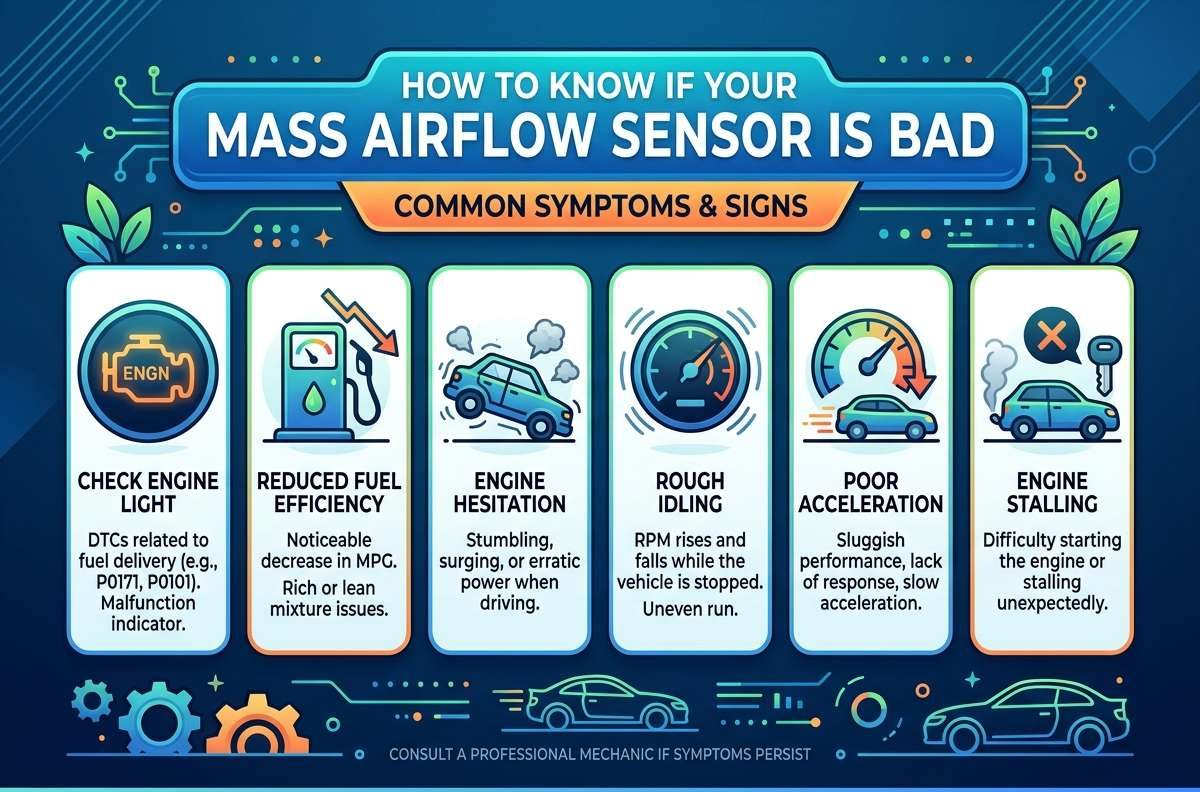
How to Know If Your Mass Airflow Sensor Is Bad
Your car’s mass airflow sensor does a job that most drivers never think about. This tiny component sits in your engine’s air intake system and measures exactly how much air flows into your engine. It sounds simple, but this measurement is actually critical to keeping your engine running smoothly. When your mass airflow sensor starts to fail, your car tells you through some pretty obvious signs. Let’s talk about how to spot a bad MAF sensor before it causes serious damage to your vehicle.
What Does a Mass Airflow Sensor Actually Do?
The mass airflow sensor is one of those parts that works silently in the background. Your engine needs just the right mix of air and fuel to run properly. Too much air and not enough fuel, or the other way around, and your engine starts misbehaving. The mass airflow sensor measures the amount of air coming in and sends that information to your car’s computer. The computer then adjusts the fuel injection to keep everything balanced.
This component sits right in the intake manifold area, in the path of air heading toward your engine. It uses hot wire technology to figure out how much air is passing through. As air moves past the hot wire, it cools it down. The sensor detects this cooling and calculates the mass of air based on how much heat it takes to keep the wire at a constant temperature. Pretty clever engineering, right?
The mass airflow sensor feeds real-time data to your engine control unit. This information helps your car run at peak efficiency. It affects fuel economy, engine performance, and emissions control. When the sensor gets dirty or starts to fail, the engine’s computer gets bad information. The computer then makes wrong adjustments, and that’s when you start noticing problems.
The Check Engine Light Might Show Up
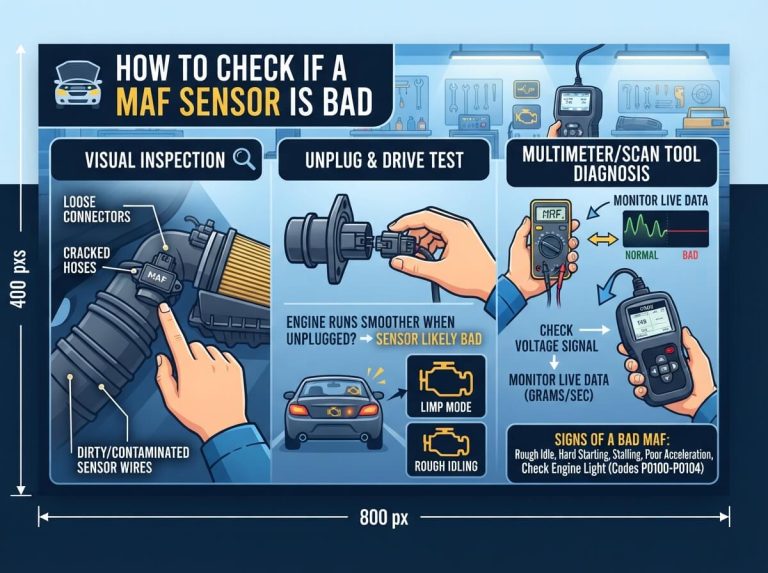
One of the first signs of a bad mass airflow sensor is the dreaded check engine light. This light pops up on your dashboard when your car’s onboard diagnostic system detects a problem. A failing MAF sensor triggers specific diagnostic trouble codes. The most common ones are P0101, P0102, and P0103. These codes all point to problems with the mass airflow sensor circuit.
When you see the check engine light, don’t panic. It doesn’t mean your engine is about to explode. It means your car’s computer found something worth investigating. A bad mass airflow sensor is one of several possible causes, but it’s definitely worth checking out. You can use a code reader to see exactly what trouble code your car is storing. Many auto parts stores will read your code for free, which gives you a starting point.
The check engine light alone doesn’t confirm a bad sensor, but it’s definitely a clue worth following. Combined with other symptoms, it helps paint a clear picture of what’s going on under the hood.
Your Engine Runs Rough and Shaky
When your mass airflow sensor goes bad, your engine often runs rough. You’ll feel it when you’re sitting at a red light or idling in traffic. Instead of that smooth, steady idle, your engine feels like it’s shaking or vibrating more than usual. This rough idle happens because your engine isn’t getting the right fuel-to-air ratio.
A faulty MAF sensor sends incorrect data to the engine computer. The computer thinks there’s more air coming in than there actually is, so it injects too much fuel. Or it might think there’s less air, so it cuts back on fuel. Either way, the combustion process becomes uneven. Some cylinders burn their fuel mixture perfectly while others don’t burn completely. This uneven burning creates that rough, shaky feeling.
You might also notice the engine misfiring. A misfire is when one or more of your cylinders fails to ignite the fuel mixture properly. You feel this as a hesitation or stumble when you accelerate. It feels like your car is coughing or sputtering. In some cases, you might see smoke come from the exhaust pipe, which means unburned fuel is leaving your engine.
This rough running isn’t just annoying. It can damage your catalytic converter over time. Unburned fuel entering your exhaust system heats up the catalytic converter beyond safe temperatures. If you ignore a bad mass airflow sensor long enough, you could end up with a much more expensive repair bill.
Poor Fuel Economy Gets Worse
Your gas mileage drops noticeably when your mass airflow sensor starts failing. If you usually get 25 miles per gallon and suddenly you’re only getting 18 or 20, something’s wrong. A bad MAF sensor is often the culprit.
Here’s why fuel economy suffers. A faulty sensor sends bad data to your engine’s computer. The computer responds by dumping extra fuel into the engine to compensate for what it thinks is a problem. Your engine burns through more gas than it should. Over the span of a few weeks, this adds up to real money coming out of your wallet.
You might notice you’re stopping at the gas pump more often than usual. Your car doesn’t run significantly worse, so you might not immediately connect the dots to a sensor problem. You just know your fuel costs are climbing. This slow decline in fuel economy is actually a classic sign of a bad mass airflow sensor that many drivers overlook.
Hard Starting and Weak Acceleration
A bad mass airflow sensor can make your car hard to start. You turn the key and the engine cranks, but it takes longer than normal to actually fire up. This happens because the engine’s computer is struggling to figure out the right fuel mixture based on the bad sensor data.
Once your car does start, acceleration feels weak and sluggish. When you press the gas pedal, your car doesn’t respond with its normal power. It feels like the engine is holding back. You might feel a delay between pressing the accelerator and the engine actually speeding up. This hesitation can make merging on highways or passing other cars feel dangerous because your car won’t give you the power when you need it.
In some cases, the check engine light flashes while you’re driving. A flashing check engine light is more serious than a steady one. It means your car detected a misfire while you were driving. This indicates an actual problem happening right now, not just a stored code from a previous issue. A bad mass airflow sensor can definitely cause a flashing check engine light.
Hard starts and poor acceleration happen because your engine doesn’t know how to adjust its fuel injection. Without good information from the mass airflow sensor, it’s flying blind. The computer makes guesses based on other sensor inputs, but those guesses aren’t as accurate.
Stalling While Driving
One of the scarier symptoms of a bad mass airflow sensor is stalling. Your car might stall while you’re driving at highway speeds or while you’re stuck in traffic. The engine suddenly shuts off as if you turned the ignition key. This is obviously dangerous and needs immediate attention.
Stalling happens when the engine’s computer gets such bad information from the MAF sensor that it can’t maintain combustion. The fuel-to-air ratio becomes so unbalanced that the engine just quits. You’re left coasting to the side of the road while your car restarts or refuses to start at all.
Even if your car restarts immediately after stalling, the problem will get worse. Each time your engine stalls while driving, you’re putting yourself and other drivers at risk. You lose power steering and power brakes, making your car much harder to control. If you experience stalling, get your car to a mechanic as soon as possible.
The Engine Runs Too Lean or Too Rich
When your mass airflow sensor fails, your engine usually runs in one of two ways: too lean or too rich.
Running too lean means there’s too much air and not enough fuel in the combustion chamber. Your engine tries to burn the mixture, but it can’t do it efficiently. The result is decreased power, rough running, and sometimes overheating. A lean-running engine produces more nitrogen oxides, which your emissions system has to work harder to clean up.
Running too rich means there’s too much fuel and not enough air. Unburned fuel leaves your engine through the exhaust. You’ll smell that raw gas smell coming from your tailpipe. Your catalytic converter works overtime trying to burn that extra fuel. A rich-running engine consumes fuel much faster, which is why your gas mileage drops so dramatically.
Sometimes your engine does both at different times. It might run rich during acceleration and lean during cruising. This inconsistency comes from the computer trying to make sense of conflicting sensor data. Your mass airflow sensor sends one signal, but other sensors send different signals, and the computer gets confused.
Black Smoke from the Exhaust
Take a look at your tailpipe. If you see black smoke or excessive exhaust coming out, your engine is running too rich. This black smoke is unburned fuel leaving your engine. A faulty mass airflow sensor is one of the top causes of a rich-running engine.
The black smoke smells bad and indicates fuel isn’t being burned completely in your cylinders. This wasted fuel goes straight out your exhaust pipe. Over time, this excess fuel can damage your oxygen sensors and catalytic converter. These are expensive parts, so you want to fix the MAF sensor problem before it cascades into other issues.
Black smoke doesn’t always mean a bad mass airflow sensor. You might have bad spark plugs, a clogged fuel filter, or fuel injector problems. But combined with other symptoms on this list, black smoke from the exhaust points strongly toward a failing MAF sensor.
Rough or Irregular Idling
When you’re parked and your engine is just sitting there at idle, it should run smoothly and steadily. The engine’s computer makes tiny adjustments to keep the idle speed consistent, usually around 600 to 800 RPM depending on your car.
A bad mass airflow sensor throws off these adjustments. Instead of a smooth, steady idle, your engine speed bounces around. You might see your tachometer needle jumping up and down. The engine might sound rough and uneven. Sometimes the idle speed is too high, sometimes it’s too low. This irregular idling happens because your engine can’t maintain the proper fuel-to-air ratio.
You’ll notice this especially when you’re sitting at a red light or parked in your driveway with the engine running. The vibration from irregular idling travels through your steering wheel and seat. It’s impossible to ignore once you know to look for it.
How to Test Your Mass Airflow Sensor
If you suspect a bad mass airflow sensor, you have a few options. The easiest approach is to take your car to a mechanic and have them run a diagnostic test. They’ll plug a scanner into your car’s diagnostic port and pull any trouble codes. If the code points to the MAF sensor, that’s a big clue.
Some auto parts stores will pull your diagnostic codes for free. You can get this information without paying a mechanic. If the code is P0101, P0102, or P0103, those codes specifically reference the mass airflow sensor.
You can also visually inspect the mass airflow sensor if you’re comfortable popping open your hood. The MAF sensor is usually mounted right after the air filter, in a plastic tube. The sensor itself looks like a small cylindrical component inside the tube. If you see dirt, dust, or debris on the sensor, that could be your problem.
Don’t touch the sensor with your bare fingers if you decide to inspect it. The hot wire inside is extremely delicate. Even fingerprints can damage it. If you need to clean it, use a special mass airflow sensor cleaner and follow the instructions carefully. Most people take their car to a mechanic rather than risk damaging this expensive component.
Cleaning Versus Replacing Your Mass Airflow Sensor
Sometimes a mass airflow sensor just needs cleaning. Dirt and dust accumulate on the sensor over time. This buildup interferes with the sensor’s ability to accurately measure incoming air. A thorough cleaning can restore the sensor to working condition without replacing it.
Your mechanic can remove the sensor and carefully clean it with specialized cleaner. This costs less than replacing the sensor. If cleaning fixes the problem, great. If not, you know the sensor needs replacement.
Replacing the sensor is more expensive but might be necessary if the sensor is actually damaged internally. A new mass airflow sensor for most cars costs between $150 and $400 before labor. The labor to install it usually runs another $50 to $150 depending on how easy it is to access.
Some people try to clean their mass airflow sensor themselves to save money. This works sometimes, but it’s risky. If you damage the sensor during cleaning, you’re out the cost of a new one anyway. Unless you’re really comfortable working on cars, let a professional handle it.
What Happens If You Ignore a Bad Mass Airflow Sensor?
Ignoring a bad mass airflow sensor leads to escalating problems. First, your fuel economy gets worse and you pay more at the pump. Then your engine starts running rough and you deal with that check engine light. Left alone long enough, your engine stalls while driving, which is genuinely dangerous.
But the domino effect doesn’t stop there. Running too rich all the time damages your catalytic converter. This component costs $500 to $1000 to replace. Unburned fuel also fouls your oxygen sensors, which need replacement. You might damage your spark plugs from the bad combustion. Each of these repairs costs real money.
In worst-case scenarios, a bad mass airflow sensor causes engine damage. Prolonged running with the wrong fuel-to-air ratio can damage pistons, rings, and other internal engine components. At that point, you’re looking at engine rebuild or replacement, which costs thousands of dollars.
The smart move is fixing a bad mass airflow sensor as soon as you notice the symptoms. The cost to diagnose and fix this problem early is tiny compared to the cost of engine damage later on.
Signs It’s Time to Call a Mechanic
You don’t need special tools or expertise to know when something is wrong with your car. Trust your instincts. If your engine is running rough, the check engine light is on, your fuel economy has tanked, and you’re experiencing any combination of these symptoms, get your car checked out.
You don’t necessarily need to visit the expensive dealership mechanic. A trusted independent mechanic can diagnose and fix mass airflow sensor problems just as well and often charges less. Ask friends and family for recommendations.
Tell your mechanic about all the symptoms you’ve noticed. The more information you give them, the easier it is to narrow down the problem. Mention when the check engine light came on, when you first noticed the rough idle, and how much your fuel economy has changed. These details help your mechanic make the right diagnosis.
Prevention and Maintenance
You can help prevent mass airflow sensor problems through regular maintenance. Change your engine air filter on schedule. A clean air filter keeps debris from reaching the mass airflow sensor. Check your car’s maintenance schedule and follow it. Most cars need an air filter change every 15,000 to 30,000 miles.
Use quality fuel and quality oil. Cheap fuel sometimes has more contaminants that can build up in your engine systems. Quality oil keeps your engine clean and running smoothly.
Avoid revving your engine excessively when the engine is cold. Let your car warm up before driving hard. This reduces stress on all your engine components, including the mass airflow sensor.
Have your mechanic inspect your mass airflow sensor during regular service appointments. They can spot early signs of dirt buildup or sensor degradation before it becomes a major problem.
Conclusion
Your mass airflow sensor is a small part that does a big job. When it starts failing, your car gives you clear warning signs. A rough idle, check engine light, poor fuel economy, hard starting, weak acceleration, and stalling all point toward a bad MAF sensor. You might see black smoke from your exhaust or notice your engine runs too rich or too lean.
Don’t ignore these symptoms. A bad mass airflow sensor is fixable and relatively inexpensive compared to the damage it can cause if left alone. Get your car diagnosed quickly, clean or replace the sensor as needed, and your car will run smoothly again.
The next time your check engine light comes on or your engine starts running rough, think about your mass airflow sensor. It’s probably trying to tell you something. Listen to what your car is saying, take action, and you’ll avoid much bigger headaches down the road.

Peterson is an automotive enthusiast and auto parts reviewer with a passion for vehicle maintenance, upgrades, and performance. He enjoys researching and testing car parts, tools, and accessories to help drivers make informed buying decisions. Through AutoPartsTalk.com, Peterson shares honest reviews, practical maintenance tips, and expert guides to keep vehicles running safely and efficiently.