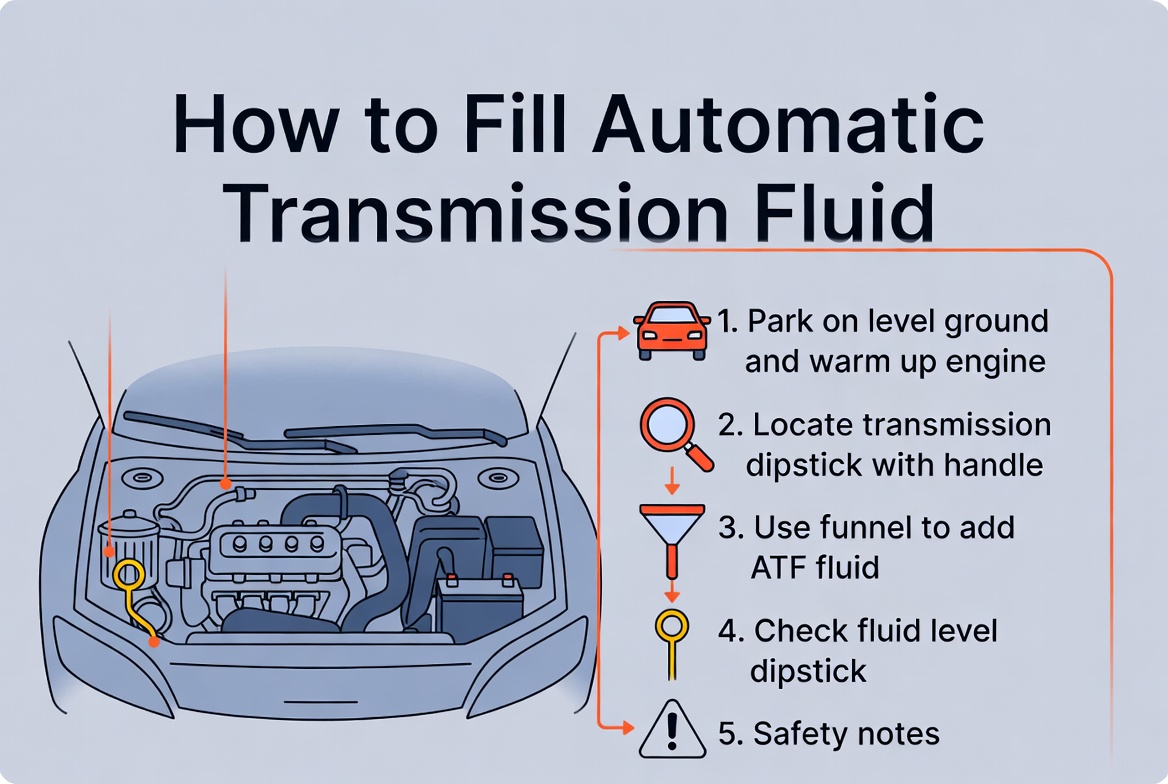
How to Fill Auto Transmission Fluid?
So your car is acting weird. Maybe you hear strange noises from under the hood. Perhaps the transmission feels sluggish or the gears slip. There’s a good chance your auto transmission fluid levels are running low. The good news? You can fix this yourself in about thirty minutes without spending a ton of money at a mechanic’s shop.
This guide walks you through the entire process. I’ll explain what transmission fluid does, why it matters, and exactly how to add more to your vehicle. Let’s get started.
What Is Auto Transmission Fluid Anyway?
Your car’s transmission is basically a system that sends power from the engine to the wheels. It changes gears so your engine doesn’t have to work too hard at different speeds. Pretty smart, right?
Transmission fluid keeps all those gears happy. Think of it like the blood of your transmission. This fluid does three big jobs:
First, it lubricates all the moving parts inside the transmission. Metal parts need oil to slide against each other smoothly. Without proper lubrication, parts grind and wear out fast.
Second, the fluid transfers power between different gears. This happens through pressure and hydraulic force. The fluid takes power from one part and pushes it to another part.
Third, transmission fluid keeps everything cool. As gears spin and parts rub together, heat builds up. The fluid flows around inside and removes that extra heat so nothing melts or breaks.
Without the right amount of clean transmission fluid, your transmission won’t work right. You’ll notice problems like jerky shifts, slow acceleration, or weird sounds when you drive.
Why Your Transmission Fluid Gets Low
Your transmission fluid doesn’t just disappear for no reason. Several things cause the level to drop.
Leaks are the biggest culprit. Your transmission has seals and gaskets that keep fluid inside. Over time, these rubber seals can crack or shrink. Once that happens, fluid slowly drips out. You might notice pink or red spots under your car when you park. That’s transmission fluid.
Heat breaks down transmission fluid. Every time you drive, the fluid gets hot. Hot fluid works fine for a while. But as it stays hot for long periods, it gets weaker and loses its protective powers. Eventually, you need fresh fluid.
Some transmission fluid naturally burns off. It’s just how cars work. A tiny bit escapes as vapor. After thousands of miles, those tiny bits add up.
If you tow heavy loads, drive in stop-and-go traffic a lot, or live somewhere hot, your transmission works harder. Harder work means more heat and faster fluid breakdown. Your levels drop quicker in these situations.
The bottom line? Check your transmission fluid regularly. Most mechanics suggest checking it every month or so. If the level is low, top it off. Catching small problems early saves you from huge repair bills later.
Signs Your Transmission Fluid Is Low
Your car sends you messages when something is wrong. Pay attention to these warning signs.
The most obvious sign is a puddle under your car. Pink or reddish liquid beneath your vehicle points to a transmission fluid leak. Don’t ignore this. Check your fluid right away.
Strange noises coming from the transmission area are another red flag. You might hear whining, grinding, or clunking sounds. These noises mean metal parts aren’t getting enough lubrication. They’re rubbing together without the protective layer of fluid.
Does your transmission shift hard? Does it jerk or hesitate when you change gears? Low fluid causes poor shifting because the hydraulic pressure isn’t strong enough to work smoothly.
Your transmission might slip. This means the engine revs high but your car doesn’t accelerate like it should. The wheels aren’t getting power from the engine properly.
Some cars have a check engine light or a transmission warning light on the dashboard. If this light comes on, it’s time to investigate. Low fluid is one common reason this light appears.
The transmission might also smell bad. Burnt transmission fluid has a distinct smell. It’s sharp and unpleasant. If you smell something weird when you open your hood, get the fluid checked.
If you feel the car is slower to respond than usual, or if it struggles to shift into reverse, low transmission fluid might be the problem.
Getting Ready to Fill Your Transmission Fluid
Before you start, gather everything you need. Being prepared makes the job easier and safer.
You’ll need:
- The right type of transmission fluid for your car
- A funnel (preferably a small one that fits your transmission dipstick hole)
- Paper towels or rags to clean up drips
- Your car’s owner’s manual (this tells you exactly which fluid type your car needs)
- Safety glasses to protect your eyes from dust and drips
- Gloves to keep your hands clean
- A jack and jack stands if you need to lift your car (though most cars let you access the transmission fluid without lifting)
- A flashlight to see under the hood better
The most important thing is getting the RIGHT TYPE of fluid. Different cars need different fluids. Automatic transmissions, continuously variable transmissions, and manual transmissions each have different fluid requirements.
Check your owner’s manual to find the exact type and capacity your vehicle needs. You can also ask at an auto parts store. Tell them your car’s year, make, and model. They’ll find the right fluid for you.
Transmission fluid comes in different weights and formulas. Using the wrong type damages your transmission. Don’t guess. Get it right.
Most auto parts stores sell transmission fluid in bottles. A typical bottle holds one quart. You can buy it in one-quart bottles or larger jugs, depending on how much you need.
Locating Your Transmission Fluid Dipstick
The dipstick is your best friend for this job. It tells you exactly how much fluid you have inside.
Most cars have the transmission dipstick under the hood near the engine. Pop your hood open. Look for a yellow or orange handle sticking up. Some dipsticks are red. The handle usually has writing on it like “ATF” or “Transmission.”
Don’t confuse it with the oil dipstick. The transmission dipstick usually hangs down from the top of the transmission. The oil dipstick comes up from the oil pan on the engine. They’re different.
If you can’t find it by looking around, check your owner’s manual. It has a diagram showing exactly where your transmission dipstick is located. This saves time and frustration.
Some cars, especially newer models, don’t have dipsticks. These vehicles use sealed transmissions. If your car doesn’t have a dipstick, you’ll need special tools or a mechanic to check and fill the fluid. Check your manual to see what applies to your car.
Checking Your Current Fluid Level
Before you add more fluid, you need to know how much you already have.
First, warm up your engine. Start your car and let it run for a few minutes. This heats the transmission fluid to its normal operating temperature. Hot fluid gives you an accurate reading.
Turn off the engine. Wait a minute for the fluid to settle.
Pop your hood again. Grab the dipstick handle firmly and pull straight up. It should slide out easily. If it’s stuck, wiggle it gently while pulling.
The dipstick has marks on it. Usually there’s a “minimum” mark and a “maximum” mark. Some have a cold and hot range. Look at where the fluid reaches on the stick.
Wipe the dipstick clean with a paper towel or rag. Look at the color while you do this. Good transmission fluid is bright red. Dark or burnt-looking fluid needs replacing soon. The smell tells you something too. Fresh fluid smells clean. Burnt fluid smells bad.
Put the dipstick back in its tube all the way. You’ll hear or feel it click when it seats properly.
Pull it out again. Now look at the level. If the fluid reaches the maximum line, you have enough. If it’s below the maximum line, you need to add some.
Write down the level so you remember it later. Some cars need just a quart. Others might need more.
Adding Transmission Fluid Step by Step
This is the main event. Take your time and do it right.
First, find where you pour the fluid in. On many cars, you remove the transmission dipstick completely and pour new fluid through that opening. On others, there’s a separate fill plug or cap on top of the transmission. Check your manual to see which applies to your car.
Get your funnel ready. A regular kitchen funnel works, but a long, thin one designed for cars is better. It fits the dipstick hole perfectly without spilling.
Place the funnel in the opening. Make sure it’s sitting securely so it won’t tip over.
Open your transmission fluid bottle. Slowly pour the fluid through the funnel into the transmission. Don’t rush. You want steady flow without splashing or spilling.
A quart is a standard amount. Most transmissions need one to two quarts when they’re low. Start with one quart. You can always add more.
Pour slowly and carefully. Transmission fluid can stain clothes and skin. Wear gloves and old clothes you don’t mind getting dirty.
Once you’ve poured one quart, let it sit for a minute. The fluid needs to flow down into the transmission.
Pull the funnel out slowly so the remaining fluid drips down.
Put the dipstick back in the tube and seat it fully. You should hear it click.
Wait a few minutes. The fluid needs to settle and distribute throughout the transmission system.
Pull the dipstick out again and wipe it clean. Check the level. If it’s at the maximum mark, you’re done. If it’s still below, add more fluid in the same way.
Don’t overfill. Too much fluid causes problems just like too little does. Stick to the marks on the dipstick.
Once the level is right, put the dipstick back in its home position and make sure it’s fully seated.
Close your hood.
What to Do With Your Old Fluid
You might have collected some old fluid when you were checking and refilling. Don’t just pour it down the drain or throw it away.
Transmission fluid is hazardous waste. It contains materials that hurt the environment. Pouring it out wrong is illegal in many places.
Take old transmission fluid to a recycling center. Most cities have hazardous waste collection events. Your local auto parts store might also take it. Some shops recycle it for free.
Call ahead before you go. Ask if they accept used transmission fluid. Have a clean container ready to hold the old fluid if you collected any.
After You Fill: Testing Your Work
Now that you’ve added fluid, test everything to make sure it worked.
Start your car and let it idle for a minute.
Put it in drive and gently press the accelerator. Feel how it shifts. Does it feel smoother? Does it respond better? Good signs.
Drive around your neighborhood slowly. Listen for strange noises. Feel the transitions between gears. Everything should feel smooth and normal.
Check under the car after you park. Is there any new fluid leaking out? If yes, you have a leak that needs professional attention. A small drip here and there is normal after you add fluid, but a puddle forming is a problem.
If everything feels and sounds normal, you’ve done it right. Congratulations.
Common Mistakes to Avoid
Even simple jobs can go wrong if you’re not careful. Here are things people mess up.
Using the wrong type of fluid is mistake number one. I can’t stress this enough. Different transmissions need different fluids. Always check your manual. Always ask at the parts store. When in doubt, take the extra five minutes to verify.
Overfilling is another common error. More fluid doesn’t mean better. Too much fluid causes the same problems as too little. Trust the dipstick marks. Fill to the maximum line, not above it.
Some people fill their transmission when it’s cold. This gives a false reading. Cold fluid sits lower on the dipstick. You think you need more than you do. Then you overfill. Always check and fill when the engine is warm.
Don’t confuse your transmission dipstick with your oil dipstick. Adding transmission fluid to your engine oil does serious damage. Take your time finding the right stick.
Mixing different brands of transmission fluid is risky. Different manufacturers use different additives. Mixing them sometimes causes problems. Stick with one brand if possible.
Some people forget to fully seat the dipstick. If it’s not pushed all the way in, it might fall out while you drive. Your transmission fluid pours out and you have a much bigger problem.
Don’t skip checking for leaks. If you add fluid and it immediately leaks out, you have a leak that needs fixing. Ignoring this costs you way more money down the road.
Spilling fluid on hot engine parts is dangerous. It smokes and smells bad. It’s also a fire hazard. Pour carefully and clean up any spills right away.
When to Seek Professional Help
Some situations require a mechanic. Know when to call in the experts.
If your transmission has a persistent leak, you need professional diagnosis. A small leak might mean a simple seal replacement. A big leak might mean something more serious. A mechanic can find the source and fix it right.
If you added fluid and the problem doesn’t go away, something else is wrong. Your transmission might have internal problems. A professional can scan your car’s computer and figure out what’s really happening.
If your transmission is making grinding or clunking noises that continue after you add fluid, get it checked. These sounds might mean damaged gears or worn parts. These problems get worse if you ignore them.
If you don’t have a transmission dipstick and don’t know how to check your fluid, take your car to a shop. Some sealed transmissions require special equipment to check properly.
If your car is under warranty, always contact the dealer for transmission issues. Attempting fixes yourself might void your warranty.
If you’re not confident in your ability to do this safely, that’s totally fine. Having a professional do it costs money, but it’s better than making things worse.
Transmission Fluid Maintenance Tips
Keeping your transmission healthy is easier than fixing a broken one. Simple habits save you stress and money.
Check your transmission fluid regularly. Every month or every five hundred miles is a good habit. It takes five minutes and prevents problems.
Watch for leaks. Get under your car occasionally and look for drips. Catching a leak early makes repairs cheaper.
Avoid harsh driving. Aggressive acceleration, hard braking, and excessive towing all stress your transmission. Drive smoothly and your transmission lasts longer.
Keep your car in good general condition. A well-maintained engine and cooling system help your transmission stay cool. An overheated engine can overheat the transmission too.
Don’t ignore warning signs. Strange noises, weak acceleration, or warning lights all mean something. Address them quickly.
Follow your car’s maintenance schedule. Your manual recommends when to change your transmission fluid completely. This isn’t the same as topping it off. A complete change flushes out old fluid and replaces it with fresh fluid. Doing this regularly keeps everything working right.
Use the right fluid always. Never cut corners on this. The cost of the right fluid is small compared to transmission repair costs.
Understanding Transmission Fluid Types
Different vehicles need different transmission fluids. This section explains the main types so you understand what you’re buying.
ATF stands for Automatic Transmission Fluid. Most automatic transmissions use this. It’s a red or pink colored fluid. ATF has special properties that help power transfer and cooling.
CVT fluid is for continuously variable transmissions. These are becoming more common in newer cars. CVT fluid is different from regular ATF. It’s designed for the unique way CVT transmissions work. Never use ATF in a CVT.
Manual transmission fluid is heavier and thicker than ATF. Manual transmissions don’t use the same fluid as automatics. The gears work differently and need different lubrication.
Dexron is one specific type of ATF. Many older cars used this. Newer ATF formulas have better properties and might be labeled Dexron III, Dexron VI, or other numbers. These are improvements over the original formula.
Mercon is another brand of ATF. Ford vehicles often use this fluid. It’s similar to Dexron but has different additives made for Ford transmissions.
Synthetic transmission fluid is made in a lab instead of from crude oil. It lasts longer and handles temperature extremes better than conventional fluid. It costs more but might be worth it for your car.
The exact fluid your car needs depends on its year, make, and model. This is why checking your manual matters. No guessing allowed.
Transmission Fluid Color and What It Means
The color of your transmission fluid tells you its condition.
Bright red or pink means fresh, new fluid. This is what you want to see. Good fluid protects your transmission properly.
Dark red means the fluid is getting old. It’s probably still working but won’t perform as well. Consider replacing it soon.
Brown or dark brown means old fluid that’s breaking down. It’s not protecting your transmission as well as it should. Plan a fluid change.
Black fluid means the transmission is in trouble. It’s burned from extreme heat or broken down from age. This fluid isn’t protecting anything. Change it immediately.
Clear or translucent fluid is weird and usually bad. Something is wrong if your fluid looks clear. Get it checked by a professional.
Cloudy fluid with a milky appearance means water got inside. Water ruins transmission fluid. This is a serious problem needing professional help.
Foamy fluid that looks bubbly is also a problem. It means air got into the system. Foamy fluid doesn’t protect parts like normal fluid does.
If your fluid smells burnt, like something cooking, the transmission is overheating. This is a warning sign to get service immediately.
Pay attention to color and smell. These simple observations tell you a lot about your transmission’s health.
Frequently Asked Questions
Let’s answer questions people ask all the time about transmission fluid.
How often should I check my transmission fluid? Check it every month or every five hundred miles. This catches problems early before they cost you serious money.
Can I check my transmission fluid myself? Yes, absolutely. It’s one of the easiest car checks you can do. The dipstick makes it simple.
How much does transmission fluid cost? A quart typically costs between five and fifteen dollars. You might need one to four quarts depending on your car. This is cheap compared to transmission repair.
Can I use any transmission fluid? No. Use only the type specified for your car. Check your manual or ask at the parts store.
Is it normal for transmission fluid to leak? A small leak is common in older cars. But it shouldn’t leak a lot. If you see puddles under your car, get it checked.
What if I overfilled my transmission? You need to remove the extra fluid. Don’t drive with overfilled transmission. Either drain some out or take it to a shop.
How long does it take to add transmission fluid? Usually fifteen to thirty minutes if you’re not rushed. Going slowly is fine. Don’t hurry.
Can transmission fluid go bad? Yes. Fluid breaks down over time and with heat. Eventually it won’t protect your transmission anymore. That’s why regular maintenance matters.
What’s the difference between checking and changing transmission fluid? Checking means looking at the level and topping it off. Changing means draining all the old fluid and putting in new fluid. Changing is more involved.
Should I change my transmission fluid? Check your manual for the recommended schedule. Some cars need it every fifty thousand miles. Others go longer. Follow your manual’s guidance.
Wrapping It Up
Your transmission is one of the most important systems in your car. Keeping it healthy keeps your whole vehicle running right. Adding transmission fluid when it’s low is one of the simplest maintenance jobs you can do yourself. It takes maybe thirty minutes and costs just a few dollars.
Remember the key points: get the right fluid for your car, check your level when the engine is warm, fill slowly without overfilling, and watch for leaks.
If you’re not comfortable doing this yourself, there’s no shame in taking it to a mechanic. The important thing is that your transmission gets the attention it needs. Regular checks and topping off fluid as needed keeps your car running smoothly for years to come.
Your car depends on you to keep it healthy. A little attention now prevents big problems later. Good luck with your transmission fluid maintenance. You’ve got this.

Peterson is an automotive enthusiast and auto parts reviewer with a passion for vehicle maintenance, upgrades, and performance. He enjoys researching and testing car parts, tools, and accessories to help drivers make informed buying decisions. Through AutoPartsTalk.com, Peterson shares honest reviews, practical maintenance tips, and expert guides to keep vehicles running safely and efficiently.