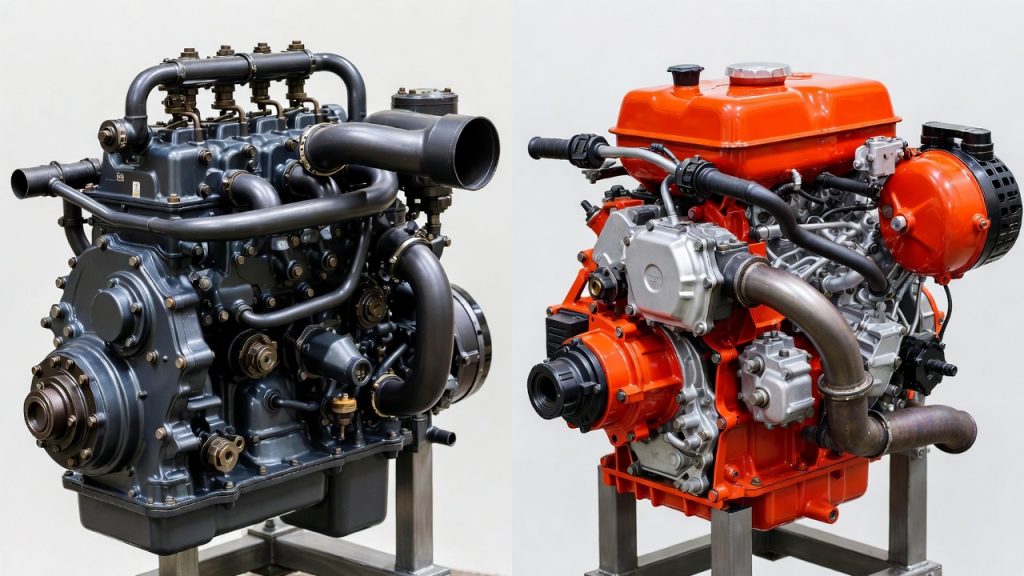
Diesel Engine vs Gas Engine
So you’re thinking about buying a new vehicle or maybe you’re just curious about what makes engines tick. You’ve probably heard people talk about diesel engines and gasoline engines like they’re completely different animals. And honestly? They kind of are. Let me break down the differences in a way that actually makes sense.
The Basic Difference: It All Comes Down to Fuel and Ignition
Let’s start simple. A gasoline engine and a diesel engine both burn fuel to create power. That’s the thing they have in common. But the way they work is totally different.
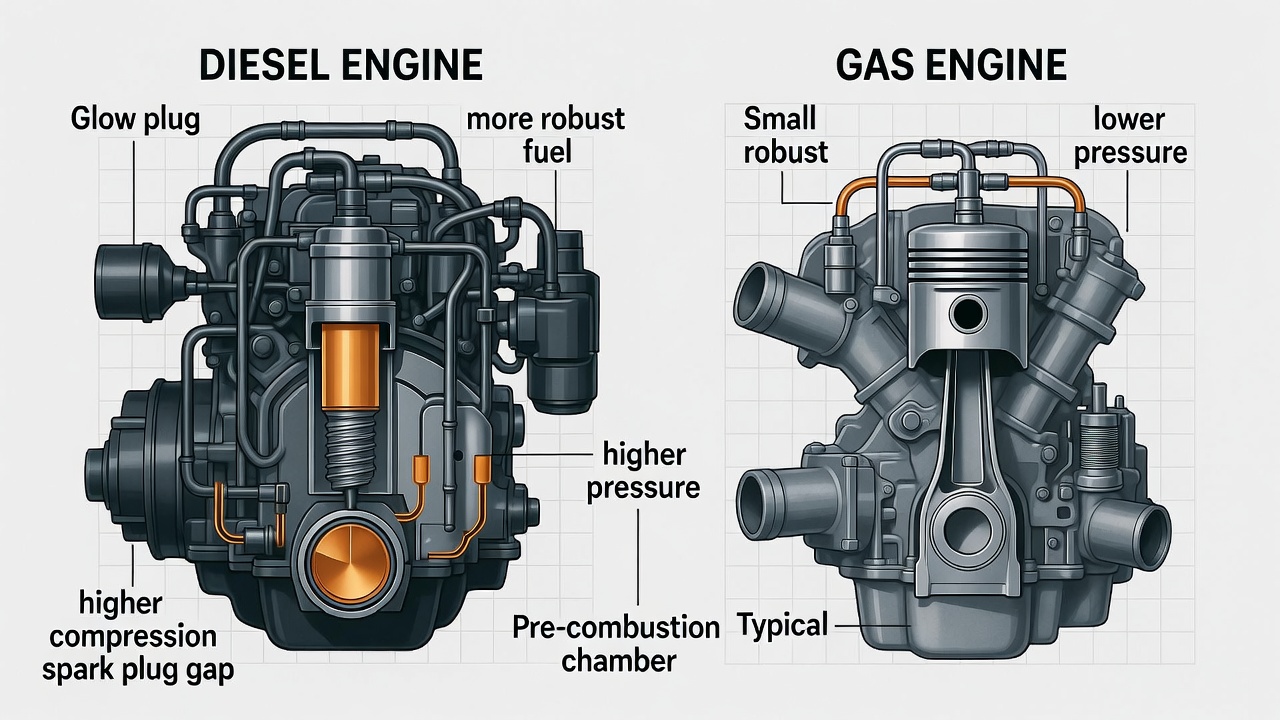
A gasoline engine uses spark plugs to ignite the fuel. Think of it like a lighter—the spark plug creates a spark, and boom, the fuel catches fire. A diesel engine doesn’t use spark plugs at all. Instead, it compresses the fuel and air together so much that the heat alone causes the fuel to ignite. No spark needed. This is called compression ignition.
That one difference changes almost everything else about how these engines operate.
How Gasoline Engines Work
Here’s what happens inside a gasoline engine:
First, the engine sucks in air and fuel mixed together. Then it compresses that mixture. When the mixture is compressed, a spark plug fires and ignites it. The explosion pushes down the piston, which creates power. Finally, the exhaust gases get pushed out.
This whole process happens really fast. Your engine might do this thousands of times per minute. Gasoline engines are designed to run at higher RPMs (revolutions per minute). They like to spin fast.
Because spark plugs create the ignition, gasoline engines need to be very careful about how much they compress the fuel and air. If you compress it too much, it can ignite too early and cause problems. This is called knocking or pinging.
How Diesel Engines Work
Diesel engines work a bit differently. Here’s the breakdown:
A diesel engine sucks in just air—no fuel yet. Then it compresses that air a lot more than a gasoline engine does. We’re talking really serious compression here. When air gets compressed that much, it gets super hot.
Once the air is hot enough, the diesel fuel gets sprayed in. The heat ignites it instantly. No spark plugs required. The explosion pushes down the piston, creating power. Then the exhaust comes out.
This process also happens very quickly, but diesel engines typically operate at lower RPMs than gasoline engines. They build their power differently.
Fuel Efficiency: Diesel Wins Here
This is one area where diesel really shines. Diesel engines are more fuel efficient than gasoline engines. You can drive further on the same amount of fuel with a diesel engine.
Why? A few reasons. First, diesel fuel has more energy in it than gasoline. A gallon of diesel contains about 11% more energy than a gallon of gasoline. Second, diesel engines are more efficient at converting that fuel into actual movement.
The compression ratio plays a big role here too. Diesel engines can compress the fuel and air mixture much more than gasoline engines. This higher compression means more efficient energy use.
Real-world numbers show this clearly. A diesel truck might get 20-25 miles per gallon, while a similar gasoline truck gets 15-20 miles per gallon. For SUVs and cars, the difference isn’t quite as dramatic, but diesel still wins.
This better fuel economy is huge if you drive a lot. Over time, you save real money on fuel, even if the diesel fuel costs a bit more per gallon.
Power and Torque: What’s the Difference?
Okay, let’s talk about something that confuses a lot of people: power and torque.
Power is how fast you can go. Torque is the twisting force that gets you moving. Think of it like this: torque is what you feel when you press the gas pedal and the car takes off. Power is how fast you’re actually going.
Gasoline engines typically make more horsepower. They reach higher RPMs, and that high RPM capability translates to more total power output. This is why many people think gasoline engines are faster.
Diesel engines typically make more torque at lower RPMs. That means you get a huge amount of pushing force from the very beginning. This is why diesel trucks can tow so much weight. The torque is just incredible.
So if you’re asking which is more powerful—it depends on what you mean. More horsepower? Gasoline usually wins. More torque? Diesel almost always wins. For most everyday driving, you won’t notice a huge difference. But if you’re towing heavy trailers or doing serious hauling, diesel torque is what you want.
Cost: Both Have Expenses
Here’s where it gets real. Both engines cost money to buy, maintain, and fuel.
Diesel engines are more expensive upfront. A diesel vehicle might cost $4,000-$7,000 more than the same vehicle with a gasoline engine. That’s significant. But remember, you’ll spend less on fuel over time.
Let’s do some math. Say you drive 12,000 miles per year. With a gasoline vehicle getting 20 MPG and gasoline at $3 per gallon, you spend $1,800 per year on fuel. With a diesel vehicle getting 25 MPG and diesel at $3.10 per gallon, you spend $1,488 per year on fuel. That’s $312 saved per year.
If you pay $6,000 more for a diesel vehicle, it takes about 19 years of driving to break even on fuel savings alone. That’s a long time. But for people who drive a lot more, the break-even point comes much faster.
Maintenance costs vary. Diesel engines tend to last longer—200,000 to 300,000 miles isn’t unusual. Gasoline engines typically last 150,000 to 200,000 miles. However, when diesel engines need repairs, those repairs can be more expensive. Diesel mechanics often charge more per hour than gasoline mechanics.
Emissions: The Environmental Impact
Both engines produce emissions. Both contribute to air pollution. Let’s be real about that.
Gasoline engines produce carbon dioxide, which is a greenhouse gas. They also produce nitrogen oxides and particulate matter.
Diesel engines produce less carbon dioxide per gallon of fuel. But they produce more nitrogen oxides and soot (particulate matter). For decades, this was a big problem with diesel engines. That’s why they got a bad reputation environmentally.
Modern diesel engines are much cleaner than they used to be. New regulations require diesel engines to have advanced emissions control systems. These systems catch a lot of the soot and chemicals before they go into the air.
Modern gasoline engines are also cleaner than older ones. All cars sold today are much better for the environment than cars from 20 or 30 years ago.
If you’re concerned about the environment, consider this: a fuel-efficient diesel vehicle that uses less fuel overall might actually have a smaller carbon footprint than a less efficient gasoline vehicle, even if the gasoline engine is technically cleaner per unit. It’s complicated.
Engine Noise and Vibration
This is something you’ll notice the second you sit in a diesel vehicle. Diesel engines are louder and more vibrate-y than gasoline engines.
This is because of how diesel engines work. The compression and ignition process creates more forceful explosions inside the cylinder. These stronger explosions make more noise and vibration.
Modern diesel engines are quieter and smoother than older diesels, thanks to better sound insulation and engine management. But they’ll always be louder than gasoline engines. If you’re sensitive to noise, this matters.
For some people, this is a deal breaker. For others, they don’t mind it at all.
Driving Experience: How They Feel
Let me tell you how these engines actually feel to drive.
Gasoline engines feel responsive. When you step on the gas, the RPMs jump up quickly. The car accelerates in a smooth, predictable way that most drivers are used to. They’re easy to drive in traffic and normal stop-and-go city driving.
Diesel engines feel different. There’s a slight delay—just a moment—when you first step on the gas. Then the torque hits you. It’s strong and steady. This is why diesel vehicles can pull heavy loads so well. The feeling is more like something pushing you from behind.
For highway driving, both are great. For towing, diesel is superior. For city driving, many people prefer gasoline because of its more responsive feel.
Cold Weather Performance
Here’s an important practical consideration: cold weather affects these engines differently.
Gasoline engines don’t love cold weather, but they handle it okay. You might need to let them warm up for a minute or two, but generally they start and run fine.
Diesel engines really don’t like cold weather. In freezing temperatures, diesel fuel can actually thicken and clog the fuel filter. It’s called gelling. To prevent this, diesel fuel sold in cold climates has additives that keep it flowing at low temperatures.
But even with additives, diesel engines can struggle to start in extreme cold. Many diesel engines have glow plugs (similar to spark plugs, but serving a different purpose) that preheat the fuel before starting in cold conditions.
This is a real consideration if you live somewhere cold. Diesel engines need more attention and care in winter.
Acceleration and Speed
Most people perceive gasoline engines as quicker off the line. That’s because of how the power is delivered.
Gasoline engines build power quickly. They create most of their horsepower at higher RPMs. This is great for acceleration from a standstill.
Diesel engines deliver their peak power at lower RPMs. They feel strong and steady, but the initial acceleration isn’t quite as sharp as a gasoline engine.
However, there are exceptions. Some modern diesel vehicles accelerate just as quickly as comparable gasoline vehicles. Technology has improved a lot.
For top speed, gasoline engines usually win because they can rev higher and continue to make more power at higher RPMs.
For most everyday driving, you won’t notice a huge difference.
Resale Value
When you eventually sell your vehicle, fuel type matters.
Used diesel vehicles hold their value pretty well. In some cases, they hold their value better than comparable gasoline vehicles, especially trucks. This is because people value the fuel economy and towing capacity.
However, in some markets, diesel vehicles are harder to sell. Not everyone wants a diesel. In areas where diesel is less common, you might have a harder time finding a buyer.
Gasoline vehicles are easier to sell. There’s a bigger market of potential buyers. This can be good if you want to move your vehicle quickly.
Maintenance Differences
Both engines need regular maintenance, but there are some differences.
Gasoline engines need:
- Oil changes every 5,000-7,500 miles
- Regular spark plug replacements (every 30,000-100,000 miles depending on the vehicle)
- Standard wear items like filters and belts
Diesel engines need:
- Oil changes every 7,500-10,000 miles (sometimes longer)
- No spark plugs (advantage!)
- Fuel filter changes more frequently because diesel fuel can carry more contaminants
- Glow plug replacement if they fail
- DEF fluid top-ups (on newer diesels with emissions control systems)
DEF is diesel exhaust fluid. It’s an additive that helps reduce emissions. You have to refill it periodically, which is an extra maintenance step that gasoline owners don’t deal with.
Which One Should You Choose?
This really depends on your situation. There’s no one-size-fits-all answer.
Choose a diesel engine if:
- You drive a lot of miles per year (especially highway miles)
- You need to tow heavy trailers or hauling is part of your life
- You keep vehicles for a long time
- You don’t mind the extra noise and vibration
- You don’t live somewhere extremely cold
- You want a vehicle that will run for 200,000+ miles
Choose a gasoline engine if:
- You drive average miles per year
- You don’t tow or haul much
- You like responsive acceleration
- You prefer quieter vehicles
- You live in a cold climate
- You change vehicles every few years
- You want lower upfront costs
The Bottom Line
Diesel engines and gasoline engines are fundamentally different. They work in different ways and deliver their power differently.
Diesel is the more efficient choice for high-mileage drivers and anyone who needs serious towing power. Gasoline is the more practical choice for most average drivers who need responsiveness and lower upfront costs.
Modern engines of both types are reliable and clean. The best choice is the one that matches your driving needs and preferences.
If you drive a lot, a diesel makes financial sense. If you drive normal amounts, gasoline is probably fine. If you need to haul heavy stuff, diesel is your answer.
Think about how you actually drive. How many miles per year? Do you tow? Do you live somewhere cold? Answer those questions, and the right choice becomes clear.
Both engines have been around for over a century. Both work great when matched with the right driver. So don’t stress too much about this decision. Either way, you’re going to be fine.
Just drive safe out there.
FAQ: Common Questions About Diesel and Gas Engines
Can I use diesel fuel in a gasoline engine? No. Don’t do this. Diesel fuel will damage your gasoline engine. It won’t ignite properly and will gunk up your entire fuel system. The opposite is also true—never use gasoline in a diesel engine.
Do diesel engines pollute more? Modern diesels pollute less than older ones. They’re not as clean as modern gasoline engines in some ways (more soot), but overall emissions are comparable when you account for the fuel efficiency advantage.
Is diesel fuel really more expensive? Not always. Sometimes diesel costs more per gallon. Sometimes it costs less. Prices change constantly. On a per-mile basis, diesel usually costs less because the engines are more efficient.
Can diesel engines run on vegetable oil? Some older diesel engines can, but it’s not recommended for modern engines. It can damage injectors and cause problems.
How long do diesel engines last? Much longer than gasoline engines on average. 250,000-300,000 miles is normal. Some go over 500,000 miles with good maintenance.
Are diesel engines quieter now? Newer diesel engines are much quieter than old ones, but they’re still louder than gasoline engines.
What’s regenerative braking? That’s not related to diesel vs gasoline. That’s a hybrid or electric vehicle feature. It captures energy when you brake.
Can I tow with a gasoline engine? Yes, but not as much as a diesel. Gasoline engines have less torque, so they’re not ideal for heavy towing.
Is diesel maintenance more expensive? Generally yes, but diesel engines last longer, so total lifetime maintenance can be comparable.
Why do trucks usually use diesel? Because of the torque and fuel efficiency. Trucks need to haul heavy loads, and diesel engines are better at that.
Remember, both engine types are proven technologies that work well. Pick the one that fits your life, and you’ll be happy with your choice.